




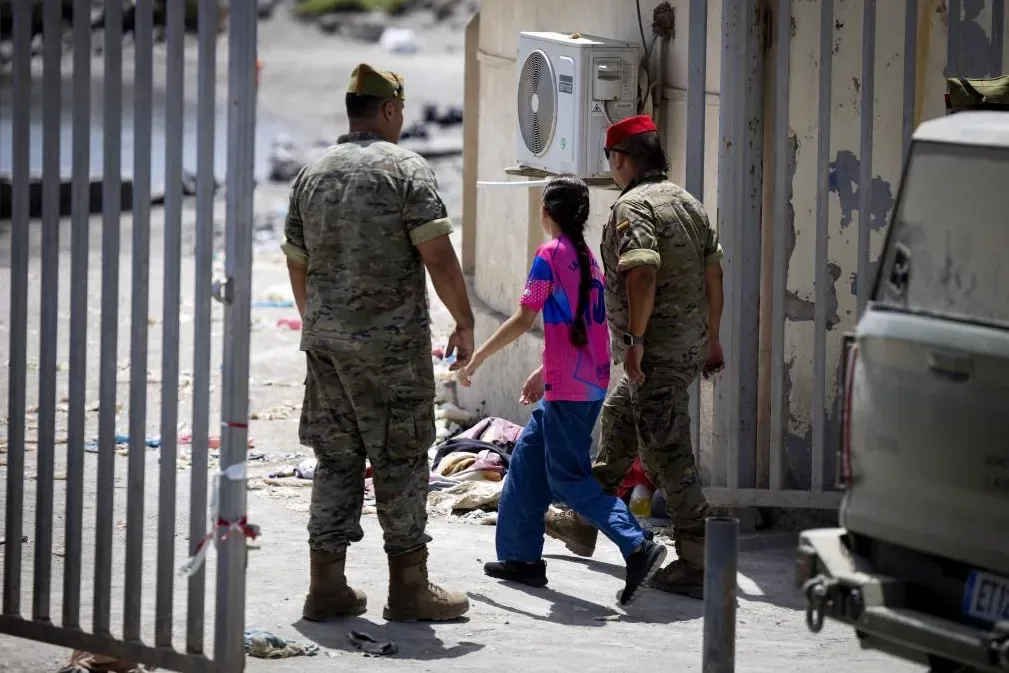
Pedro Sánchez is not responsible for Morocco being a very complicated neighbor to manage. Nor for that neighbor having politically organized itself as a capricious autocracy indifferent to the suffering of its subjects. He is also not responsible for Rabat not recognizing Spanish sovereignty over Ceuta and Melilla, and claiming its own over the Sahara. Nor is he responsible for that country being fundamental in combating irregular immigration, jihadist terrorism, or drug trafficking.
Read more Meloni rethinks her ‘Albania plan’ before her European partners to deport immigrants to Africa
The Government is not responsible, ultimately, for the starting point of our relations with Morocco. It is responsible for how it has managed those relations in the last eight years. And it is also responsible for several problems that have become clear during the current crisis. The first of these: its own negligence in the face of the worsening situation in Ceuta. The city authorities already denounced an unsustainable increase in irregular arrivals several days before the great influx; there was no response from the Executive. That negligence also extends to the signals that should have warned of what was going to happen. If that “unusual activity” on social networks denounced by Minister Albares played a decisive role, it is not understood why it was not detected by intelligence services that should have Morocco and irregular arrivals as two of their top priorities. If warnings were ignored, that is bad; if there were no warnings, that is also bad.
The Government is also responsible for the evident failure of its appeasement policy with Morocco. Sánchez did not invent this way of dealing with our most conflictive neighbor, but he has made it his own and taken it to astonishing extremes. With an aggravating factor: opacity. We still have to fill in the gaps of several incomprehensible episodes, such as the abandonment of the Spanish position on the Sahara or the lack of reaction to the espionage of the president’s and three ministers’ phones with the Pegasus program.
The most benevolent reading for the Government is that, in both cases, a pragmatic criterion was persisted in: one must bite one’s tongue and keep Morocco happy, because the alternative would be worse. But it is clear that this supposed realism has not improved the security of Ceuta and Melilla, now exposed to assaults whenever the tyrant of Rabat feels like it. The Government, however, does not correct its strategy. Seeing several ministers praise the cooperation and reliability of the same State that encouraged the massive entry into Ceuta is not only humiliating; it is also a sign that the Government has no alternative plan. If appeasement fails, the only option considered is to try again.
Finally, the Government is also responsible for its own loneliness in a context as fundamental as the European one. The massive regularization promoted by Sánchez does not explain the assault on Ceuta—again, this would not have happened without the complicity of the Moroccan authorities—but it was openly against the priorities of our partners on an issue understood as a European problem. Denouncing now the “lack of solidarity” of others is too much like the tantrum of someone who realizes that their actions had a greater cost than they thought. And who no longer knows how to reverse the damage.