



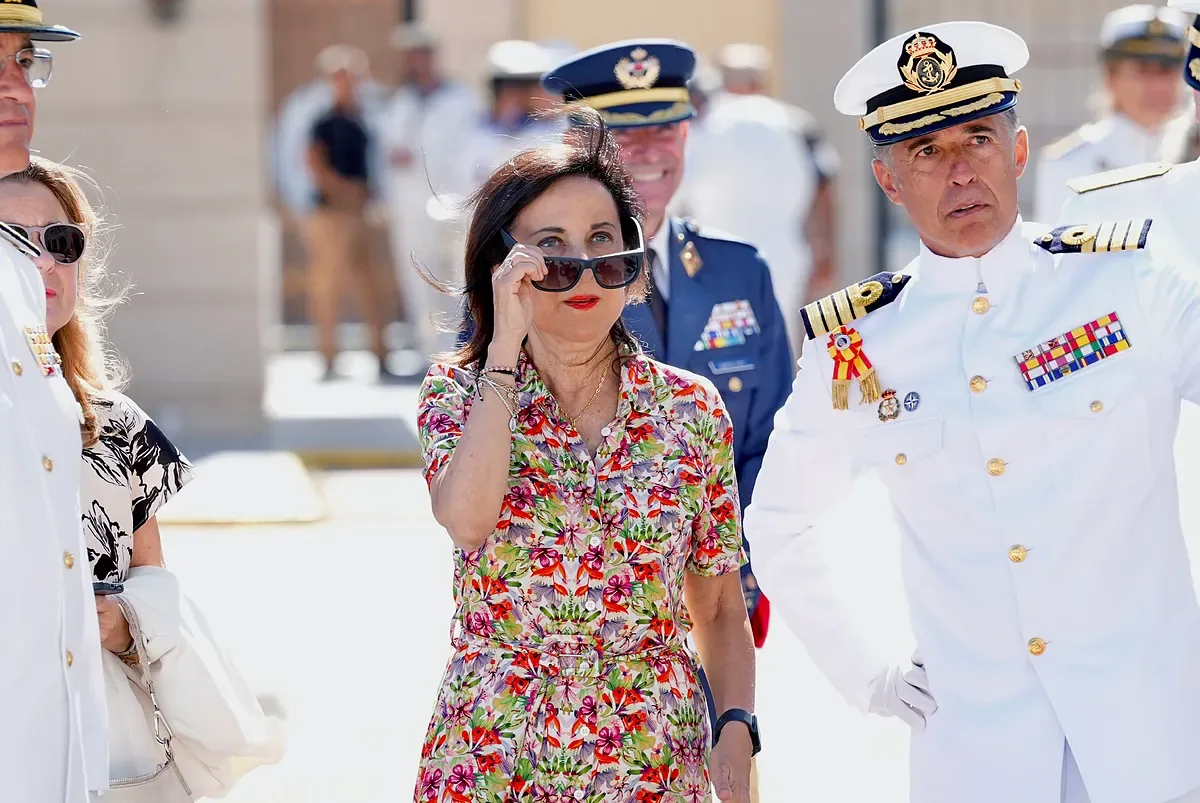
Of the Government representatives who have appeared in Ceuta since the border was overrun by more than 70,000 Moroccan citizens, only Margarita Robles, Minister of Defense, came out unscathed and accompanied by the applause of the people. Robles listened to a woman from Ceuta crying out of fear, out of the despair of not knowing what anymore. The minister attended to Pepi’s (66 years old) tears and did not flinch at the criticism pouring in from other outraged locals. She maintained her composure and kept her attention. The frightened woman gradually calmed down. Margarita Robles had paused her mission until she found out what was happening in the streets of the autonomous city and dispensed calm, if calm still has any chance in Ceuta.
She entered politics in 1993. She came from the judiciary. Her first endeavor in Felipe González’s Government, as undersecretary and later as Secretary of State for the Interior, could have been lethal: to thoroughly know the state’s sewers and once mapped, start fumigating shady people. Trash came out in all directions. Then, just like now, she chose the path that goes through the brambles, the uncomfortable one, and did not stay silent when it was necessary to say something. For example: rejecting the criminal plot of the GAL. When Aznar arrived at La Moncloa, she returned to the judicial career, reached the position of Supreme Court magistrate, and later moved to the General Council of the Judiciary (CGPJ), where she also did not practice the gymnastics of submitting to the humiliating party discipline, the most effective yoga for making a career. Some progressive judges (those on her side) cast an evil eye on her, but that did not wrinkle her blouse either.
She entered Congress in 2016. Pedro Sánchez placed her second on his list and participated in the motion of no confidence against Mariano Rajoy, breaking the voting discipline. Anyone you ask, anyone who knows this woman and the strange combination of boldness and discretion that shapes her way of acting, will tell you this: she is loyal and brave. She has a strong political personality and is not easy to entangle. In some of those lumpen WhatsApps exchanged between Pedro Sánchez and the prisoner José Luis Ábalos during one of their two honeymoons, the president called her “pájara” and the two shared some messenger laughs at her expense. I imagine some bosses sobraos do this, confusing collaborators with pushovers. It was rude, thug-like, sexist, silly. Just look at the situation of each of the three at this moment: Sánchez unable to gain any sympathy, Ábalos in his cell with yard rights (as it should be), Margarita Robles as one of the most valued professionals in today’s murky politics.
She went to Ceuta to say it is a “very Spanish” city and that “Ceuta and Melilla are untouchable”. Maybe she was given license to say it, although it seems more likely that she says what she wants to say when she can say it. The people of Ceuta have thanked her for “showing her face.” Showing your face is an expression of great weight and scarcely defiant. Those who know what they are doing show their face. Those who carry a measure of courage. Those who know how to take care of themselves. The very self-assured. The very self-assured women. Showing your face is a commendable attitude that in politics is usually done through a proxy. That is, pushing onto the stage one of the mandaos willing to be dragged along to keep climbing in the party. This is not the case with Margarita Robles, a woman from León raised in Barcelona and deposited in this dog-eat-dog world that November 1956. She likes to call “Spain” “Spain” and never lets slip an inappropriate cock-up about the Army, the police, or the civil guards. She criticizes and self-criticizes without holding back, something anyone will reproach as another of my exaggerations but more or less can attest to.
Read more Raúl Martín (Martínez Family): «The need to eat prepared dishes keeps growing and will not stop»
I imagine she will accumulate despicable secrets she knows not to speak of. And she will have well located the sinister and the scoundrels who have made a career where she has served as judge or minister. In her, however, there is no sign of the anger typical of political scoundrels, no bitter words nor general disrespect for the truth, for the people. Anger is vulgar. Politics is mostly spoken about by those who do not live off that racket. Margarita Robles made her best appearance in Ceuta in the last year because she dedicated time to the streets and the locals. And because she does not neglect the drama of those who crossed and returned. Or those who swam to reach the Spanish shore in the worst way and now flounder inland, existing painfully at a slow pace.
Sometimes it is enough to pay attention, besides working. To do things normally and not make them seem daring. To practice sobriety and let that attention to others not be stiff. While violence blooms on the asphalt, the Minister of Defense speaks with just the right protocol. She denounced the offensive ordered by Netanyahu against Gaza as “a true genocide” before some Government colleagues. It was May 25, 2024. Margarita Robles understands, in the vine of her hieratic demeanor, that there is nothing as modern as being good and letting a thread of kindness show. It is these lost customs that make some politicians more approachable. Not shaking hands recklessly or handing out kisses anyhow, but being silent to understand the discomfort of others. The rest is a passing wind. Raúl del Pozo always spoke well of her. He knew her courage. Almost no one among public officials remembers what a political career on the street is anymore.
Read more Fear of Putin and distrust of Trump mark the referendum on Iceland and the EU