






«Next stop: Atocha. Connection with all Cercanías lines and Metro line 1. Connection with AVE, Long Distance and Medium Distance trains from Puerta de Atocha station». On average, about 244,000 people hear this announcement every day, so much so that many could even recite it from memory. However, in recent years, another recording has become more frequent on Renfe’s public address system than the thousands of daily Cercanías users would like: «Due to a failure in the facilities at Atocha station, all trains heading to or passing through Atocha are running with significant delays». And if all trains passing through Madrid’s railway hub Madrid are delayed, as happens in Barcelona, Seville, Murcia, Alicante…, the city comes to a standstill. A reality that is increasingly familiar to the citizens of the capital.
«We will promote rail transport ensuring connectivity throughout the territory, consolidating it as a more efficient and less polluting alternative», PSOE and Sumar committed almost three years ago, in the pact that supports the Government coalition. But for many, the train, especially the Cercanías service, is increasingly less that «alternative» to bet on.
«It is a structural problem, in the sense that it happens very recurrently, almost daily», summarizes Sandra Cerrada, a resident of the Santa Eugenia neighborhood, in the Madrid district of Villa de Vallecas, and a member of the Fed-up Cercanías Users Platform.
She takes – or used to take, because she does it less and less – the train from there to her workplace in Atocha, a journey that usually takes about 20 minutes, but she says it has extended up to an hour due to incidents and delays – Santa Eugenia and Atocha are separated by four train stops, nine kilometers by car -. «We live with that uncertainty a bit, because Madrid Cercanías users do not know what each day holds for them», she says at the platform of this neighborhood on the outskirts of the capital. According to statistics provided by Renfe, in June, the trains that were delayed – 34.6% of the total – had an average delay of 12.3 minutes.
It is not that the last month of the school year before summer was an exception. If the data from the first half of the year are analyzed, it turns out that only 61.2% of the trains running on the Madrid Cercanías network completed the journey on time or with a delay of less than five minutes. That is: those waiting on the platform, four out of ten times did not arrive on time at their destination. And this is not a problem that affects exclusively the capital’s rail transport. In Catalonia, for example, the scenario was even worse: only 36.9% of Rodalies Barcelona trains arrived at the end of the line on time or with that slight five-minute delay. Behind, punctuality was 31.4% in the Cantabrian network and 29.8% in Seville. Meanwhile, Málaga (93.4%) and Zaragoza (92.8%) top the ranking for the most efficient service in terms of schedule compliance.
But overall, there is a feeling that has taken hold of those who depend on the Cercanías network to move around their city: «Desperation». «It is a bit like a roller coaster, you don’t know what to expect», describes Sandra, and probably many users would agree, given the satisfaction surveys that have been released in recent years and that do not reflect well on Óscar Puente, the person responsible for Cercanías from a ministry previously marked by José Luis Ábalos’ management.
One of the surveys, from the National Commission on Markets and Competition (CNMC), confirms that only 34.2% of Spaniards who used Cercanías in 2025 say they are «satisfied» or «very satisfied» with train punctuality, while five years earlier, 52.1% of travelers endorsed that approval of the service’s schedule compliance. Also, in line, satisfaction with travel times has fallen in recent years – previously liked by 50.9%; now, by 43.9% – and, in general, «with the trains»: 38.3% approve them in 2025, compared to 53.7% in 2020.
Public opinion confirms that the short-distance rail public transport service has worsened in recent years. And this has led, contrary to what the Government intended, some who can choose alternative means to travel around large cities. «I honestly used it much more before», admits Sandra, who points out, among the reasons that discourage her from taking Cercanías, the «fear» of being late, which makes her have to leave «almost an hour and a half in advance». «Because I don’t know what awaits me», she laments. A 2025 study by the Psychology Department of the Universitat Rovira i Virgili (URV) shows that frequent train travelers have more symptoms of anxiety, depression, and physical discomfort.
Agreeing with Sandra on why not to take the train is Loli Lóriga, a resident of Collado Villalba, a municipality 40 kilometers from central Madrid, but only eight stops from Chamartín station.
-I have been working in a Madrid nursing home for 26 years and have always used Renfe. But now I have had to opt to use my own car, – Loli explains.
-Why?
-Mostly out of respect for my colleagues. If I have to start at seven-thirty […] and I arrive late, my colleague cannot leave, because we cannot leave our residents alone, – she explains.
If all goes well, Loli can get from her home to work by public transport in 45 minutes, but she has taken «an hour and more». And that is why she now goes by car, even though traffic jams are also a constant on the roads she has to travel. It is, nevertheless, a better alternative. «At first I took the 6:20 train, then I started taking the 6:10. What, am I going at five in the morning?».
The cases of Sandra and Loli portray a problem that is not limited to mobility but affects the functioning of cities on a larger scale. «Cercanías is the only means of transport that connects the entire Madrid region», summarizes Sandra, who believes that improving the network’s operation could encourage more people to live in towns on the outskirts of Madrid, decongesting the city and helping to relieve, for example, housing demand pressure.
Another goal that PSOE and Sumar set out to achieve in this legislature is the 30-minute city model: «We will approve the portfolio of basic quality services within 30 minutes of the place of residence». However, now, delays and incidents in Cercanías make it difficult for, for example, a resident of a town on the outskirts of the capital to reach the hospital in 30 minutes.
Alongside the deterioration of the Cercanías service that has occurred in recent years – as evidenced by testimonies and surveys – the number of passengers has increased in parallel, already exceeding pre-pandemic levels, when the number of users plummeted. On average, according to data from the National Institute of Statistics (INE), 49.6 million people used the Cercanías train to move each month in 2025, only 0.6% more than the previous year, but at the same time 6.6% more than in 2018, when Pedro Sánchez took command in Spain.
This, beyond what results from population growth, is perhaps the result of their governments placing the democratization of public transport among the priority axes. Especially rail transport, both long distance – with the entry of new operators – and short distance, with the approval of free Cercanías service for regular users as one of their flagship measures – it was approved to mitigate the consequences of the Ukraine war but was extended until mid-2025 -.
In line with this, Spain is today one of the European countries where the fewest citizens cite the price of public transport as the reason that keeps them from using it – only 1.3% cite this reason, according to 2024 Eurostat data, compared to the 3.4% EU average. On the contrary, 76.8% justify it citing «other reasons», among which would be, for example, punctuality and incidents.
That is, on the street level, what users complain about the most. «We pay taxes. They will have to give us the services», reproaches Sandra, for whom, regarding rail transport, «the Welfare State we had… The Welfare State no longer exists». From the Fed-up Cercanías Users Platform, of which she is a part, they ask the Government to promote greater investments in the remaining year of the legislature and, above all, better directed and coordinated. Sources in the sector point out that, while for decades «the necessary investments were not made», that situation is changing «for the better», as both maintenance and new track works are being carried out. «But works are known to cause service disruption», these sources explain.
The punctuality and incident crisis – in short, service quality – that Cercanías is going through is a daily topic on social media, a phenomenon fueled by the controversial profile of the person in charge of most of the competencies: Minister Óscar Puente. It went especially viral when, in summer 2024, he said that «the train is living the best moment in its history» in Spain. Sandra responds to that statement «with all respect and politeness»: «That when he has to travel to his workplace he does so via Cercanías, not by private car. And maybe, just maybe, he will know what all citizens are experiencing daily». Loli takes it «as homework. Or as punishment».
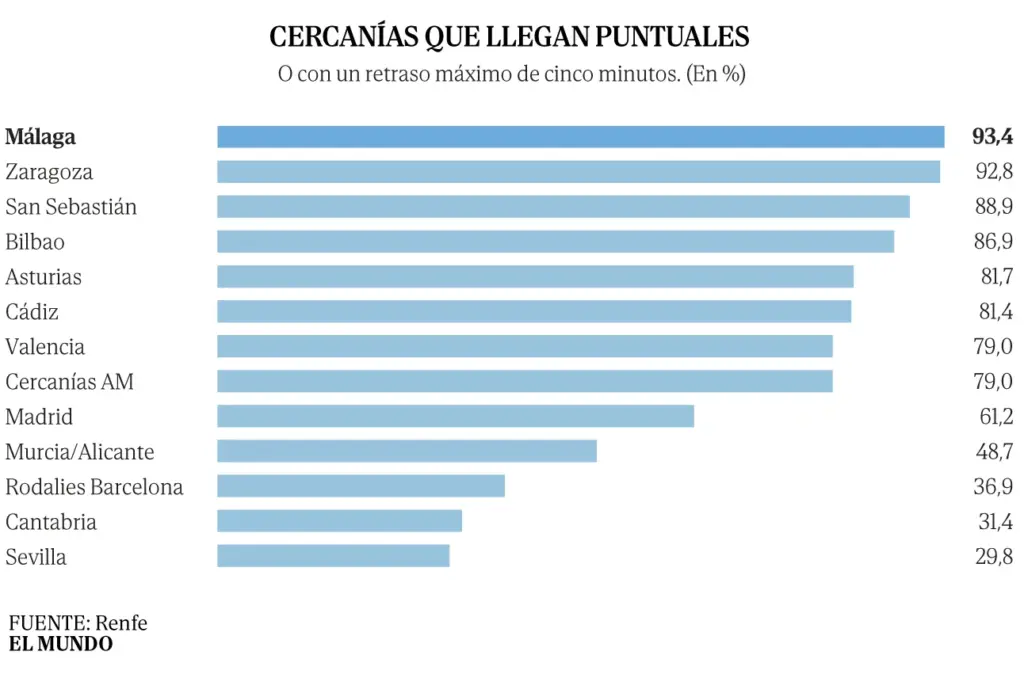
Less than half of trains on time in four networks
In the Cercanías network of Murcia-Alicante, Barcelona, Cantabria and Seville, less than half of the trains running in the first half of 2026 arrived on time at their destination. In Madrid, the city with the most Cercanías trips, just over six out of ten trains reached the end of the line at the scheduled time or with a maximum delay of five minutes. At the opposite extreme, in Málaga, Zaragoza, San Sebastián, Bilbao, Asturias and Cádiz, average punctuality was above 80%. According to a CNMC survey, in 2025, only 34.2% of Cercanías users were satisfied with punctuality.

ÓSCAR PUENTE
2023-PRESENT. The most active and controversial minister on social media, he went viral when, in 2024, he said that the train «is living the best moment in its history». Before him, between 2018 and 2021, the Transport portfolio was held by José Luis Ábalos, who is now convicted of corruption for crimes committed as minister.