










The regional financing system does not underfund Catalonia, but rather this community receives 3,456 euros per adjusted inhabitant, 1.9% more than the average received across the country and 93 euros more than each citizen of the Community of Madrid receives, which represents a total gap of about 719 million euros annually in favor of Catalonia that could worsen if the reform proposed by the Government goes ahead.
Specifically, this community would receive an extra 92 euros per inhabitant, while the Community of Madrid would lose 97. Along with it, Galicia, Asturias, or Castilla y León would also end up losing in net terms, so it is not true that “all communities gain”.
“The Ministry of Finance’s reform proposal from January 2026 makes Catalonia the big winner of the new regional financing system, with an improvement of 507 euros per adjusted inhabitant. Far from correcting grievances, the reform worsens them and deepens the perception of arbitrariness throughout the system. The evidence suggests that the main fiscal challenge would not lie in financing, but in the structure of public spending,” concludes the report Madrid vs. Catalonia: the myth of underfunding and the real spending problem prepared by the Ruth Richardson Center, of the University of the Hesperides, which was released this Tuesday.
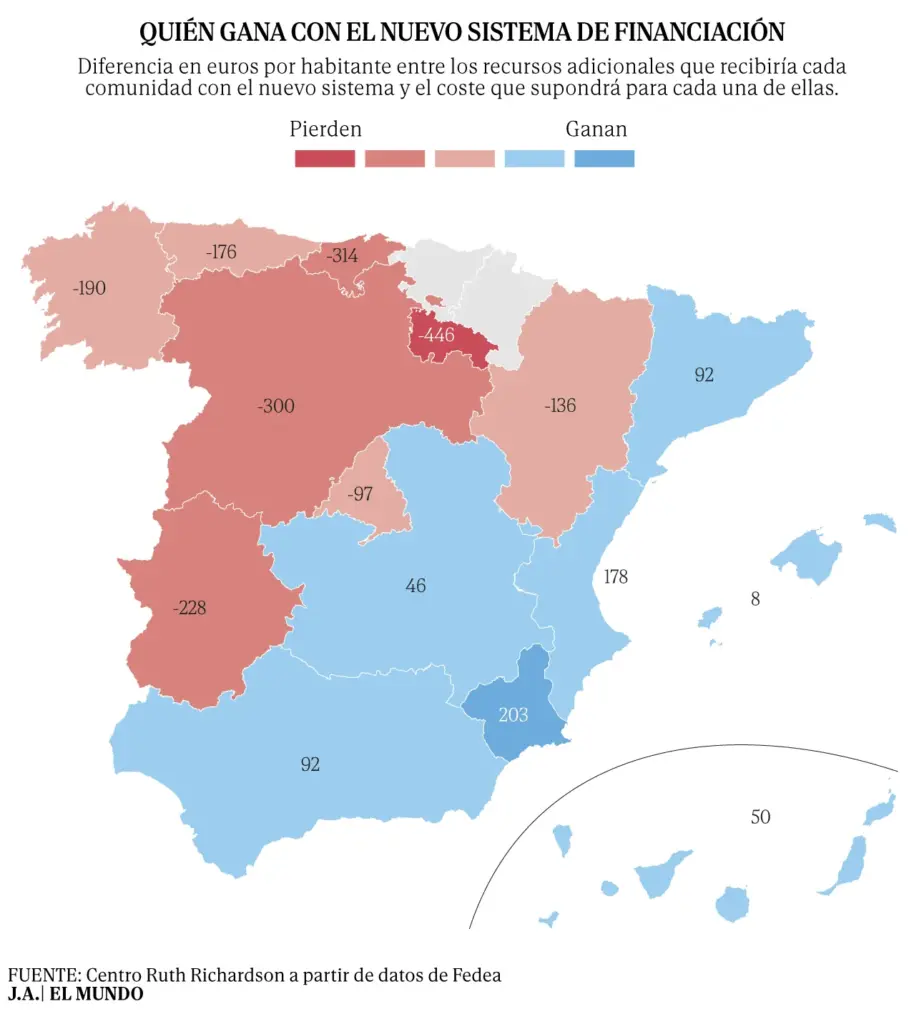
Specifically, compared to the 3,456 euros each Catalan receives from the financing system once all its instruments operate, Madrid residents correspond to 3,363 euros. These two regions along with Balearic Islands are the only three that are supportive of the rest of the communities of the Common Regime – all except the two foral ones, Navarra and the Basque Country – since they contribute more than they obtain from the system.
To know how much each of them contributes to the common fund a calculation is made based on their tax capacity, that is, the possibilities they would have to collect via taxes before making any decision to lower them. Catalonia “loses” 7.8% of its homogeneous tax revenues (2,266 million), while Madrid contributes 26.3% of its theoretical collection (7,975 million). This community, in practice, then collects less because its economic policy is based on tax cuts, but its contribution to the system is independent of that decision. “This greater redistributive effort by Madrid means it ends up with final financing slightly below the national average, while Catalonia is clearly above,” explain the authors of the document, who wanted to compare only these two autonomies because they are similar in terms of their contribution to GDP, size, and structure.

Ordinality, equalization, status quo… easy guide to finally understand regional financing
- Written by: ALEJANDRA OLCESE
The reform proposed by the Government will widen that gap. “It will open even more, considering something quite curious: Madrid is the most supportive, contributes 26.3% of its theoretical collection and ends up below the average. If in the end they are talking about maintaining ordinality as the former minister said, that message does not match what happens to Madrid. As the new model works, it will especially benefit Catalonia, mainly because of the VAT on SMEs, where it is very favored,” Santiago Calvo, author of the study, explains to EL MUNDO.
Debt and spending
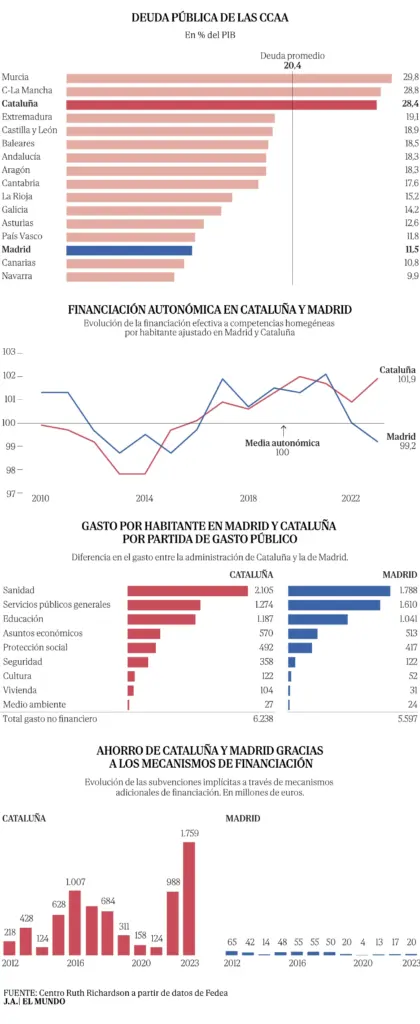
The thesis of Catalonia’s underfunding is also questioned by its “extraordinary dependence on subsidized state financing“, they point out. They refer to the fact that the Generalitat’s outstanding debt reached 89,069 million euros at the end of the third quarter of 2025, 28.4% of its GDP, almost triple that of Madrid (11.5%) and well above other communities. Of these, 85% are loans granted through the Autonomous Liquidity Fund and other autonomous liquidity mechanisms that offer interest rates much lower than market rates – between 0% and 1.5% in the last decade -.
Madrid, however, finances itself at market rates (3.33%), which the authors consider for Catalonia an “implicit annual subsidy of approximately 1,759 million euros just in 2023. If accumulated since 2012, the total savings for Catalonia exceed 7,196 million euros.” If Madrid did so, it could achieve savings for taxpayers in the cost of its debt.
Read more The Police raise to 3 million the immigrants regularized with their families
“It does not do so because, although it could finance itself more cheaply, it would condition its adjustment plans – that is what must happen, that the Central Administration watches you more -, so it is to gain independence regarding resource management. Its policy is to be autonomous and to sell that it does not need to resort to those aids from the State,” Calvo points out.
This financing model via joint debt allows communities to finance themselves more cheaply because the rates at which the State finances itself are lower, it was designed in 2012 when communities could not access markets, but the author considers that “it makes no sense for it to remain in force in 2026”.
Although Catalonia benefits from greater financing, it presents more deficit and debt than the rest because it incurs a higher level of spending in practically all budget functions. In healthcare, for example, it allocates 316 euros more per person than Madrid; in education, 147 euros more, and in housing, 73 euros. In total, it allocates 641 euros more per inhabitant than Madrid.
Could it affect the quality of public services? “In the end, there are two models: one based on higher spending and greater fiscal effort, and the opposite. When we see other analyses, it is not shown that Catalonia is far above the rest of the regions in service quality but quite the opposite, it is not translating into better public services. Madrid spends less on Education or Healthcare because there is greater demand for private management services,” he points out, although the question remains about what happens first. “Politically, both models are legitimate, but saying that Catalonia needs more resources does not match the reality of the data,” Calvo notes.
Model change
The author warns of the risk that if the regional financing system reform proposed by the Government goes ahead but with voluntary affiliation, Catalonia could have a different system from the rest of the Common Regime autonomies.
“It may happen that fourteen communities are in the 2009 model, Catalonia in the 2026-2027 one, and the foral ones separately. Does it make sense? Economically no, politically it could make sense as it is a political decision that may have parliamentary support,” the author tells this media. “Economically it makes no sense, money is continuously given to communities without seeing the spending priorities we have,” he adds.
Read more Volkswagen warns that it could cut up to 100,000 jobs in total