






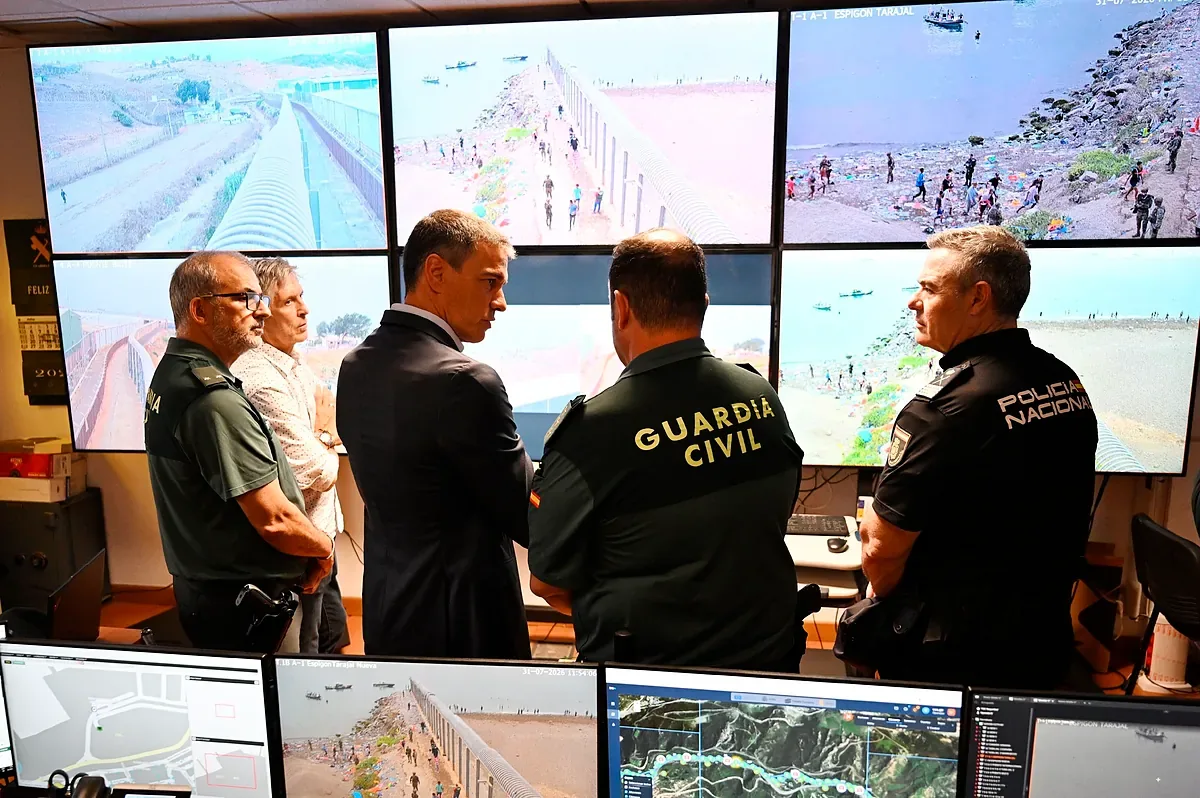
The Government of Pedro Sánchez has weathered five major crises in its eight years of frenzy that need to be organized: the covid pandemic in 2020 with more than 80,000 deaths; the dana in 2024 with 237 victims; a power outage in 2025; the train accident in Adamuz, which resulted in 46 deaths, and the most recent, the State crisis in Ceuta on July 30 and 31, which resulted in the drowning of 145 people, according to the NGO Caminando Fronteras. Faced with this string of shocks, it is inevitable to ask whether any could have been avoided, and the answer points to the same institutional pattern in all of them: ignoring warnings, delaying the reaction, and subsequently overreacting by activating a defensive narrative focused on pointing to an external or political enemy.
Read more The migrants from Ceuta extend the settlement from Trampolín beach to Benítez
The crisis in Ceuta constitutes the latest and greatest political scandal within the election year, exposing a serious failure in national security and political reaction. On July 27, although it took three days to reach the Government, military Intelligence had already warned that the “massive entry” on the 30th was “very likely” after detecting internal orders in the Moroccan border police. Several agencies had already alerted about the increasing pressure by sea following the Supreme Court ruling on hot returns.
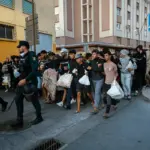
On July 29, the CNI notified via WhatsApp and through a report to the Government Delegation in Ceuta and the Intelligence units of the Police and Civil Guard that two groups organized on social networks with 180,000 followers were coordinating a massive assault taking advantage of the Moroccan holiday of Throne Day. The response of the Delegation’s Cabinet to such a warning was a “sus rilas,” followed by seven hours of institutional silence. On the morning of the assault, the National Immigration and Borders Center (Cenif) sent a note confirming the “extreme risk” of collapse with “immediate character.” Despite this cascade of reports, the border deployment bordered on negligence: only nine civil guards contained the breakwater when the avalanche was unleashed.
This same pattern of ignored warnings and subsequent overreaction debuted in the first major test of the legislature: the covid pandemic, the crisis that cost the most lives and in which Spain recorded one of the most severe mortality rates in the world. For three months, compelling evidence accumulated that was ignored. Faced with constant alerts from the World Health Organization about the existence of a “window of opportunity” and the recommendation from the European Center for Disease Prevention and Control to avoid mass events, the response of the Minister of Health, Salvador Illa, was to assure: “There is no reason to take additional measures.” As with the migratory pressure in Ceuta, where the initial discourse minimized the risk, the virus was treated as a minor threat until, after the celebration of 8-M, there was a drastic shift from disdain to the state of alarm and the confinement of the entire population.
The management of the dana that devastated Valencia in 2024 perfected this machinery of shifting responsibilities; in this case, towards the president of the Generalitat, Carlos Mazón. The data expose inaction at the regional level, but also nationally. At 18:43 on the fateful October 29, the Júcar Hydrographic Confederation, dependent on the Ministry for Ecological Transition and the Demographic Challenge, sent an email alerting of a flow of 1,686 cubic meters per second in the Poyo ravine, which had begun to overflow from 17:00. Moreover, during the critical meeting of the Coordination Center (Cecopi), attended by the Confederation’s own president, Miguel Polo, this vital information was silenced. Polo confessed before the judge that he did not report the overflow at Cecopi because “it did not catch his attention” and because “he assumed that Emergencies was doing what was necessary.”
While the Confederation practiced what the Generalitat called an “information blackout” – a thesis not supported by the judge investigating the tragedy – between 16:15 and 18:43, excusing itself by saying that this data “was not relevant,” within Cecopi itself confusion and inaction were total. The minutes reveal that at 17:00 firefighters were already reporting “people on the roofs” in Utiel. A senior Generalitat official even suggested then sending a message to the mobiles in the area, but the measure was dismissed. The inactivity of the consellera Salomé Pradas joined that of the Confederation: the Ministry’s representative did not speak about the Poyo ravine to focus on the Forata dam, while the Generalitat sank into its own incompetence, taking hours to send the ES-Alert. The subsequent state strategy was to take advantage of the evident regional paralysis to wash its own inaction of the Confederation, dependent on the Government.
BLACKOUT ALERTS
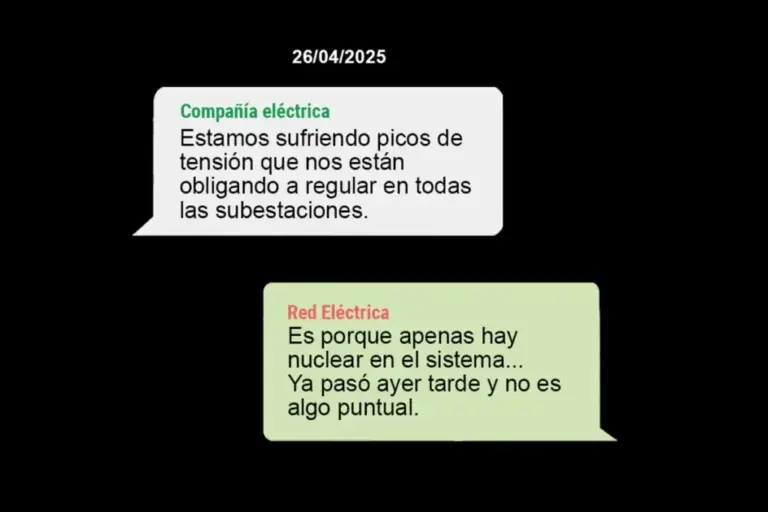
Before the 2025 energy collapse, energy companies warned Red Eléctrica about severe voltage spikes. The Executive staged a firmness it had not exercised with preventive measures.
In the 2025 energy collapse crisis, the adversary designated by the official narrative was the energy companies. However, technical warnings preceded the blackout. Twelve days earlier, the operating companies had already alerted Red Eléctrica de España about severe voltage spikes, receiving as a response that the lack of nuclear generation in the system was not a punctual event. After the overvoltages on April 22 – which motivated a report delivered to the Ministry on the morning of April 28 – and after five atypical oscillations were recorded during the morning of the blackout, the grid remained operating at the limit. At 12:30 only 11 thermal groups remained coupled with regulation capacity, the lowest number of the year. After the massive disconnection was consumed, the Government again staged its overreaction by urgently convening executives of electric companies, expert committees, and large companies to show firmness they did not exercise in the preventive supervision of the system. A measure they have not taken in the invasion of Ceuta.
Less than a year later, the dramatic Adamuz accident, which resulted in 46 deaths, was preceded by direct warnings from the Spanish Railway Engineers Union. In the summer of 2025, the organization sent a formal letter to ADIF alerting of the severe deterioration of the high-speed network, specifically emphasizing line 010, the exact section where the derailment later occurred. After the catastrophe, the Executive’s defensive strategy was not to assume the abandonment of the infrastructure but to attack the media accusing them of spreading rumors. When this newspaper reported in the following days that the origin of the accident was the poor condition of the track, the Minister of Transport, Óscar Puente, tried to discredit the information; however, investigations ended up confirming that the infrastructure failure was indeed the cause of the tragedy.
The journey through these eight years ends in a familiar scenario: in the Ceuta crisis, where institutional concealment has reached its most serious level. Against the attempts of the Ministry of the Interior to deny Rabat’s involvement by stating there was no planning, the reports show otherwise. The Police document an “active guidance” by the Moroccan Gendarmerie directing the masses towards the breakwater, large trucks transporting immigrants, and ununiformed agitators directing Moroccan forces on the ground in an operation typical of hybrid or “gray zone” warfare.
To avoid responsibility for its inaction despite alerts from the CNI, the Armed Forces’ Cifas, and the Police, Sánchez’s Executive has not only tried to cover up Rabat’s role but has unleashed a campaign against its own Intelligence services, accusing the CNI of not foreseeing the magnitude of the immigrant entry. From blindness to epidemiological alerts in 2020 to questioning Intelligence agencies in 2026.
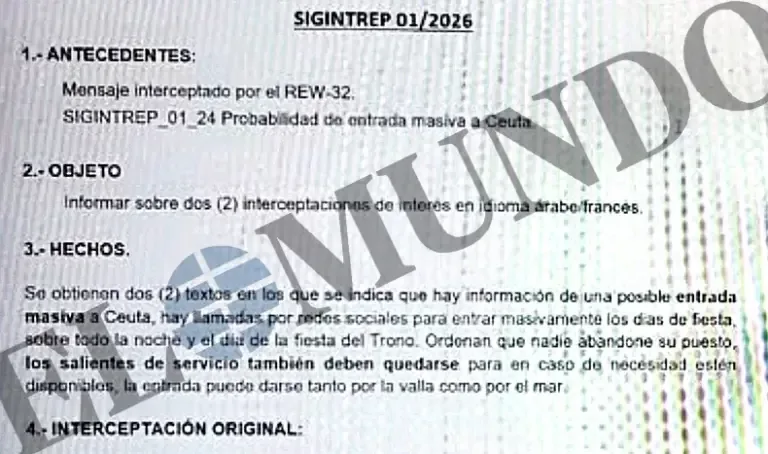
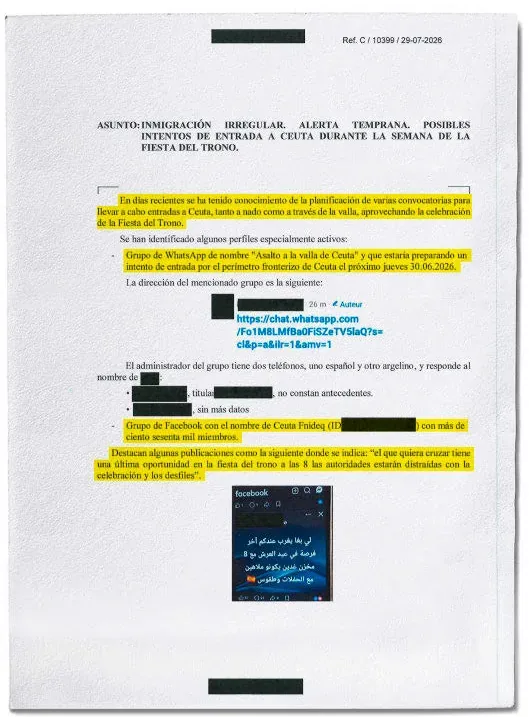
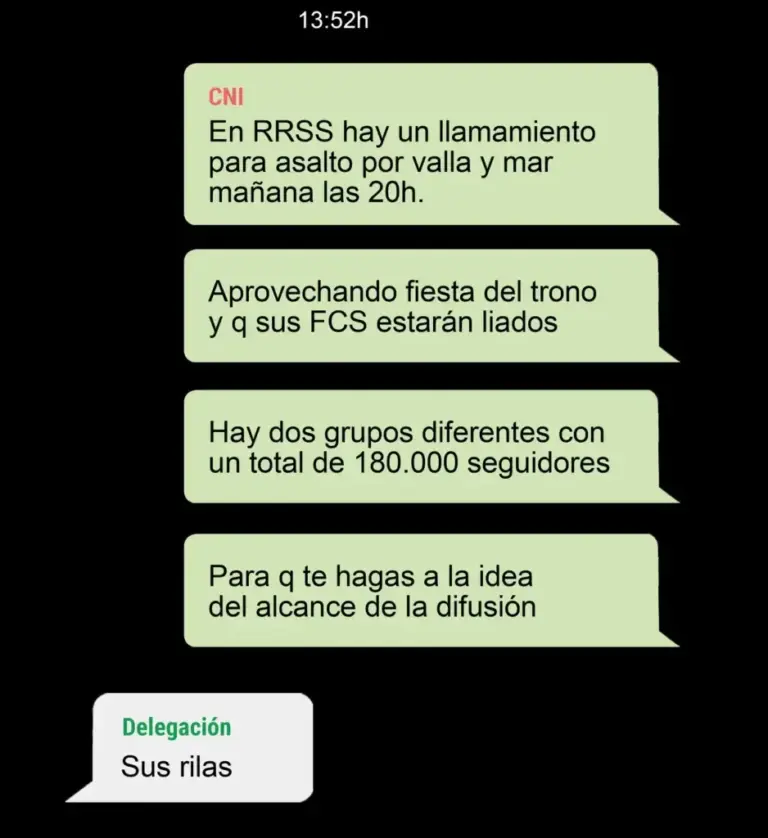
DECLASSIFIED REPORTS
By revealing communications from the days prior to 30-J, the Government has uncovered the serious institutional concealment of the Ceuta crisis. To avoid responsibility, the Executive has unleashed a campaign against its own Intelligence services.