







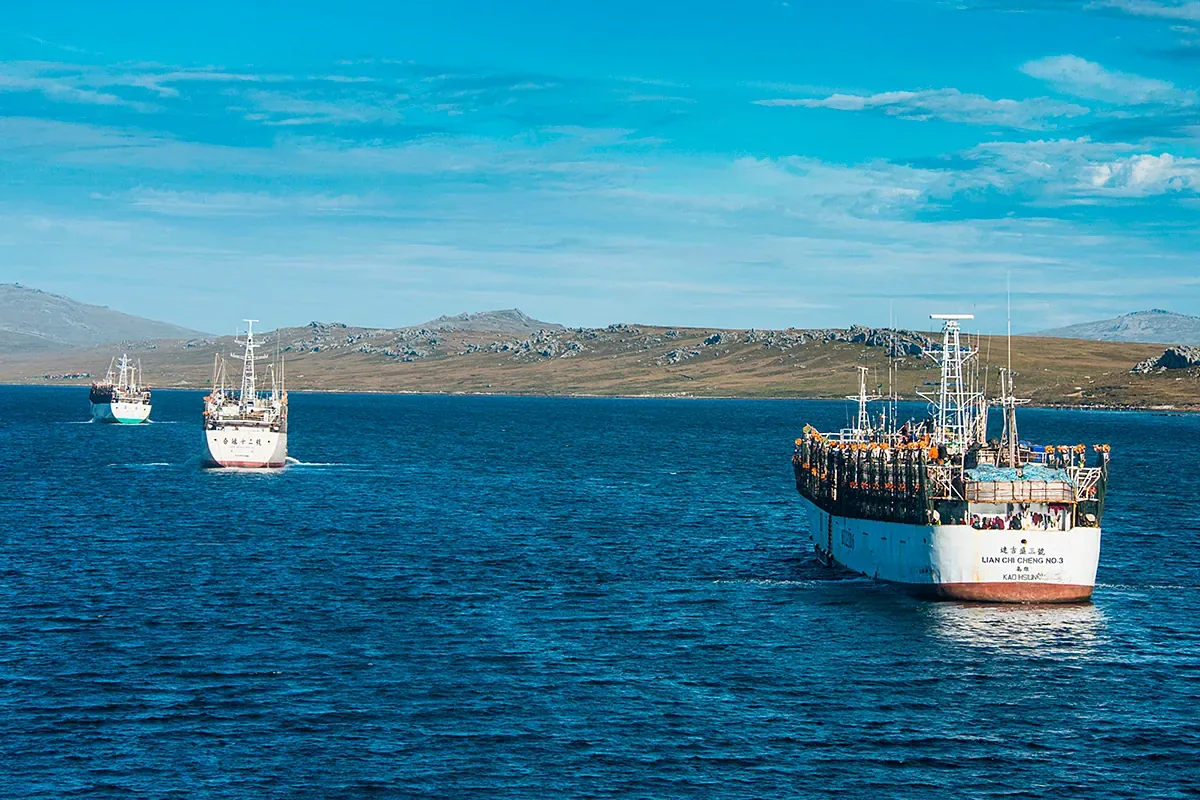
In the waters of the Malvinas, the crews of 16 factory ships and freezer trawlers try to kill time as best they can. Some take the opportunity to carry out maintenance work, others dedicate themselves to fishing hake or some other permitted species. But they did not set sail from the Galician ports of Vigo and Marín to inspect their ships 11,000 km from home. They did it to work in the second squid Loligo fishing campaign and return with tons of them to distribute in Spain and other parts of Europe. That goal, however, is anchored in uncertainty.
The idea was to cast the nets into the sea in August. But the plan took a different direction. For at least two weeks, the government of the Falkland Islands has banned catching a single squid due to low biomass levels in the fishing area known as Loligo Box. The pause began on August 12 and reopening will depend on new scientific assessments giving the green light.
In fact, there is a possibility that fishing may not be allowed for the entire season, with the risk of affecting the price of the mollusk on the market. “What we cannot do is mortgage the future to save the operating accounts of a campaign,” asserts Javier Touza, president of the Fishing Shipowners Cooperative of the Port of Vigo (ARVI).
The Falkland Islands — according to the name given by the United Kingdom — host the world’s largest fishing ground for Doryteuthis gahi, the Patagonian squid so popular in Europe. The species is concentrated to the east and southeast of the archipelago. Galicia functions as one of the main centers for distribution, processing, and marketing of this cephalopod. Around 20% of the squid consumed in Europe comes from this fishery. More than 50% of the Loligo caught is destined for Spain and the rest is processed and mainly exported to Italy, France, Portugal, Croatia, Germany, and Greece.
“We cannot mortgage the future to save the operating accounts of a campaign”
Javier Touza, president of the Fishing Shipowners Cooperative of the Port of Vigo (ARVI).
In the southern fishing ground, Spanish squid boats operate under a “joint venture system where there is a local partner and a foreign partner, in this case Spanish,” explains the president of ARVI. The model allows fishing rights to remain in local hands, while the Spanish provide the ships, capital, technology, and access to the European market.
The Galician companies linked to this structure are Pescapuerta (with four vessels), Wofco (with three ships), Grupo Pereira (also with three), Chymar (with two), Lanzal (another two), Copemar (one) and Marfrío (one). In recent years, investment in fleet construction and modernization has been around 250 million euros. These companies have upgraded their vessels by incorporating technologies to improve energy efficiency, optimize catch processing, and reduce environmental impact. “The ships are true floating companies, with large crews, between 50 and 60 people per vessel,” describes Touza, who is also CEO of Chymar.
CONTROL IN THE CAPTURE OF ‘LOLIGO’
In 2022, the United Kingdom and the island authorities renewed fishing rights for 25 years. The capture of the mollusk in the Falklands is subject to a very detailed regulation and control system. Licenses C and X authorize specific vessels to catch Doryteuthis gahi by trawling in the Loligo Box. Squid fishermen have fishing effort limits and cannot exceed 10% bycatch of unauthorized species. If they exceed that percentage, they are penalized with a fishing ban “for five days.”
The regulations also require stopping trawling if the ship’s plant cannot process the catches at the rate they are obtained. It also prohibits discarding specimens of Loligo in good condition or using them for fishmeal and requires the use of devices to prevent seals from entering the nets. The system also differentiates between who holds the transferable individual quota, who exercises the fishing right, and the vessel authorized to fish, thus establishing several layers of control over who can exploit the resource, where, how, and for how long.
As a general rule, the Falkland Fisheries Department stipulates two Loligo fishing campaigns per year: the first from February to May; the second from August to October. Behind these seasons “there is very important logistics,” notes Touza. “We are talking about operating more than 10,000 km from Spain; on the other hand, it is complex in terms of coordinating transshipments to merchant ships, container transshipments, fuel take-ups, crew movements… It is a complex task.” That is why he says it is “painful” to stop the activity.
The legislation states that there are “64 days of fishing effort”, but Touza clarifies that “the biomass circumstance prevails. The moment the reproduction level or other factors may be at risk, it is closed, period, temporarily or permanently.” The behavior of this species is difficult to predict because it is a short-cycle natural resource, whose abundance and distribution fluctuate depending on environmental conditions and the state of the fishing ground itself.
The irregularity of recent campaigns proves it: in 2022, about 101,166 tons of Loligo were caught in Falkland waters, a figure that fell to 69,751 tons in 2023 and 48,888 in 2024, after the second season was not even opened for conservation reasons. In 2025, 56,895 tons were caught.
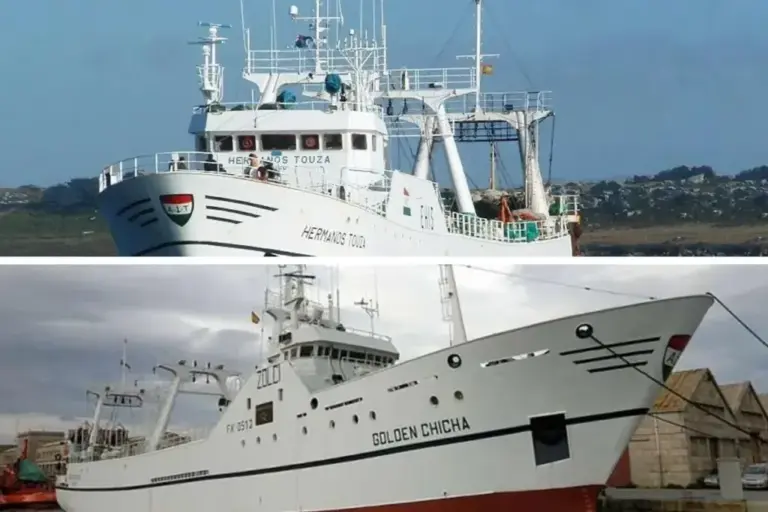
In this year’s first campaign, more than 42,000 tons were exceeded, which led to the expectation that the forecast for the second half would be favorable. But experts have shown otherwise. On every Galician squid boat, there are scientists, including Spaniards, who study the resource’s evolution and the fishing ground conditions. “There are observers on board the ships, there are scientists on land, there are people working on all information processing systems,” assures Touza.
After detecting that biomass had fallen to minimum levels, experts recommended pausing the activity. “It is difficult to reconcile commercial interests with sustainability and science, but, given the sensitivity of the resources, by consensus and together with local administrations, we made that decision,” says the Chymar executive.
The Falkland Fisheries Department announced a “trawling campaign” in the fishing area to learn about the squid distribution and determine more precisely where the species is concentrated. With the two-week pause, they hope the squid size will grow and biomass levels will improve. But scientists will give the final verdict after evaluating all technical parameters. In the worst case, the 16 vessels would have to return without squid. “We would be talking about significant lost profits, millions of euros per ship”, estimates Touza.
It would not be the first time that the lack of Malvinas squid hits the Spanish industry. In 2024, when the second campaign also did not open, Vigo’s freezers had to look for new raw materials and clients to cushion the impact of the closure. The lower availability of Loligo did not automatically translate into a price increase for consumers, but it did force the industry to seek alternative products and increased pressure on their supply costs.
A still uncertain price
If fishing does not resume for the rest of the season, the lower supply of Patagonian squid could have consequences in our country. The reduction in catches would force the industry to resort to stored stocks or seek squid in other fishing grounds, which could raise supply costs and, depending on availability and demand, be passed on to prices. The impact, however, would depend on how much product is stored, the capacity to replace it with catches from other origins, and how the market evolves.
Spain is not the only country fishing in the South Atlantic. Outside the Falklands’ jurisdictional waters and Argentina’s exclusive economic zone, beyond 200 miles, a large international fleet, mostly Asian and with a strong Chinese capital presence, operates. These vessels mainly focus on catching squid (Illex argentinus), another cephalopod, although they also catch other species.
Tensions with Argentina
The activity of this fleet, especially the Chinese, generates tensions with Argentina, which denounces the pressure on resources and the impact on migratory species. They assert that squids are caught before completing their movement towards Argentine waters. The magnitude of the Chinese fleet is considerable: in a surveillance operation, Argentina detected up to 380 Chinese fishing vessels near the 200-mile line.
These activities, explains Touza, should not be linked to the decline of Patagonian squid “because it is an endemic species of the Falklands, that is, it is born, grows, and dies in the islands’ jurisdictional waters. Since the animal does not leave those waters, the fact that there are other vessels [at a distance] does not interfere with the usual cycle of the squid [Doryteuthis gahi].”
Argentina questions fishing activity around the Falklands due to the old sovereignty dispute and pressure on South Atlantic resources. A latent conflict that even reached football: last week, FIFA sanctioned the Argentine national team for displaying a flag with the slogan “The Malvinas are Argentine” during a World Cup match. Buenos Aires considers the islands part of its territory and therefore rejects the United Kingdom granting fishing licenses. Added to this is its concern about catch volumes and the state of the fishing ground. The Argentine press even labels fishing activity in the area as “piracy,” with headlines like Spanish fishing fleets rearm with new vessels to plunder the Malvinas.
However, ARVI emphasizes that marine biodiversity conservation is a priority for the sector and defends fishery management increasingly supported by scientific research. “Every day we realize more the importance of science in the development of our activity”, says Touza. The specific causes of the biomass decline are still unknown. Studies will determine whether the vessels will return to their ports in Vigo and Marín in October with or without squid in their freezers.