




Jaume Olmos is the director of the rural school of Benavites and Quart de les Valls (Valencia), a center for Early Childhood and Primary education that enrolls the 240 children from these two municipalities and has two independent classrooms. One of them is a prefabricated building and the other, waiting for a structural reform for seven years, has the bathroom in the middle of the playground, lacks a concierge or offices, and uses the dining room also as a classroom. The children solve Math problems next to the kitchen, while the cook prepares the catering trays and the monitors come and go. There is noise and smells. It is certainly not the best place for learning.
Read more The worst August for Ceuta’s merchants: «I had to take out an iron bar to protect my store»
“The state of the center reflects the importance given to education and how the authorities value us. In the rural school, all kinds of peculiarities are allowed: we have normalized precariousness,” laments this teacher, who has been reported by the Health Department for using the dining room as a classroom, as adequate hygienic-sanitary measures are not guaranteed. It is a peculiar situation, since it is the Generalitat – through Health – that scolds a public school of the Education Department, which also belongs to the Generalitat itself. The director, in the middle of the conflict, has no possibility to resolve the situation. And it has been like this for five years.
Next to Jaume Olmos is Victoria García Castelló, director of the public institute Altos Hornos de Sagunto (Valencia), who assures that “this is not an isolated case” and that “it also happens in other centers.” This Geography and History teacher with more than two decades of experience says that “in a nearby school in Puerto de Sagunto they also have to teach in the dining room, and even in the library and offices.” “For us, with the number of groups we have, we are missing a classroom and are also thinking about using the cafeteria,” she admits.
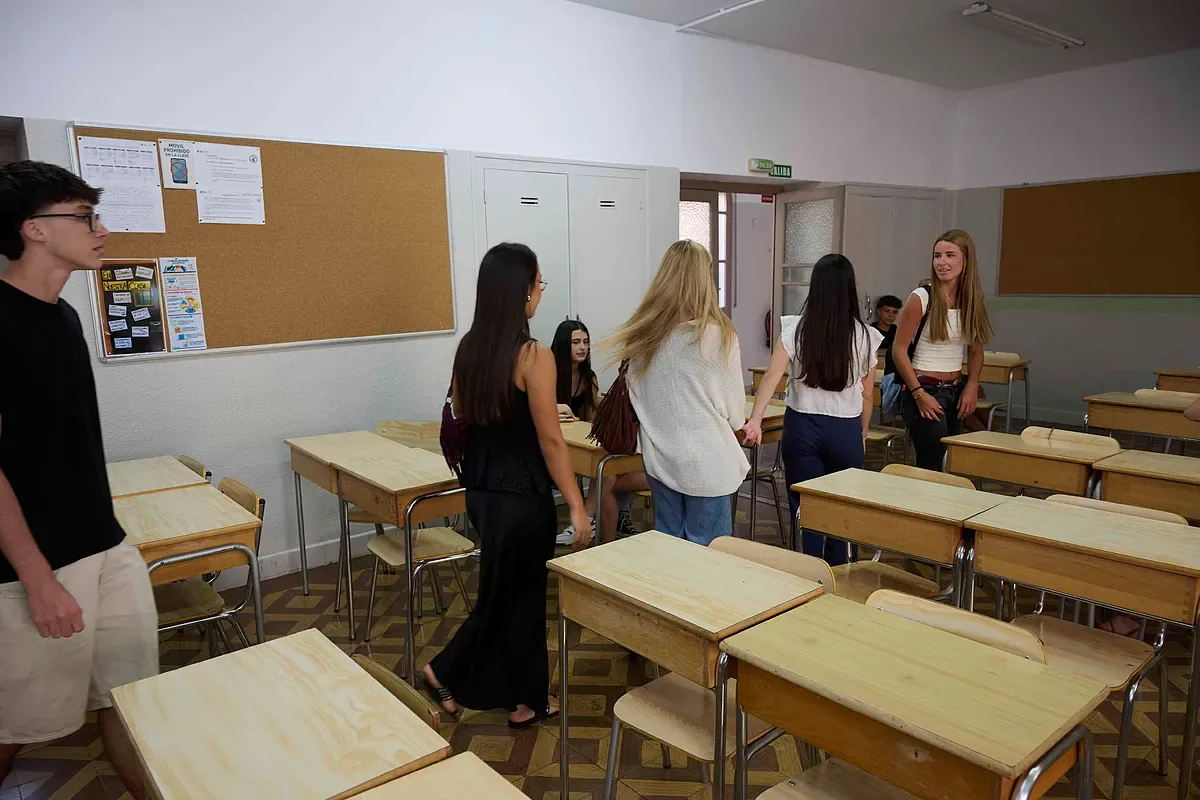
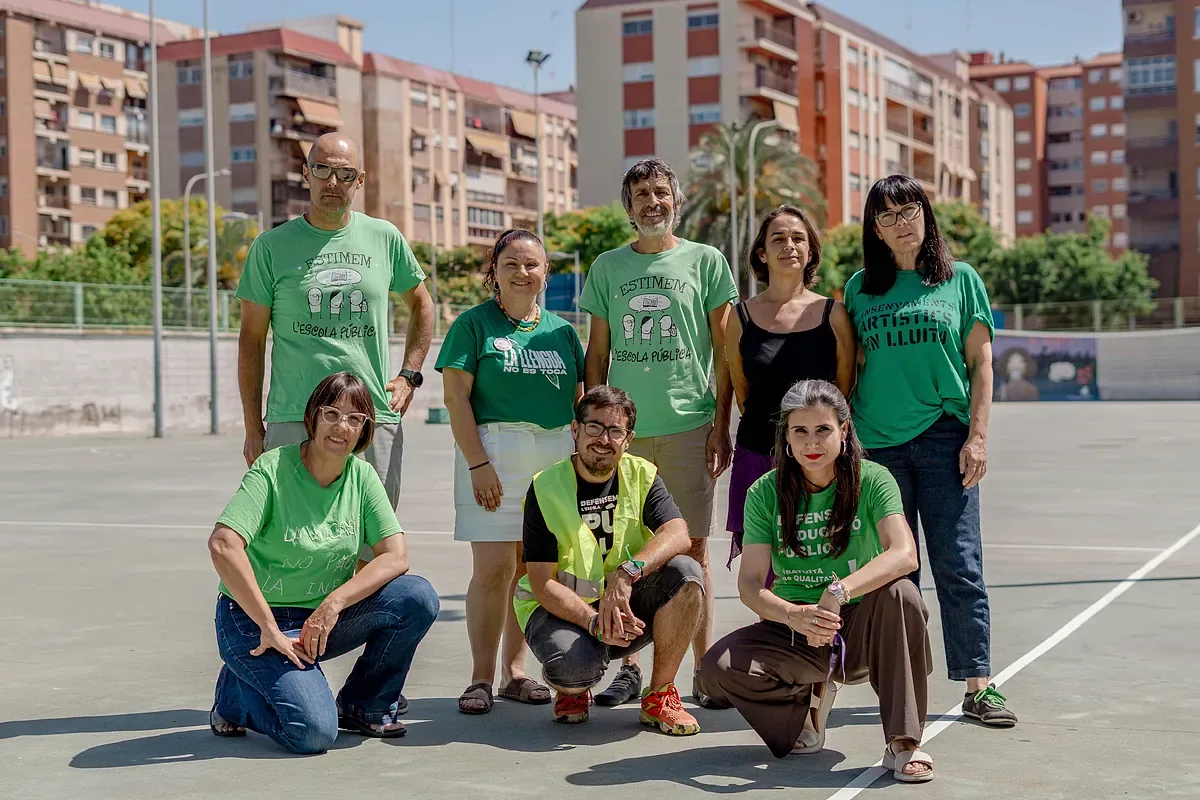
EL MUNDO has brought together Olmos, García Castelló, and six other directors of public schools and institutes in Valencia to talk about the state of education ahead of the new school year, marked by teachers’ discontent over the growing difficulties they face in performing their tasks in a transforming society. The meeting takes place in an educational center in the city of Valencia without air conditioning, where the temperature reaches 35 degrees. The classroom is empty, but it is not hard to imagine the heat felt by the thirty or so teenagers who usually occupy it. “Most centers are like this,” say the directors, shrugging.
Directors who resign
The Valencian Community was the main focus of teachers’ protests during the last school year, with a prolonged strike and numerous days of stoppage. The directors of the centers, key technical figures linked to the administration who usually stay out of these claims, also played a major role. This time the situation changed. Jaume Olmos and 137 other directors of public schools, 77 heads of studies, and 56 secretaries, as well as 19 officials with different levels of responsibility, submitted their resignation in writing to the Department as a “cry for help” for having reached “a breaking point.” The PP Generalitat has conceded on some labor issues, but negotiations will continue in September and new mobilizations are not ruled out.
The eight directors interviewed for this report are part of that group that submitted their resignation, which they must ratify in September. The main reasons for their protest are the lack of resources to attend to the growing number of students with special learning needs, and an increase in bureaucracy and their tasks that has intensified since the approval in 2020 of the Lomloe, better known as the Celaá Law.
“The school has not adapted to the social changes that have occurred in recent years. Educational laws go one way and reality another,” begins Silvia García Merino, director of the IES Marjanade Chiva (Valencia).
“There are more learning needs, more immigration, more broken families, and that is why more resources are needed to achieve real inclusion. Teachers now are also moms and dads, caregivers, psychologists, nurses… We do everything except our job,” points out Ismael Donet, director of the CEIP Víctor Oroval Tomás de Carcaixent.
“10% of our students are Ukrainian. They come from violent situations and suffer from post-traumatic stress. We need specialized staff,” adds Victoria García Castelló.
“The TEA classroom used to be only for children with autism spectrum disorder, but the Administration called us and said we had to include a foster child, promising a resource that takes months to arrive, which puts the classroom under strain,” continues Juan José Rodríguez, director of the CEIP Teodoro Llorente in Valencia.
“Protocols are necessary and we are not against bureaucracy with sense, but with the current situation, I can spend my entire workday just managing the certificates,” says Eva Bisquert, director of the IES Ramon Llull, in the same city.
September of strikes
Similar complaints are repeated in centers of other autonomous communities, which are responsible for managing education. Strikes are scheduled for September in the Community of Madrid and in Catalonia, as well as mobilizations throughout Spain promoted by the CSIF union that could lead to a national stoppage. The complaints are against the regional governments, but also against Pedro Sánchez’s Government. “This is not a punctual political situation, but a State policy that progressively deteriorates public services, empties the teaching profession and knowledge creation of content, and fills us with more and more papers and work. The school has become an NGO for society to function,” insists García Castelló.
The educational community demands “State solutions” and reproaches the Government for not fulfilling what it promised despite saying this would be “the legislature of the teaching staff.” In January 2022, then Minister Pilar Alegría presented a set of 24 proposals to reform the profession that included an innovative system for evaluating teachers linked to professional remuneration, something that would improve teachers’ situation by establishing a true career path allowing them to progress according to their interests. But nothing has been done.
The only measure related to teachers has been to approve a bill, currently in the Congress of Deputies, to reduce the number of students per classroom and limit teachers’ teaching hours. It is planned that from September the Government and unions will begin negotiating entry into the teaching profession, with a review of the Teaching degree, internships, and exam syllabi.
But, a year before the general elections, no one in the educational community believes there will be many advances due to the electoral wear caused by this type of reform, which no Government has managed to implement.
“All the effort”
Teachers and directors welcome the reduction of ratios but believe it will be of little use if not accompanied by adequate funding. “On paper everything is very nice, but the problem is how it materializes, and it is the teachers, in the end, who make all the effort. The Lomloe, for example, bets on inclusion, but it is betting on something without providing resources,” complains Jaume Olmos, who has more than 40% of students with learning needs in his school.
Paula Montesinos knows this well, the orchestra director of the El Tabalet early childhood school in Benifairó de les Valls. In addition to this role, she has taken on the tasks of head of studies, secretaries, all teaching coordinators, and even the person in charge of the dining room and the concierge. “I do everything, even open and close the school door, answer the phone, and hang up posters,” says this teacher, who is also forced to take care of “all programming, all evaluations, and all management with families.”
The case of 0-3 years education workers, who staged a notable national protest in May, is especially “critical” due to their precariousness, lack of public investment, and insufficient staff, with salaries barely above the minimum wage despite being a job with high responsibility for very young children.
But the same happens throughout Spain, in schools, institutes, Vocational Training centers, and artistic education centers. The Valencia Higher Dance Conservatory, for example, is in a building with a “1970s electrical network,” “toilets that constantly clog,” and a “broken boiler.” “They are dance students, who move constantly, but we don’t even have showers,” laments Mónica Palerm, the head of studies. Her final reflection is pessimistic: “We keep swallowing it and the students keep swallowing it. In the end, because of their vocation, they accept teaching in conditions that are not dignified.”
Next to her, Eva Bisquert confirms: “We are educating in the acceptance of precariousness.”