




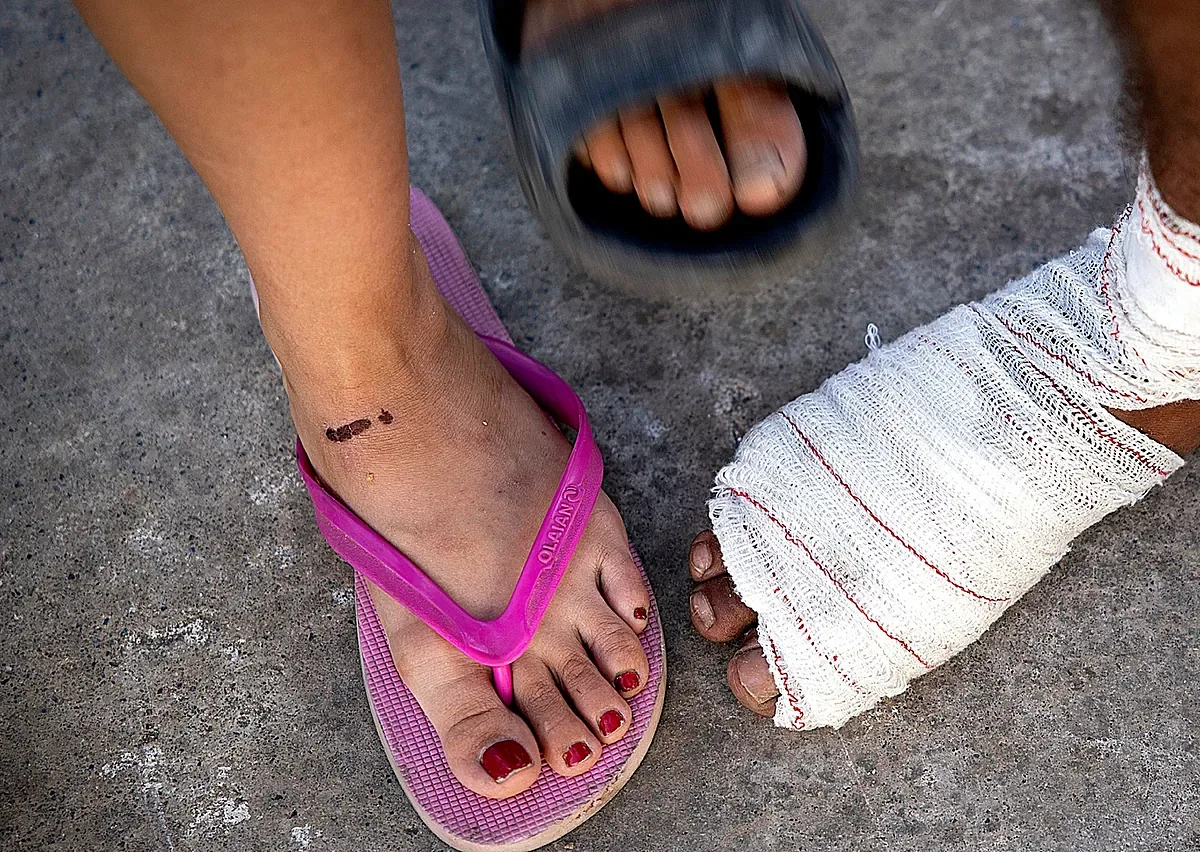
The Police have detected in Ceuta several apartments owned by Ceutan citizens of Moroccan origin used to sexually exploit underage immigrant girls who arrived in the city during the massive entry at the end of July. The situation is so serious that a team from the Central Unit of Illegal Immigration Networks and Document Falsifications (UCRIF) has been sent to the autonomous city to take charge of the investigation, according to EL MUNDO.
According to police investigations, the mafias recruited the girls once they crossed the border and, already on Spanish territory, taking advantage of their extreme vulnerability. The mechanism detected by the investigators starts, in some cases, with an offer that, in theory, covers their basic needs: food and a place to sleep. Under this claim, Moroccan pimps take them to apartments and villas of Ceutan citizens to force them into prostitution.
Investigators have begun to detect more and more homes with these characteristics, which has caused growing concern. The Police are now trying to determine who is behind these networks, their true scope, and the number of minors who could be victims of this activity.
The seriousness of the phenomenon has even led to the deployment of a specialized UCRIF team to Ceuta to reinforce investigations. The agents are focusing on identifying these apartments, the people who manage them, and the connections that may exist between those offering accommodation to the minors and the organizations dedicated to their exploitation.
Police concern is also explained by the profile of the possible victims: minors, immigrants, and in many cases, without a family or social network capable of protecting them. Their situation makes them an especially easy target for those seeking to take advantage of their helplessness. Arrival in Ceuta, far from ending the risk they face, can thus become the start of a new exploitation circuit. This reality is taking on an increasingly worrying dimension, and the Police fear that the number of homes used for these practices may continue to grow.
The sexual exploitation of immigrant minors thus becomes a new consequence of the migration crisis affecting the city and one of the scenarios that generates the most concern among agents working on the ground. In this case, the networks do not necessarily need to resort to large infrastructures. It is enough to have a home, offer a roof and food to a young woman who has no alternatives, and then take advantage of her dependent situation. That is why investigators are trying to locate and dismantle these points before they can become stable exploitation structures.
Read more 90% see Morocco behind the invasion of Ceuta
The situation adds a new layer of seriousness to a crisis that was already stretching the city’s resources to the limit and forces increased vigilance over those groups that present a higher risk of falling into the hands of exploitation networks. The police investigation now aims to establish the real extent of this practice, identify those responsible for the homes, and clarify the relationships they maintain with possible trafficking networks. The goal is to prevent these apartments from becoming refuges for organizations that find in the vulnerability of minors a fertile ground for their criminal activity. For the agents, the problem is not only detecting the places where exploitation allegedly occurs. It is also essential to locate the minors and guarantee their protection.
In a city subjected for months to extraordinary migratory pressure, the appearance of these cases worsens the lack of capacity to absorb such a large immigrant population. This type of episode adds an extra burden on an already fully stretched police device. The agents not only have to respond to migratory pressure at the border and on the streets but also investigate crimes that occur, arrest those responsible, guard the detainees, and transfer them to the courts to place them at the disposal of the judicial authority.
And all this in a city where pressure on public services continues to be extraordinary and where thousands of immigrants are still awaiting a solution. The General Council of the Judiciary itself has agreed to reinforce the courts of Ceuta due to the increase in complaints and procedures derived from the crisis, another sign that the overload does not only affect the Security Forces and Corps. The fear among agents of the National Police, Civil Guard, and Army is that this situation will continue and that the exceptionality will end up becoming normality. The Ceuta crisis, they warn, cannot be resolved simply by temporarily increasing shifts or sending units for a few days. If the pressure continues, the lack of resources may end up becoming another structural problem of a city that has already been operating at its limit for weeks.
In the early hours of last Thursday, a group of between 30 and 40 foreign men ambushed four soldiers from the Regulars Group who were heading to their usual surveillance point in the Benzú area. They were patrolling in an unarmored vehicle. “They were not armed nor equipped with adequate protection,” a soldier stationed in Ceuta told this newspaper. There were 12 arrests, and a judge has already expelled 11 of them after the National Police placed them at judicial disposal.
Read more The Government drops the case against Holaluz and halts the transfer of its customers


