






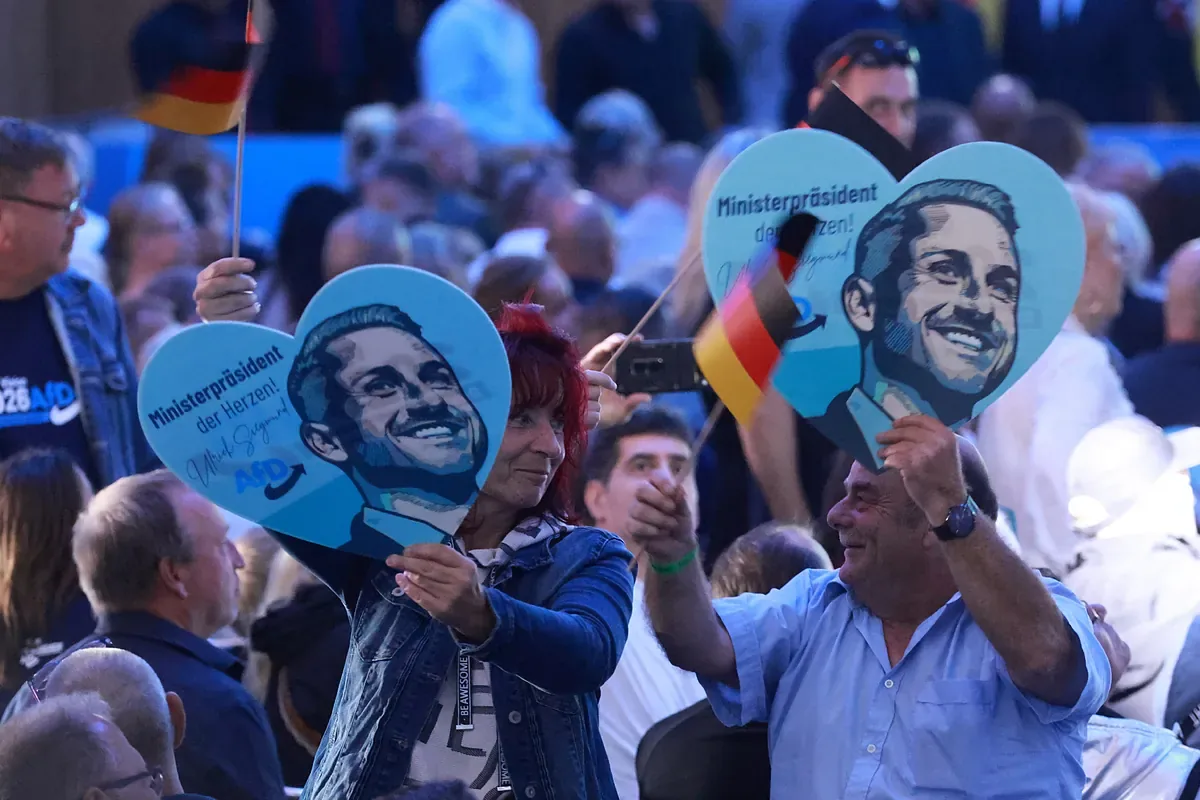
Alternative for Germany (AfD) has won the Saxony-Anhalt elections by an overwhelming margin. According to the first projection by the public broadcaster ZDF, the far-right party obtains 44% of the votes, more than double the 20.8% achieved five years ago, and leaves the Christian Democratic Union (CDU) far behind, which plummets to 18.5%. The big question of the night is whether this result will allow AfD to secure an absolute majority of seats and govern alone.
The answer largely depends on the 5% threshold. According to the ZDF projection, Die Linke gets 9% and the SPD another 9%, while the Greens rise to 8.5%. The BSW is on the edge, with 4.8%, and the FDP disappears from Parliament with barely 2.5%. If the BSW ultimately falls short, the percentage of votes without representation will increase and AfD will be closer to turning its 44% of votes into an absolute majority of seats.
The turnaround compared to the 2021 elections is extraordinary. AfD goes from 20.8% to 44%, while the CDU loses practically half of its electorate: from 37.1% with which it won five years ago to 18.5%. Die Linke falls back two points, from 11% to 9%, while the SPD remains practically stagnant — from 8.4% to 9% — and the Greens clearly improve from 5.9% in 2021. The FDP, which then obtained 6.4%, is out.
The first snapshot thus leaves a completely transformed Parliament. AfD not only doubles its strength and turns the CDU into a second force more than 25 points behind, but the arithmetic to form an alternative majority becomes enormously complicated. If it ultimately does not reach an absolute majority, Ulrich Siegmund’s party has no partner with whom to govern and the rest of the forces will have to find a formula to keep it out of power.

The first projections in Saxony-Anhalt thus push to the limit a strategy that for years has marked the relationship of German politics with the far right. The Brandmauer, as the firewall built around AfD is known in German, has managed to exclude the party from any political collaboration, but not contain its growth. And that was precisely the other half of the bet: isolate AfD while traditional parties recovered their voters. The opposite has happened.
Chancellor Friedrich Merz even promised in 2018 that he would halve support for AfD. Eight years later, the party has multiplied its strength. The strategy of disputing its issues has also not worked. The government has toughened migration policy and Merz has placed immigration among the pillars of his chancellery, but AfD has not retreated. It has also expanded the battlefield: from immigration to energy, Ukraine, Russia, and the rejection of political elites it presents as interchangeable.
But the problem with the firewall no longer consists only in that it has not stopped AfD. The more the far right grows, the harder it is to build majorities without it and the more ideologically distant the parties needed to achieve them are.