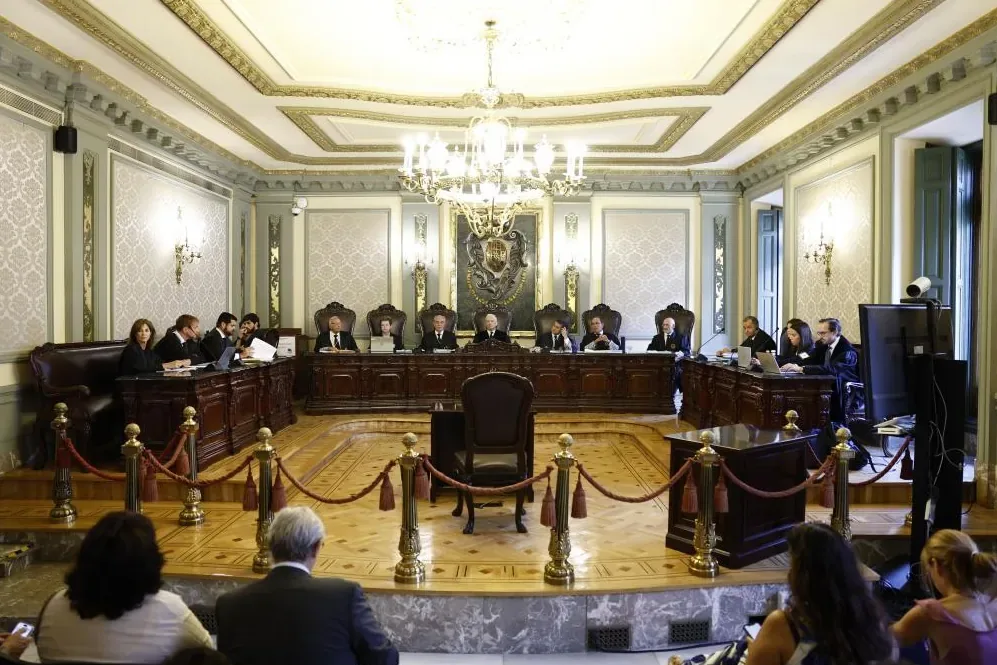





The Supreme Court yesterday suspended the broad approach with which the Ministry of Justice had been expanding the electoral register from 2024 through the so-called grandchildren law. The Contentious-Administrative Chamber thus upholds the precautionary measure requested by Iustitia Europa and Vox, who in a hearing held on Monday at the High Court argued that the Government was preparing a “massive fraud” in the upcoming electoral calls. Both the Prosecutor’s Office and the Government, through the State Attorney’s Office, opposed the precautionary measure.
The suspension of registrations in the Electoral Census of Absent Residents (Cera) derived from the grandchildren law will extend until the Supreme Court issues a ruling on the substance of the matter. The deadlines for this are very open, but sources from the High Court indicated yesterday that they will “speed up” the procedure as much as possible. The expectation is that the matter could be resolved within three months, before the end of the year, or that it will extend a little longer. This is weighed by the fact that an election year is approaching, with municipal and regional elections in May and general elections, at the latest, in July.
The minister Félix Bolaños yesterday urged the Supreme Court to resolve the case “as soon as possible” since it affects “the most sacred thing in democracy, which is the right to vote.” “We do not agree with the Supreme Court’s decision,” said the head of the Presidency and Justice, who “respectfully” asked for priority to be given to the matter and for the Supreme Court to resolve it “before the 2027 electoral processes.”
The judges of the Fourth Section only notified the decision made yesterday, not the reasoning behind it, which will be known in the coming days. They adopted the precautionary measure within the appeals filed against the refusal of the Central Electoral Board (JEC) to suspend the application of the grandchildren law. In its decision, the JEC considered that it was not competent to halt the application of the rule, something that is within the Supreme Court’s reach.
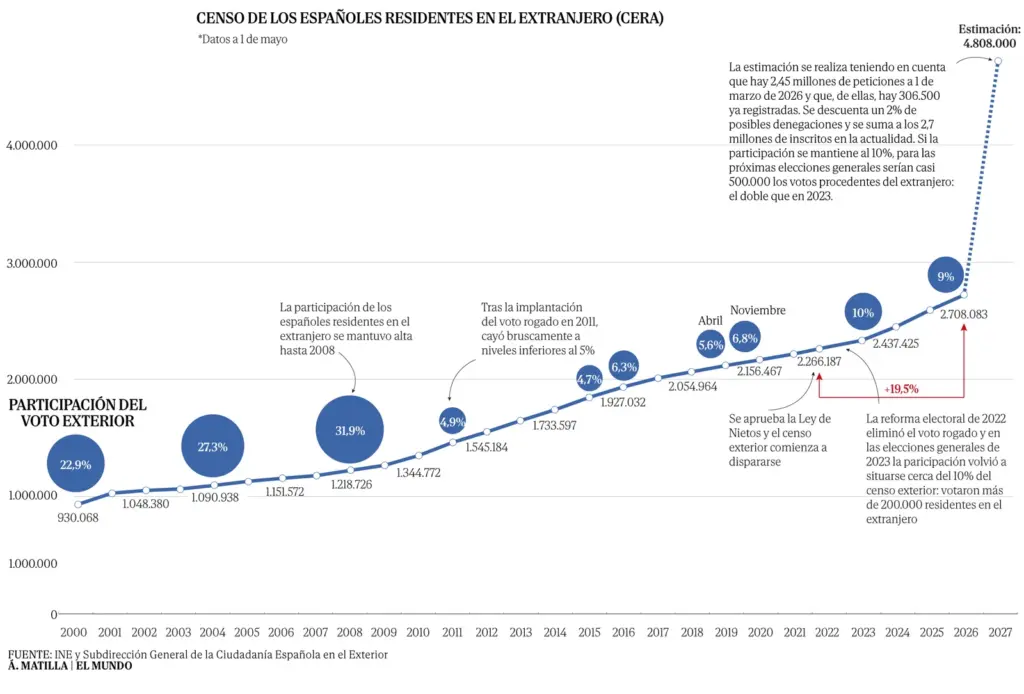
The Democratic Memory Law approved in 2022 established that those born outside Spain “to a father or mother, grandfather or grandmother, who were originally Spanish, and who, as a result of having suffered exile for political, ideological, belief, or sexual orientation and identity reasons, had lost or renounced Spanish nationality” could apply for Spanish nationality—and thus the right to vote.
For the application of this law, the Ministry of Justice issued an instruction to the registries that included the presumption that those who had left Spain between the start of the Civil War and 1955 automatically had the status of exiles. They could be granted nationality without the need to document this circumstance.
Read more Madrid achieves a victory of chaos against an Inter with dominance and errors at the Bernabéu
“The status of exile will be presumed for all Spaniards who left Spain between July 18, 1936, and December 31, 1955,” stated the instruction now affected by the Supreme Court’s suspension. It was approved on October 25, 2022, by the Directorate General of Legal Security and Public Faith, then led by Sofía Puente, sister of minister Óscar Puente.
The Supreme Court establishes that the procedures provided for granting nationality under the Democratic Memory Law may continue, but suspending the exercise of the right to vote for new registrants while the appeals are resolved. “The processing of the corresponding registration file will continue until its completion. Once this file is completed, registration in the said Census will be suspended until the judgment in this procedure is issued,” indicate the judges of the Fourth Section. In the case of those already registered, “the electoral effects of the registration in said Census will be suspended.”
The High Court does accept that those who have obtained nationality by demonstrating with documents the exile status of their predecessors maintain or gain their right to vote. The suspension “will not apply,” therefore, to those “who have suffered exile for political, ideological, belief, or sexual orientation and identity reasons and who had lost or renounced Spanish nationality, without applying the presumption.”
In the same resolution, the Supreme Court’s Contentious Chamber also requests data to verify the impact of the grandchildren law. It orders the Electoral Census Office to inform it of the number of cases processed, breaking down those that have relied on the presumption that the Ministry of Justice ordered to apply in 2024.
The High Court validates the order of the Central Electoral Board to prepare an instruction aimed at Consular Offices to specify “the criteria applicable for determining the municipality of electoral registration” of each new voter. The indeterminacy of the place where each new voter is placed has been one of the main criticisms of the grandchildren law, amid fears that this circumstance facilitates electoral manipulation.