




The countdown to the arrival of the 2026 Spanish Grand Prix in Madrid hits zero. Formula 1 returns to the city 45 years after the last Grand Prix held at the Jarama Circuit, in 1981.
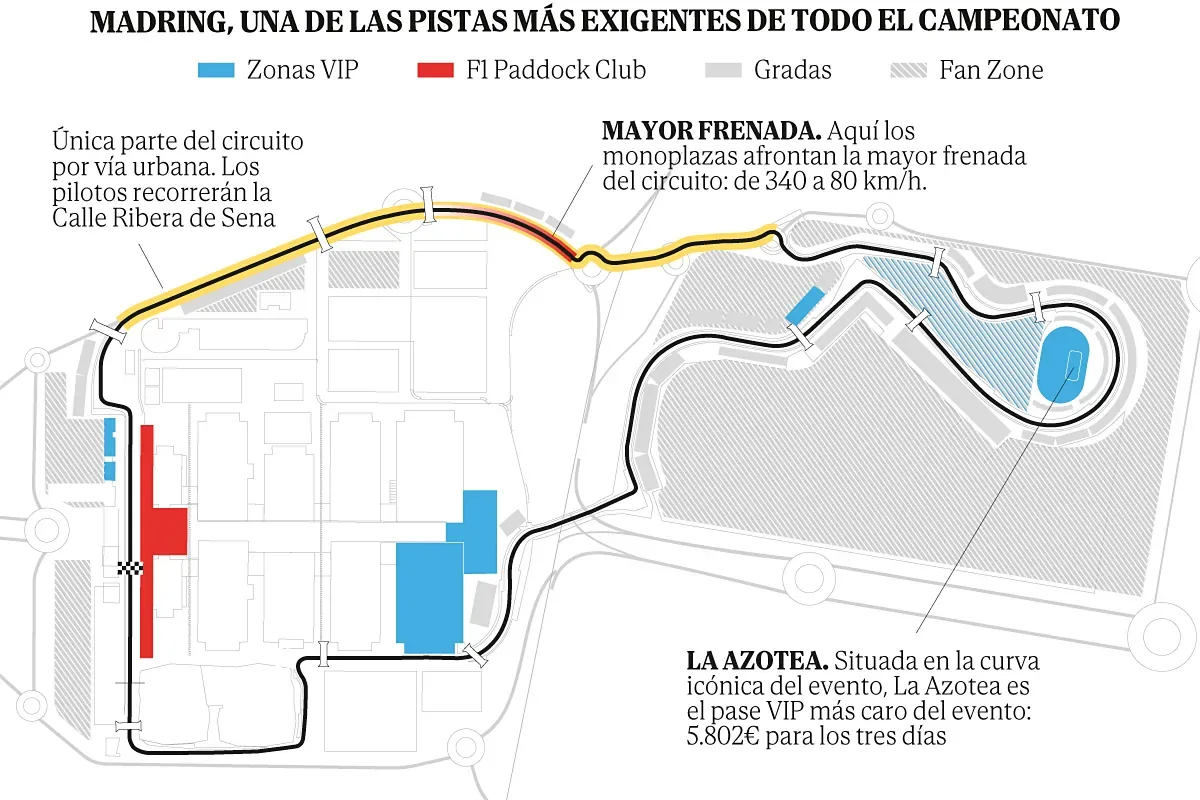
One minute and 34 seconds is how long it will take the drivers to complete the 5.4 kilometers of the Madrid circuit. In total, they will complete 57 laps to fight for a spot on the podium. More than five kilometers and 22 corners designed to bring excitement to a competition whose creation has been meticulously studied. From the starting line, where the cars will reach 320 km/h before slowing down to 100 to face the first corner, begins a route that will take the cars to the Hortaleza corner. Then, they will reach the 1,500 meters of urban layout where the 22 drivers will circulate along Ribera del Sena street, parallel to the M-40.
Next comes the highest speed point of the circuit: corner 4, where drivers will reach 340 km/h before the greatest reduction to 80 to take corner 5 and begin the Subida de Cárcavas. A section with an ascending slope of 8% that will take the drivers to the neighborhood that gives this part of the layout its name.
Once at the top, they reach corner 7, blind and located at the highest point of the circuit, at 697 meters altitude. After passing the urban part, the cars will enter corner 8, El Búnker, which skirts the Spanish Civil War bunkers of La Mata Espesa. Then they will reach corner La Chicane (10), with two consecutive turns, one right, 57º, and one left, 78º. Both aim to reduce speed before facing the crown jewel: La Monumental.
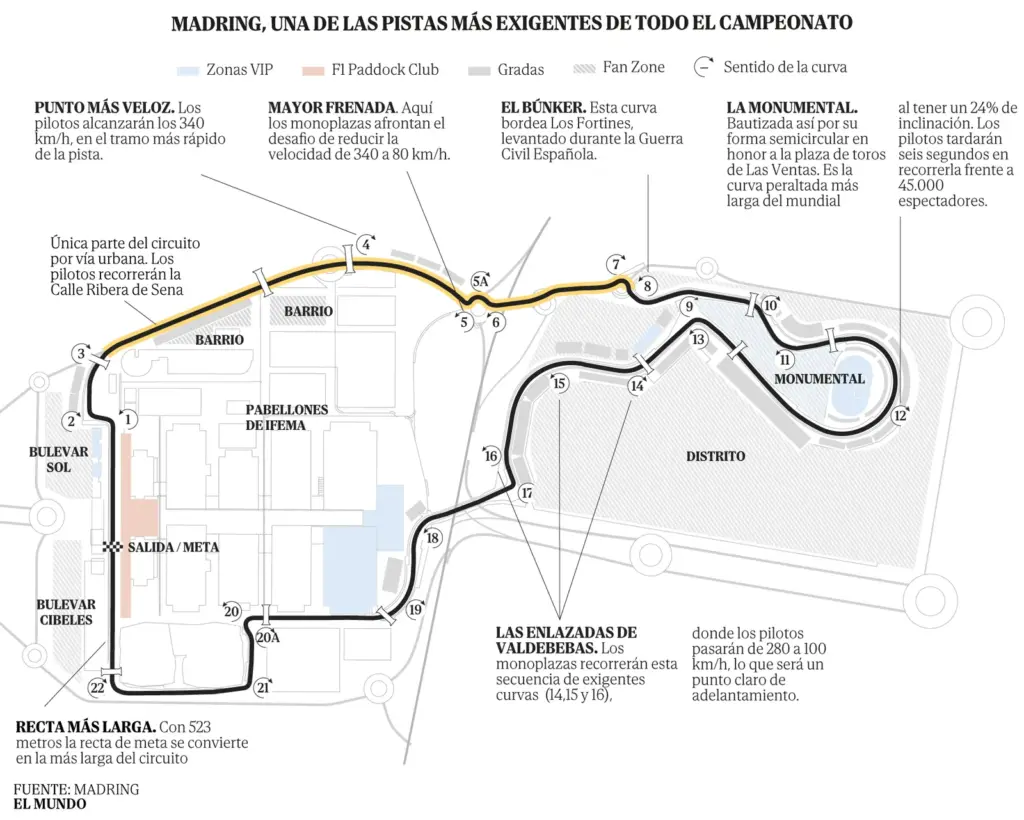
An unprecedented corner in the entire calendar and steeper than the toughest ramps of El Angliru with a maximum gradient of 23.5%. Inspired by the Las Ventas bullring and with a banking of 24%, it is the longest banked corner in the F1 World Championship. The cars will take six seconds to cover this section, inspired by Spanish bullrings, before the 45,000 spectators who will gather at this point.
Having reached the peak, the drivers will enter Las Enlazadas de Valdebebas, a very high-speed zone formed by corners 14, 15, and 16, opposite the Real Madrid Sports City.
Then comes a hard braking at corner 17, where the single-seaters will go from 280 km/h to 100 to take the 84° turn. From there, they will move to corner Norte, just at the exit of the tunnel that connects Valdebebas with Ifema and runs in front of the North Convention Center.
Finally, the cars will enter the slow zone of the circuit: corner 20. A 117° turn will force them to brake and will be a clear overtaking opportunity before facing the last two turns (21 and 22). Both flanked by pavilions 12, which houses the Paddock (nerve center of drivers and teams), and 14. After them, the single-seaters will emerge onto the finish straight, from where they will see the largest Spanish flag in the country waving.
madring hangs the ‘sold out’ sign with a capacity of 350,000 attendees
Tickets already sold out with 350,000 attendees for the entire weekend. It is estimated that more than 60% of visitors come from Spain, compared to 40% coming from abroad. The price range to access the event varies from general admission tickets (€295 – €397), the cheapest, up to €1,541 for the most expensive in the stands located right on the finish line.
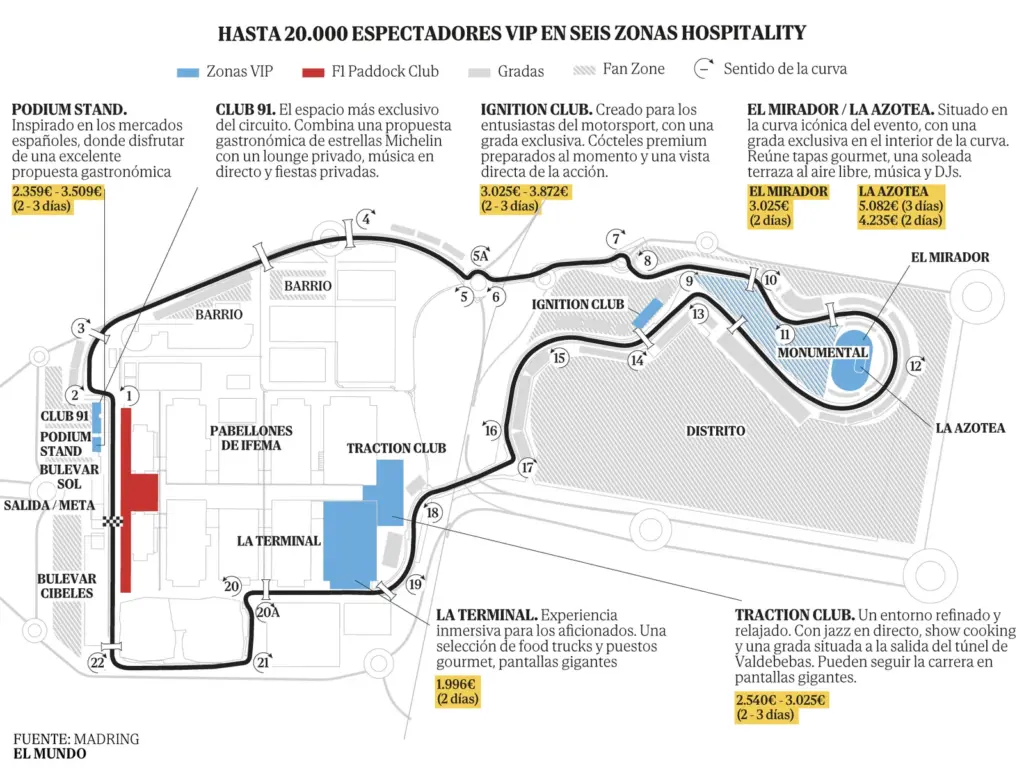
Additionally, Madring will have about 20,000 hospitality tickets, distributed across six VIP zones. Prices for Saturday and Sunday range from €1,996 for La Terminal to €4,235 for La Azotea. For the three days, they range between €3,025 for Traction Club and €5,082 for La Azotea, located at La Monumental corner. There are also VIP passes for less than 1,000 euros, although only for entry on Friday.
Read more Pedro Sánchez’s ‘lapsus’ on TVE and the record ‘smurfing’ donation to the PSOE
COST OF THE FORMULA 1 CHAMPIONSHIP IN MADRID
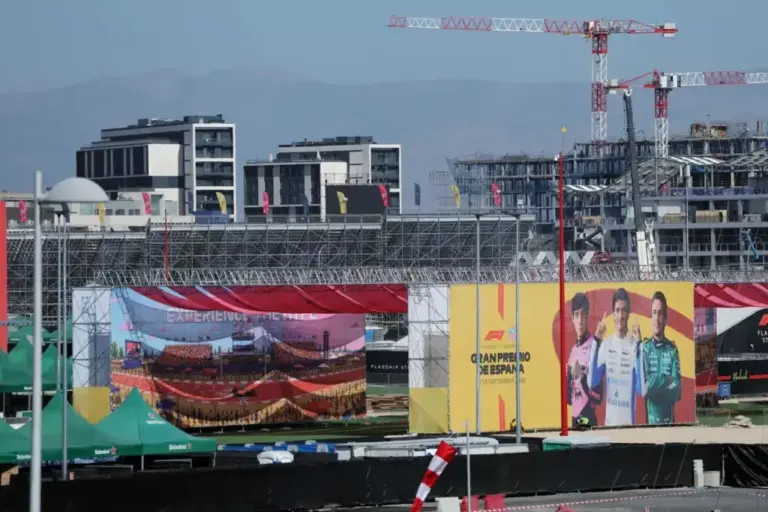
In February 2025, the Madrid City Council Plenary approved the Special Network Definition Plan for the area around the Juan Carlos I fairground. The plan increased the buildable area by 4% and reorganized the land designated for parking to expand and improve facilities and adapt its use for sporting events. Circuit construction began two months later and finished in May 2026, although the final details were completed during the summer ahead of this weekend’s competition.
One of the most debated issues is the cost of building Madring. Although the total amount is unknown, Ifema estimated €47.5 million for the planned actions in the plan, which included the renovation of three pavilions, a parking lot for heavy vehicles, and urbanization works.
The circuit construction was awarded for €83.2 million. To this amount are added services such as project management, technical assistance, and supervision, raising the estimated total construction cost to about €150 million, which will be amortized over the ten-year contract. Additionally, Ifema will have to pay about €35 million annually to host the competition.
A plan in Madring for 300,000 people to leave their cars at home for Formula 1: “It will be a unique case in the World Championship”
- Editorial: CARLOS GUISASOLA Madrid
Another question is how the sporting event is financed. Although José Luis Martínez-Almeida, mayor of Madrid, and Isabel Díaz Ayuso, regional president, assured there would be no public investment, the body responsible for bringing F1 to Madrid is Ifema, funded by the City Council (31%), the Community of Madrid (31%), the Madrid Chamber of Commerce (31%), and the Montemadrid Foundation (7%).
However, José Vicente de los Mozos, president of Ifema, stated that the goal has always been to earn more and spend less: “Only with sponsors will we pay for all the circuit infrastructure,” he said. Among them are Banco Santander, Atlético de Madrid, El Corte Inglés, Heineken, and Real Madrid.
Additionally, the expected economic legacy will reach €467 million annually, according to a PwC report, and will generate up to 8,850 jobs. In ten years, it would amount to €4.67 billion.
Hospitality, transport, and commerce will be the most benefited sectors according to the document, with estimated impacts of €59, €22, and €18 million, respectively. Also, the estimated average spending per visitor could reach €1,680 over the entire weekend.
Lewis Hamilton, Lando Norris, Charles Leclerc, and Max Verstappen are some of the big stars who will compete on Madrid’s asphalt at over 300 kilometers per hour. Alongside them, the two great Spanish drivers, Fernando Alonso and Carlos Sainz Jr. The latter, Madring ambassador, was also the first to debut the circuit after completing a full lap last May. With them, Formula 1 returns to Madrid 45 years later.