









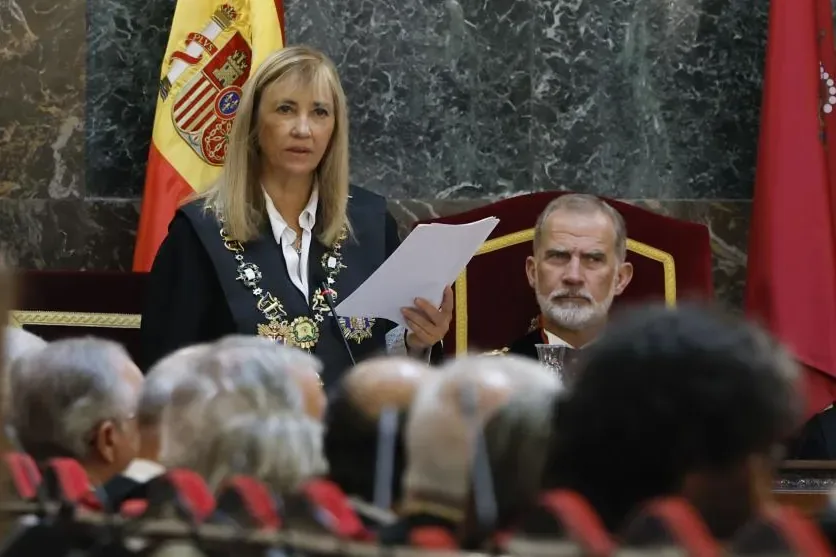
The President of the Supreme Court and the General Council of the Judiciary, Isabel Perelló, stated this Thursday before the attentive gaze of King Felipe VI that “the reality suffered by the people of Ceuta demands a response that preserves the integrity of our borders and the orderly control of access, and that, at the same time, ensures the application of the guarantees provided in our legal system.”
Perelló also wanted, during the solemn act of the Opening of the Judicial Year, to make a special mention of those who have lost their lives in “the serious crisis in which Ceuta is immersed.”
“In such a complicated situation, citizens can trust in the commitment of the Judiciary to the State; and that judges will continue working, safeguarding the rights of those affected and ensuring compliance with the law,” she emphasized.
Throughout her speech, the magistrate also made a strong defense of the Judiciary and its members. “The Rule of Law requires an independent Judiciary. If an independent Judiciary is lacking, the Rule of Law itself disappears, since there is no longer anyone to guarantee compliance with laws and constitutional principles and that all citizens and also public powers act subject to the Law and the Right,” she stressed.
Likewise, the President of the Supreme Court and the General Council of the Judiciary did not shy away from clashing with the Government during her intervention regarding the “disqualifications” of judges that “come from those who hold institutional responsibilities.” “Recently, we have heard widespread explicit accusations that judges and courts make certain decisions for political reasons and not for the legal reasons expressed in their rulings. This is an accusation of extraordinary seriousness, which can even imply the attribution of criminal conduct. An accusation of this nature calls into question whether judicial action responds exclusively to the Law.”
In this regard, Isabel Perelló said that in these cases the “seriousness” of the disqualifications is “greater.” The magistrate recalled that the Judiciary constitutes, because the Constitution assigns it, a “true counterbalance to the other powers of the State.”
The President added that “judicial rulings can be criticized. The interpretation of the norm, the evaluation of the evidence, or the solidity and quality of the reasoning can be discussed. The decisions of judges and magistrates are not exempt from public debate. (…) But the legal discussion about the reasons for a ruling cannot be replaced by attributing political or ideological purposes to the judge, based solely on disagreement with the decision, because this ignores the nature of the function that the Constitution exclusively entrusts to judges and magistrates.”
Likewise, Perelló emphasized that “the democratic legitimacy of the Judiciary derives directly from the Constitution, which proclaims that Justice emanates from the people. Judicial independence is not an exception to the democratic principle, but one of its guarantees. Constitutional democracy is not exhausted by the rule of the majority. It is also based on the recognition of rights whose effectiveness cannot depend on the political, social, or economic position of those who invoke them. Courts must decide according to what the Law provides, without direct or indirect pressures.”
As a representative of one of the powers of the State, the President of the Supreme Court and the General Council of the Judiciary stated that “defending” Justice “away from corporatism is defending the rights of citizens. Because our independence is the best guarantee we can offer them to be convinced that, when making a decision, we will do so without yielding to influences, pressures, or interference of any kind.”
Read more Pedro Sánchez’s ‘lapsus’ on TVE and the record ‘smurfing’ donation to the PSOE