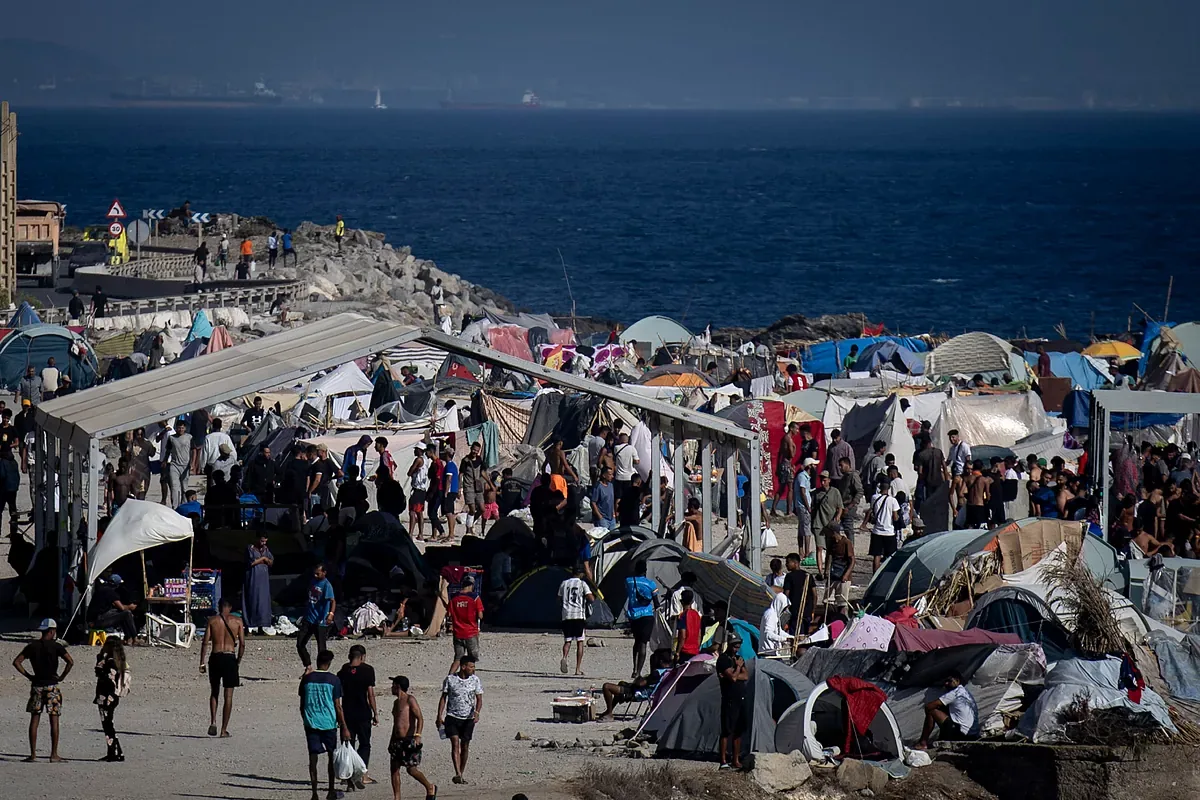









It was 1:00 p.m. this Friday and a boy of just under three years old was kicking a ball through the makeshift alleys formed between the shanties of the immigrants settled on the Playa del Trampolín in Ceuta. Around him, thousands of people continued to occupy a space that the authorities intended to clear with the new camps set up at the Muelle Oeste of the port of Ceuta, amid judicial controversy.
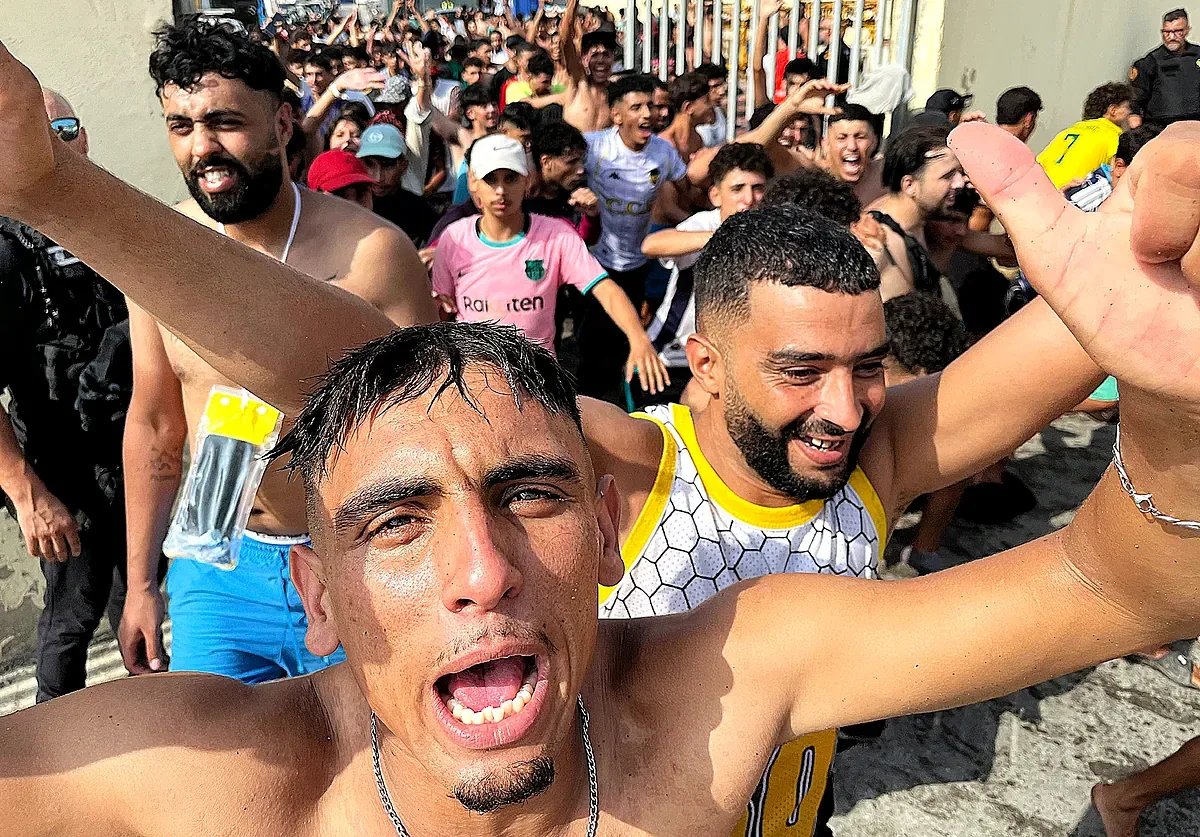
Saladin and his group of friends were heading toward the boy. They were all around their twenties, though they could have been younger, but 45 days of living in harsh conditions among sticks and cloth had taken a toll on the five of them. They came from the entrance on the west side of the port, where various tense incidents had occurred mid-morning between immigrants and authorities. They, like others, tried to improve their conditions by accessing that camp with a capacity for 1,700 people where they would have access to public bathrooms, showers, and a medical care area.
They got up at five in the morning, an hour before the scheduled time to start the operation, to get in line to enter the camp. They never made it. Hundreds of migrants hidden around the city and the hills behind Trampolín beach and Benítez arrived before them.
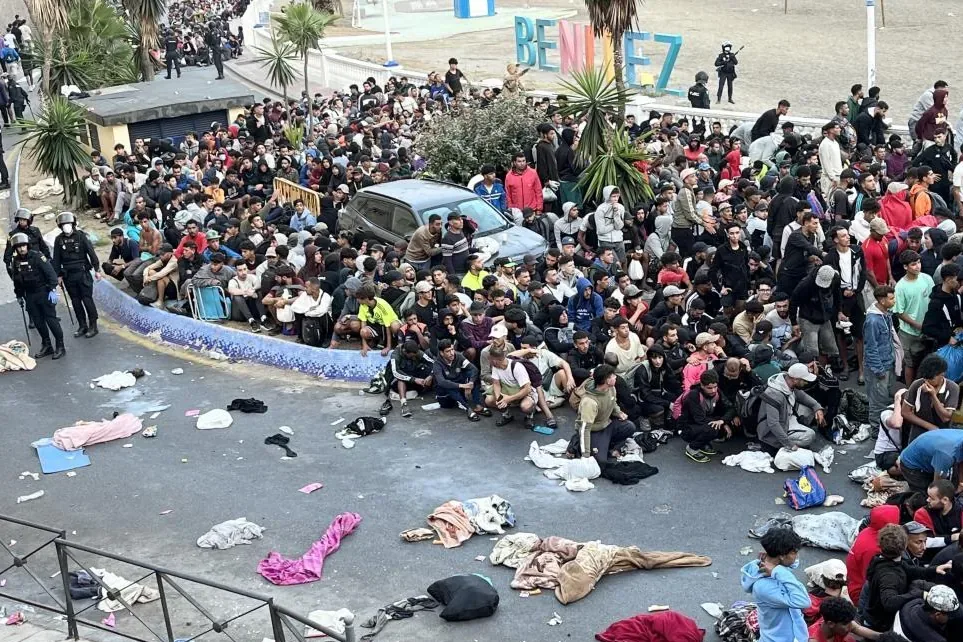
“They came out of nowhere,” explains to EL MUNDO a member of the UIP present in the immigrant transfer operation. The idea of the operation was to evacuate the western part of Benítez beach, occupied by more than a thousand people, whose makeshift tents extend along the breakwater to the desalination plant that separates it from Trampolín. This police officer was among the thirty or so personnel who escorted about fifty people back to the beaches. “Thank you for your work,” shouted a Ceutan who crossed paths with the convoy.
Ahmed, one of the occasional residents in a tent on Benítez beach, did not even try to go to the camp. When he saw the crowd, he decided to stay in his space. Although he understood some Spanish, he wanted to speak through ChatGPT to understand the questions. He smiled nonstop despite also having lived for a long time in inhumane conditions. That camp was the opportunity for 1,700 of them, but the truth is that the number of migrants wandering around Ceuta is much higher than officially reported.
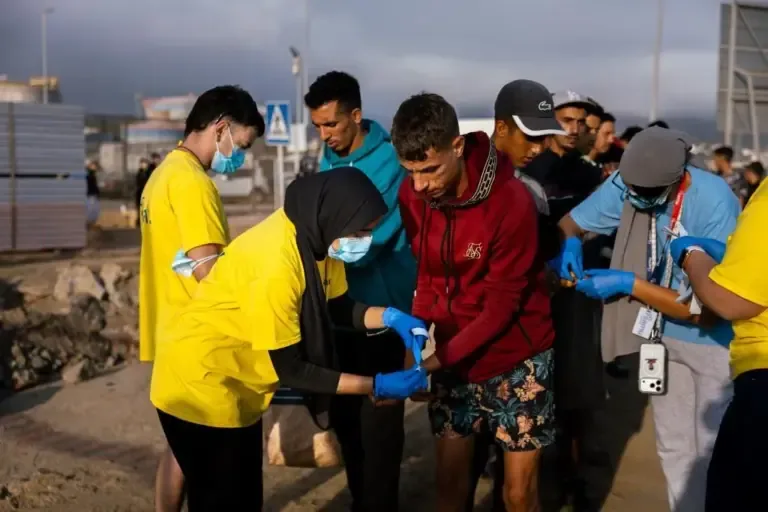
There are 6,000 places enabled in the temporary reception spaces. These are places that the authorities consider “indispensable” so “these people are well attended to in confined areas,” “to be registered,” and “to start the return procedures.” After the operation, the beaches of Trampolín and Benítez remain as occupied as they were 24 hours ago.
Read more Yes, ask Vivas
The operation lasted about five hours. It ended mid-morning and involved personnel from the National Police, the Civil Guard, and the Army. Vehicles and members of these State Security Forces patrolled from Benítez road, which runs along the beaches of Trampolín and the beach of the same name, to Explanada de Poniente street, which runs parallel to the sea up to the west access of the port of Ceuta, through which the migrants entered. The route is a little over two kilometers.
Salvos in the air
The operation was led by members of the Police Intervention Unit and was carried out through containment (controlled groups) of about fifty migrants who advanced in stages to the final access point. At some point, due to the slow progress of the operation, the crowd’s eagerness caused some disturbances that had to be quelled with blank shots and some baton strikes. Several immigrants showed minor injuries from pushing and stumbling while continuing their advance. The Civil Guard also monitored the breakwaters where migrants tried to sneak into the crowd to not miss the opportunity to enter the camp.
Members of Civil Protection were also present in the operation, mainly taking care of minors who had also come with the crowd to the camp. The reception center is intended only for adult males, unlike what happened in Loma Colmenar, where unaccompanied minors were initially accommodated.
At 2:00 p.m., several migrants who had not been able to enter the camp returned with supermarket bags full of supplies, mainly bread and water, waiting for a new opportunity or a solution. On that route, a Ceutan received and responded to insults from several residents of Benítez beach when they reproached him for filming them. “We are in Spain and I film wherever I want,” he replied to another who scolded him for his attitude. It has been 50 days since the “invasion” of a number of people almost equal to the population of the autonomous city, and although many returned, the patience of the population is beginning to run out because they are aware that the number of those who stayed is greater than what they are told. 13,000 according to the Government of the president of the Autonomous City, Juan Jesús Vivas.