







My mother told me many times that she had the feeling that I knew Diana better than anyone else in the world. We both grew up together and were the youngest in a house divided by divorce and marked by the sadness of the death of a brother.
However, when, as often happens, I am asked: “What did it mean to grow up alongside Diana?”, my first thought is always “But I don’t know what it means not to grow up with her.” We shared a roof every night for the first seven years of my life, more or less, and lived together for the vast majority of the holiday periods of our boarding school until Diana turned 16 and I was 13.
In many ways, our relationship was the typical one between an older sister and a younger brother. She was almost three years older than me and I, being a boy, was always noticeably less mature. The Swan Song is a book that stems from my deep admiration for her, especially considering the dynamics of Park House, the home where we had a tremendously happy childhood and where she was not only my constant companion but also, in some respects, my main caregiver. Often, in her later years, she joked when greeting me or referring to me in front of others as “little brother,” even after I had grown 15 centimeters taller than her.
Diana always had a strong maternal instinct. When our mother left home, she was more attentive to my needs than would have been expected of an older sister in other circumstances. According to what I have heard from the adults around us at that time, although she might have outwardly shown great annoyance at having to spend even more time with her little brother, Diana almost always enjoyed my company.
We were both quite reserved with strangers and extremely sociable with friends. We shared a natural tendency to stubbornness when pressured, especially if we considered the reason unfair. We tended to protect each other, often with tooth and nail. We created a very strong initial bond.
The discordant note, which transformed our sibling relationship into one so uncommon during the second half of her very brief life, was her marriage to a member of the British royal family. When, in 1981, she appeared dressed as a bride in St. Paul’s Cathedral, she walked down the aisle arm in arm with our father as my sister and emerged before the crowd that acclaimed her as the princess who had captivated the entire world. People wanted a fairy tale, and that morning Diana was named the heroine of a global fantasy. No one knew it at the time except herself, but her reality was quite different.
Many readers are too young to remember her as she was. For them, her identity is reduced to a pretty face from history; a tragic figure from the past who, although touched by the mantle of royalty, died in a car accident, as unfortunately happens to a million people every year. Thinking of those people, in The Swan Song I set out to develop the true fabric of Diana’s existence, so they can appreciate her more fully.
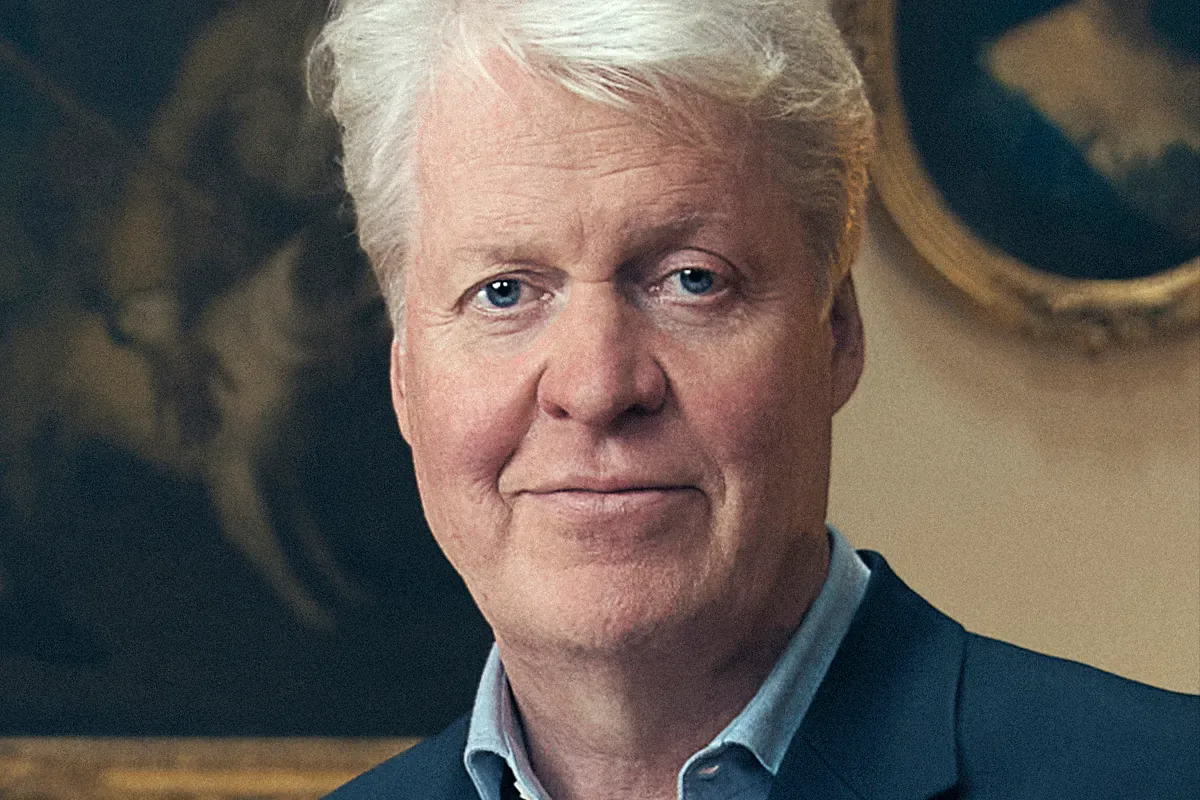
The book The Swan Song. Diana, My Sister, by Charles Spencer, is published on September 23 (Plaza y Janés).
As for readers over 30 years old, I have explicitly linked different chapters of her life to phrases from my eulogy: the speech I wrote in her memory during the days following her death and delivered at the funeral held the following Saturday. To that older group, some of the themes in The Swan Song will be familiar, but perhaps the perspective from which I approach them will be new.
In that funeral speech I wanted to speak for her at a time when she had been deprived of her own voice forever and so suddenly that she never had the chance to sing her swan song. I wanted to remind the world what Diana’s qualities were, as befits any good eulogist.
But I also hoped to mobilize the powerful people who could spare their beloved children the most gruesome details of her life. My main goal was to protect them from the torture she was regularly subjected to during her final years by the worst sectors of the media.
When Diana triumphantly entered the arena of life as a member of the royalty, I was just a 17-year-old boy, flooded with hormones and trapped in adolescent egocentrism. I was not very involved in what was happening outside my immediate environment and royalty had never interested me much, apart from its role as a powerful force in distant history, when it was the centerpiece of a broader human truth.
I don’t remember paying much attention to Diana’s social rise at that time. I think I simply took for granted that my older sister would fit quite well into her new role. I knew she was a good person, with a clear sense of what is right and what is not. One of her favorite expressions when someone made an unpleasant comment about another was “Don’t judge others based on yourself!” I loved that way of thinking and believed that such sensibility would be very useful in leading a life that, by all appearances, would be very different from the one we had both led in our original environment.
I also thought she would be welcomed in an atavistic institution that my family had served unconditionally for centuries more out of patriotism than flattery. The Spencers had traditionally been Whigs in the political sphere: they respected the Crown but were not afraid to demand that those who wore it act for the benefit of broader political and social interests, including their own.
All those thoughts ran through my head without me delving deeply into any of them. Basically, I believed my older sister would feel comfortable occupying a place that undoubtedly commanded much respect and would ultimately benefit the country.
At no time did it occur to me to think she would become a worldwide phenomenon, as indeed happened.
Many others, older than me, also underestimated Diana. They probably chose her as future queen because her background was suitable and because she was young enough to have no romantic past. Those things were much more important in 1981 than anyone today can even imagine.
But the great unknown at that time was the unique spirit that dwelled within her. She possessed an extraordinarily original strength that burst onto the world stage propelled by her charisma, adorned by her beauty, and sustained by an absolutely natural way of connecting with people. Such a combination was striking when it began to show and captivating when it fully unfolded.
Diana radiated star magnetism, but unlike a top actress or a pop diva, she never had to sell any product to stay in the spotlight. Although she entered royalty through her marriage, she enjoyed a unique rank and power destined to last until her last breath.
And that gave her another kind of value: the media one. Most of what was spread about her worldwide was very positive. Her wedding had 750 million viewers, but that was just the beginning. Throughout her life, she was on the cover of People magazine in the United States 45 times. Her funeral, watched by 2.5 billion people, is one of the most viewed events in television history.
All that was achieved by a young woman born into a discreet English aristocratic family, the third of the four surviving children of our parents. As such, she was probably destined to marry someone of similar background and enjoy the typical upper-class life, perhaps living in a large mansion and participating in some good work for the local community.
Instead, she caught the interest of the Prince of Wales. She took on an unprecedented modern position, since no one had been Princess of Wales since 1910. However, although she enjoyed extreme privilege, her role could have been undemanding and simply consisted of having children and supporting a few worthy and risk-free causes. She could have settled into a life of care and luxury, flattered by court members, while avoiding attention. But there was the possibility of doing much more, and that prospect better suited Diana’s personality and attitude. Settling into a life of useless pleasures was not in her plans. She was always willing to go beyond established limits to generate positive effects on those around her.
While her career, so to speak, developed naturally, her core values never wavered. She had grown up with a clear goal in mind: to marry for love. She was sure that was the most important thing to avoid divorce, which our parents failed to avoid, and to be able to devote herself body and soul to the children she always longed to have.
Everywhere it is said that Diana had an unhappy childhood. However, that does not correspond to the child I knew. My sister was the object of great parental love and, therefore, grew up secure in a mainly welcoming and affectionate home. Perhaps our parents did not often verbalize how much they loved us, because that is how people of their class and time acted, but we felt that they did.
She was also clearly happy with her schoolmates, despite carrying the terrible burden of undiagnosed learning difficulties that made her academic life a harsh landscape lacking guidance.
In a way, the goal of The Swan Song is to tell the truth about Diana from a brother’s perspective, just as I tried to do when I spoke at her funeral. She deserves my greatest efforts in view of the large number of inventions and simplistic half-truths told out there. I have never read a biography of hers, but what has reached me in brief excerpts through newspapers does not correspond at all to what I knew and know. All of it stands out for its great inaccuracy.
So, why write this now? With the thirtieth anniversary of her death in sight, I have again repeatedly declined countless invitations to appear in documentaries about her; and I thought: “You know what? Instead of considering just appearing on a program that will undoubtedly follow the usual biased pattern and adapting to the agenda set by a producer I will never meet, or by a TV channel I will never watch, I will tell things as I remember them and make them clear once and for all.”
As with my eulogy, I want to speak on behalf of Diana. I do so in an openly positive way. I am not going to analyze in detail every aspect of my sister’s life with the intention of criticizing, and my mood in this regard is far from pretending she was perfect. Of course she was not, as I frankly acknowledged the day I delivered the speech. However, I am clear that many of the aspects that led to her breaking with those around her, including me and the rest of the close family on many occasions, have their origin in the unparalleled pressure she had to endure during her years of fame. Many of those stressful situations were unbearable, and I applaud her for having endured them. Given the circumstances, she could hardly have done better.
I also want to do this because I am over 60 years old and increasingly aware of my own mortality, since neither my father nor my mother reached 70. Without intending to be dramatic, I don’t know how much time I have left to tell this story, so I have no doubt that my duty is to leave it written, as my own swan song.
I am the author of eight history books and a volume of memoirs, but this is the work that matters most to me. In a way, it is as if the nine previous publications had guided me here without me realizing that inevitable progression before.
I hope this book interests all those who still fondly remember Diana in life, and I would love that, after reading it, those who were too young to remember her in her best years feel that they finally understand who she really was: a unique person full of vitality, love, charisma, and insecurities who lived life with extraordinary intensity and left the world much better than she found it, despite having left it too soon.
She achieved all that despite not having experienced the kind of deep love she always longed for. For that, she deserves respect and applause, and I offer her both in the pages of The Swan Song.
———
Excerpt from the introduction of Charles Spencer’s book ‘The Swan Song. Diana, My Sister’.