




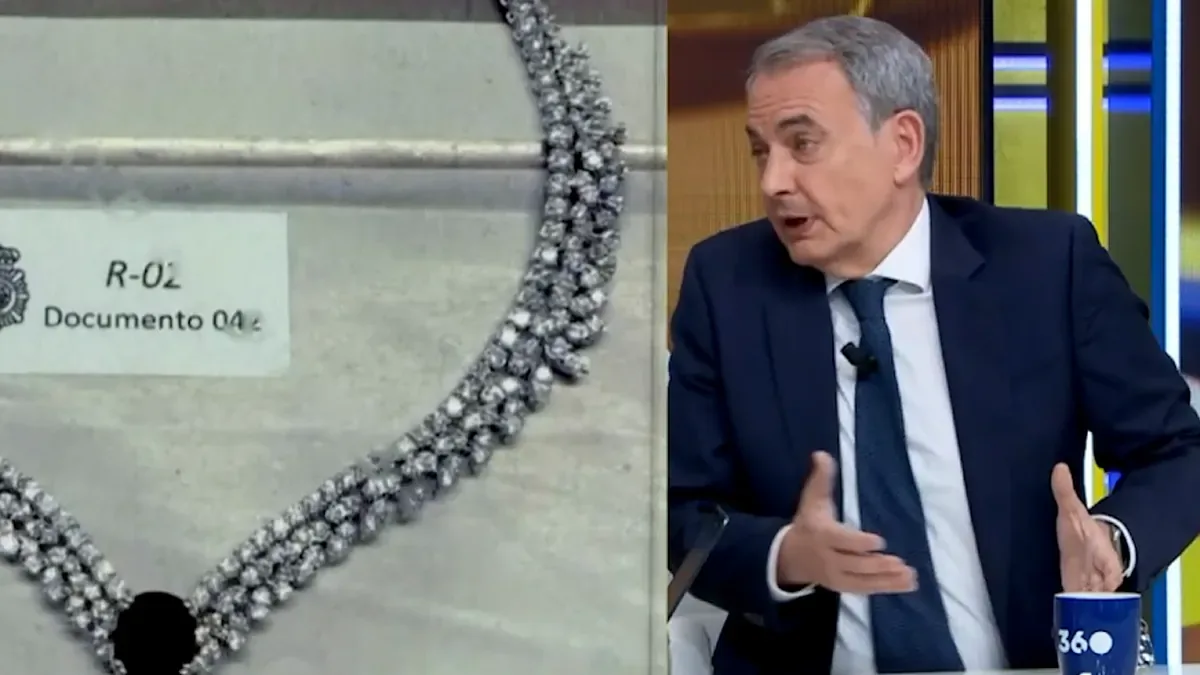
The Anti-Corruption Prosecutor’s Office has requested an extension of the study on the millionaire jewels that former Prime Minister José Luis Rodríguez Zapatero kept hidden in a safe in his official office, located on Ferraz street, in Madrid.
According to fiscal sources informed EL MUNDO, the prosecutor of the Plus Ultra case, Elena Lorente, has sent a letter to the National Court magistrate José Luis Calama to order the Ansorena jewelry store to expand the gemological analysis of the pieces it valued in a preliminary study at 1.3 million euros.
The Public Prosecutor’s Office wants to know two questions that it does not consider answered in the valuation made by the aforementioned auction house. On the one hand, it seeks to ascertain the current market value of the jewels (Anti-Corruption suspects that the price of the loot is much higher than the provisional figure of 1.3 million euros given by Ansorena) and, on the other hand, when these high jewelry pieces were set. In other words, the prosecutor asks the judge to extend the study with the aim of determining, by gemological experts, the date of assembly of the high jewelry pieces that were seized on May 19 by the Economic and Fiscal Crime Unit (UDEF) in this corruption case.
Among the multiple jewels that the former Prime Minister and former PSOE Secretary General kept in a safe in his official office in the capital were emeralds, rubies, and sapphires of high economic value. For example, there was a white gold necklace “studded with diamonds” and topped by “two natural emeralds” originating from Zambia, valued by Ansorena at 278,000 euros. The former PSOE leader also kept another 18-carat white gold necklace with “13 sapphires” from Thailand and diamonds, which was valued at 220,000 euros, as well as a third necklace of natural rubies and brilliant-cut diamonds valued at 155,000 euros.
When issuing its valuation last June, the Ansorena auction house – which had to request the help of the Spanish Gemological Institute – acknowledged that the valuations they had carried out on 103 pieces corresponded to the “replacement value” of the jewels. It added that this is a type of quantification that is usually “requested for the inclusion of jewels in insurance policies” and, therefore, with “moderate prices”. The jewelry store itself warned that the commercial margins of each establishment may “not adjust to average market values and offer some differences”.
When former President Zapatero was summoned as a defendant to testify before the National Court on June 17, he refused to give explanations in court about the jewels. This silence, prolonged for weeks, constitutes for investigators a “very powerful indication” against the defendant who, for now, is clearly unable to prove the lawful origin of the jewels.
The sources of the case consulted recall that the doctrine of the European Court of Human Rights, reflected in multiple judgments by the Supreme Court, holds that such silence can reinforce indications of criminality against an investigated person. “The European Convention does not prohibit taking into account an accused’s silence to declare him guilty, unless his conviction is based exclusively or primarily on his silence (…). National courts convincingly established a set of evidence corroborating the applicant’s guilt, and his refusal to give explanations about the origin of the money, when the situation demanded an explanation from him, only served to reinforce that evidence,” the Strasbourg Court ruled (case Zschüschev v. Belgium).
Yesterday, in an interview with TVE, Zapatero referred to this matter and said that the jewels were a “courtesy gift” and that “they were there and that’s it.” “They had no use or destination, nor did we think about them, nor about the value that has been attributed, which by the way will be subject to contradiction,” added the former head of the Executive.
After receiving Ansorena’s preliminary valuation, valuing the jewelry pieces at 1,323,915 euros, instructor Calama quickly opened a separate investigation into the former PSOE leader for tax fraud and smuggling. The magistrate argued that the possession of high-value luxury goods, coupled with the absence of fiscal traceability regarding their acquisition, constitutes “an objective and rational indication of the possible existence of significant tax fraud, inasmuch as the acquisition of jewels of the indicated value necessarily generates tax obligations, either as VAT, Property Transfer Tax, Inheritance and Gift Tax, or Personal Income Tax, depending on the nature of the legal transaction.”
In that order, Calama also argued that Zapatero’s actions could fit into a crime of smuggling in relation to articles 2 and 3 of Organic Law 12/1995, on the Repression of Smuggling, “insofar as the introduction, possession or circulation in national territory of jewels whose global value amounts to approximately 1,323,915 euros, without accreditation of the payment of customs duties, special taxes or taxes associated with their import, constitutes an objective indication that such goods could have entered the customs territory of the European Union by evading the required controls and tax obligations.”
The magistrate is currently awaiting a response to the new request for diligence from Anti-Corruption regarding Zapatero’s jewel loot.