




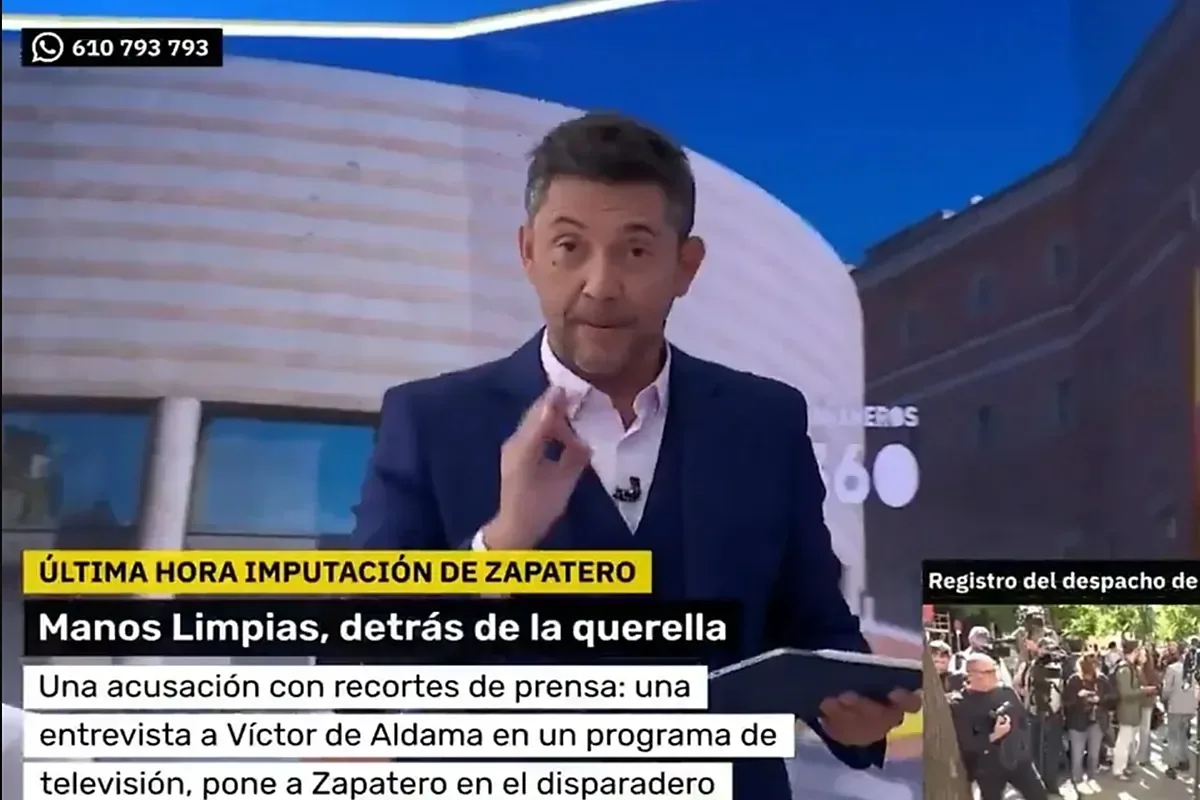
The TVE News Council has issued a harsh report on the coverage that various RTVE programs gave on May 19 regarding the judicial investigation involving former Prime Minister José Luis Rodríguez Zapatero. The body considers that, especially Mañaneros 360 and, to a lesser extent, La Hora de La 1, violated the principles of journalistic rigor set out in the Style Manual, the RTVE Information Statute, and audiovisual legislation by broadcasting as the origin of the investigation a complaint from Manos Limpias from December 2025 without sufficiently verifying it and without subsequently correcting that information.
The document on the conclusions of the investigation, dated July 24 and accessed by this newspaper, was prepared following complaints received about the news coverage of that day and after reviewing the broadcasts of La Hora de La 1, Mañaneros 360, Canal 24 Horas, Telediario 1, Directo al Grano, Malas Lenguas and Telediario 2, as well as requesting explanations from the editorial heads of the different programs.
In its general conclusions, the Council holds that the information disseminated by some programs wrongly placed the origin of the investigation in a complaint filed by Manos Limpias at the end of 2025, when later the judicial order itself and the Verifica RTVE service confirmed that the investigation was earlier and responded to a request from France and Switzerland.
The report considers that this version “came solely from the Government” and was never explicitly attributed as such to the audience.
The CdI is especially critical of Mañaneros 360, a program presented by Javier Ruiz, understanding that it repeatedly opened its coverage with “a false hypothesis about the origin of this investigation,” giving great importance to a fact that was later proven incorrect. It also reproaches La Hora de La 1 for its presenter, Silvia Intxaurrondo, maintaining that thesis despite the fact that, during the broadcast itself, the court-specialized journalist Mateo Balín explained several times that the December 2025 complaint was subsequent to the investigation and, therefore, could not constitute its origin.
According to the News Council, both programs committed “errors in the information,” disseminated content “not substantiated or verified with a sufficient number of sources,” omitted identifying the source of that information, and furthermore, did not make any correction the following day, a circumstance the body considers “especially serious” given the public significance of the matter.
The report also insists that, in an event of such relevance, RTVE should have interrupted its regular programming to offer a special news report from the News Services, also extending the duration of the Telediarios, instead of leaving the main weight of the coverage to current affairs programs. A reflection that links to one of the recurring criticisms of the CdI about the editorial separation between magazines and the corporation’s News Services.
Silvia Intxaurrondo’s warning to the CdI
During the investigation, the TVE News Council sent several questions to the heads of the programs involved. In the case of La Hora de La 1, only its director and presenter, Silvia Intxaurrondo, responded, defending that the information broadcast was “verified” and supported by judicial documentation.
In an extensive response sent to the CdI, Intxaurrondo maintained that the procedure leading to the investigation of Zapatero could be traced back to proceedings initiated in 2021 based on a complaint from Manos Limpias, so she considered the statement that the case originated from that organization in procedural terms to be “correct.”
“We do not agree that it was erroneous or unverified information,” said the journalist, arguing that “the statement that the case originates from Manos Limpias was duly verified.” Her letter concluded with a phrase directed directly at the Council: “Having clarified the matter, I believe those who should correct are you.”
Read more Trump orders to stop bombings against Iran to negotiate a deal
The Council, however, rejects that argument. In its report, it states that the explanation provided by Intxaurrondo refers to a different complaint than the one mentioned during the May 19 broadcast and regrets that she did not answer the questions posed about the specific coverage of that day. Furthermore, it insists that the only known source to support the thesis disseminated then was the Government and that this circumstance should have been made explicit to the viewers.
The exchange did not end there. When the News Council replied that her letter did not answer the questions posed because it referred to a different complaint than the one dealt with in the May 19 broadcast, Intxaurrondo responded: “If you read with some attention, you could understand it is the same.” She also requested that all correspondence be made public to RTVE employees so that “everyone can draw their own conclusions.”
The management of Mañaneros 360 did not send a specific response to the News Council. The body only received a generic reply from the Magazines director, Esther González Garín, who spoke on behalf of all current affairs programs and who, according to the report itself, “does not answer most of our questions.”
González Garín avoided answering the Council’s questions one by one and defended the work done by the teams of La Hora de La 1, Mañaneros 360, Directo al Grano and Malas Lenguas. She argued that the coverage was live, while a complex judicial resolution was progressively becoming known, and reminded that case law does not require absolute accuracy but professional diligence in verifying information. She also highlighted the good audience results of all those formats and RTVE’s recognition as a credibility benchmark.
In response, the Council states in its report that it “understands” the difficulty of reporting in real time but considers that precisely this complexity made it even more necessary to intensify verification before presenting as fact information that was later revealed to be incorrect. It also rejects that audience data can be used as an argument to justify the detected errors.
Against the objections directed at current affairs programs, the report clearly distinguishes the work done by the News Services. The CdI concludes that both Telediario 1 and Telediario 2 offered coverage that was “relevant and accurate,” never attributing the origin of the investigation to the Manos Limpias complaint of December 2025 nor giving it newsworthy relevance.
It also generally considers the performance of Canal 24 Horas correct, although it understands that at some points in the morning it could have better clarified the context of the investigation.
The report thus again highlights the rift that the News Council itself has been denouncing for months between current affairs programs and RTVE’s News Services. An editorial difference that, in the professional body’s view, became evident again during one of the most relevant news days of the year and leads to a clear recommendation: that current affairs news programs “depend directly on the News Directorate” and be fully integrated into that structure to guarantee a single criterion in covering events of special significance.