



Everything was merriment on Madrid’s Paseo de la Castellana. Tens of thousands of young people sang, chanted, and enjoyed the surroundings of Lima Square from half past four in the afternoon, waiting in communion and with patience for the Holy Father. Officially, the organization reported that 240,000 people had signed up for the vigil prior to Corpus Christi; however, they assumed that two-thirds do not sign up for these events and go independently, so easily half a million people gathered at the youth event, which closed the Pope’s first day in Spain.
It was half past six in the afternoon when the musical performances began. An hour and a quarter of entertainment that closed with Antonio Banderas’s Samaritan of Godspell. Then, after the fun, spirituality began. The Virgin of Almudena appeared in procession and all the faithful together prayed a rosary: 65 prayers in five mysteries in which each participant placed their intentions at the feet of Madrid’s patron saint.
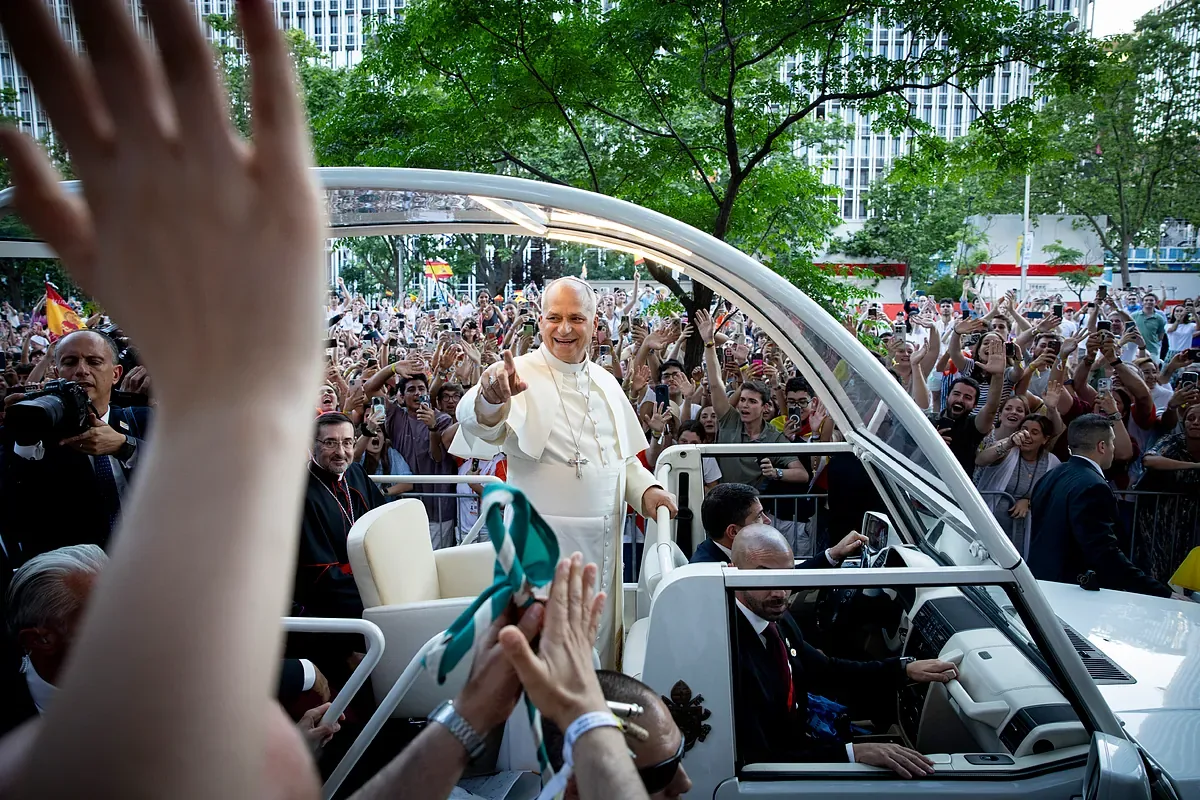
At half past eight in the evening, the Holy Father appeared aboard his popemobile. The fervor turned into madness as Robert Prevost traveled along the central lane of Paseo de la Castellana. It was an act to get closer to young people after there had been a surge in Spain of people declaring themselves Catholic for the first time in decades, and they wanted to make it dynamic in a kind of conversation between Leo XIV and the boys and girls present. And the Pope had a clear message, a mission for them: “Be human. Not appearances without reliable faces.”
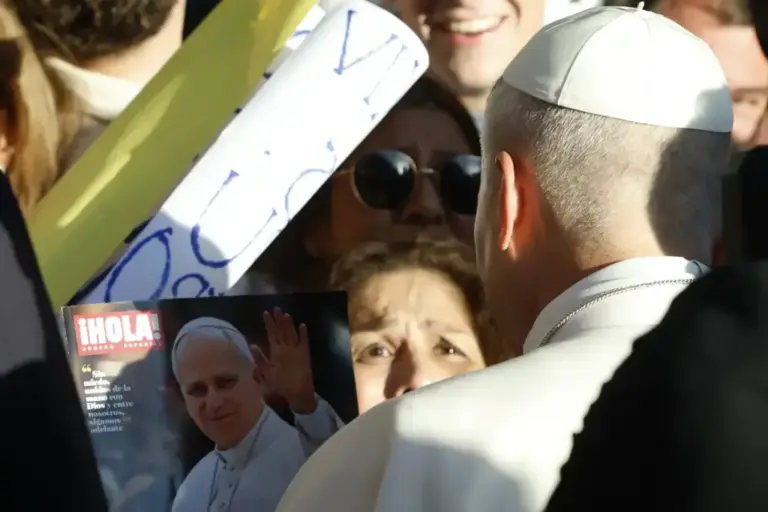
Leo XIV took more than 20 minutes to reach the main stage. Along the way, thousands of young people chanted: “This is the Pope’s youth!” Almost every minute, babies were brought to him for the Holy Father to bless them. The first one he touched on the forehead was only a few days old. In total, 21 more children were brought to him.
The Vatican presented this event as a conversation with the Holy Father, a kind of interview. Thus, the Pope was asked about other saints who were references for him besides Saint Augustine. In a very thoughtful answer, he listed three: John Chrysostom, one of the Church Fathers; the Spanish Tomás Villanueva, an Augustinian named bishop of Valencia by Charles V who reformed part of the clergy: “His charity encourages me in times of trial,” he assured. And, finally, the Spanish missionary Toribio de Mogrovejo, who dedicated himself in Peru to the evangelization of the Indians: “Saint Toribio united an intense life of prayer with a commitment to justice, especially against the abuses and corruption of his time,” he explained to the young people.
In addition to the saints, the Pope assured that from the years lived in Peru he remembered “above all the testimony of faith of the people, marked by many difficulties, but full of hope.” Thus, he assured that “the encounter with the wounds and joys of the people made me grow in the path of following Jesus.” That time, he assured, helped him experience that “the word of the Lord brings peace where there is conflict and becomes, for everyone, a source of reconciliation and justice.”
They then asked him about how to find God’s voice and how to accompany others in their process of searching for faith. It was here that the Pope directly addressed the youth. Leo XIV assured that to “recognize the voice of God, silence can help us above all, as it favors attention and recollection.” He explained to the boys and girls that “when we seek silence, we decide what not to listen to and from what noises not to let ourselves be distracted. By freeing ourselves from the din of a thousand voices, we recognize that some deceive our desires, others buy us without nourishing us, others speak out of self-interest. In silence, we understand that ideologies pass, while truth remains,” the Pope recalled. “Many times we go with headphones, with music, with distraction, but we don’t know how to be in silence, and it is in the experience of Silence that God can speak to us,” he insisted
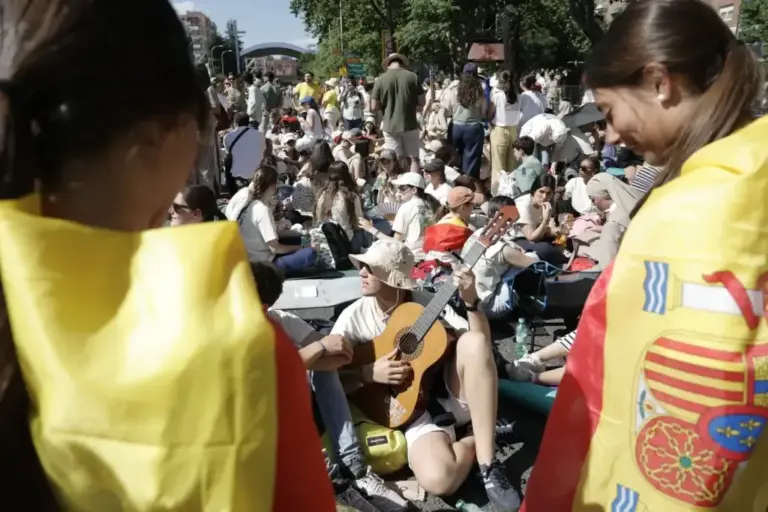
Next, he encouraged young people to share their spiritual paths “by bearing witness to him with consistency of life: the will to follow Jesus will constantly renew you, especially in times of weariness.” The Pope did not cease to encourage young people on the path of apostolate: “If you pray with love, young people will appreciate the importance of prayer. If you burn with faith, you will transmit its living fire. If you remain faithful to your vocation, you will reflect its attractive grace. Therefore, educate in discernment, knowing that every virtue is transmitted in a bond of listening that becomes dialogue,” he affirmed.
Finally, they asked him how young Christians can live committed to society and what specific mission he asked of them as the main representative of the Catholic Church. “Young people, you are called to give a new direction to society, becoming protagonists of change starting from your daily bonds, what you experience in the family, at university, and at work. Seeing you, dear young people, full of this enthusiasm motivated by faith, it excites me to think about your capacity to bear witness to Christ in the world, including the digital reality, to communicate the values and beauty of the Gospel,” the Holy Father assured.
Finally, Leo XIV insisted to the young people on being joy: “When life tastes of nothing, it is as if it were snatched from us: we no longer feel it is ours. Faced with the emptiness of indifference and conformism, faced with the violence of war and lies, be yourselves a spark of a new humanity.”
Then the Holy Father wanted to conclude his words with a direct message to the young people: “The mission I entrust to you is precisely this: be human. Yes, be human!: men and women of flesh and blood. Not appearances, but reliable faces. People who seek justice because they hunger for it, like daily bread. People who desire an honest and upright life, because they gladly do for others what they would want others to do for them.”