




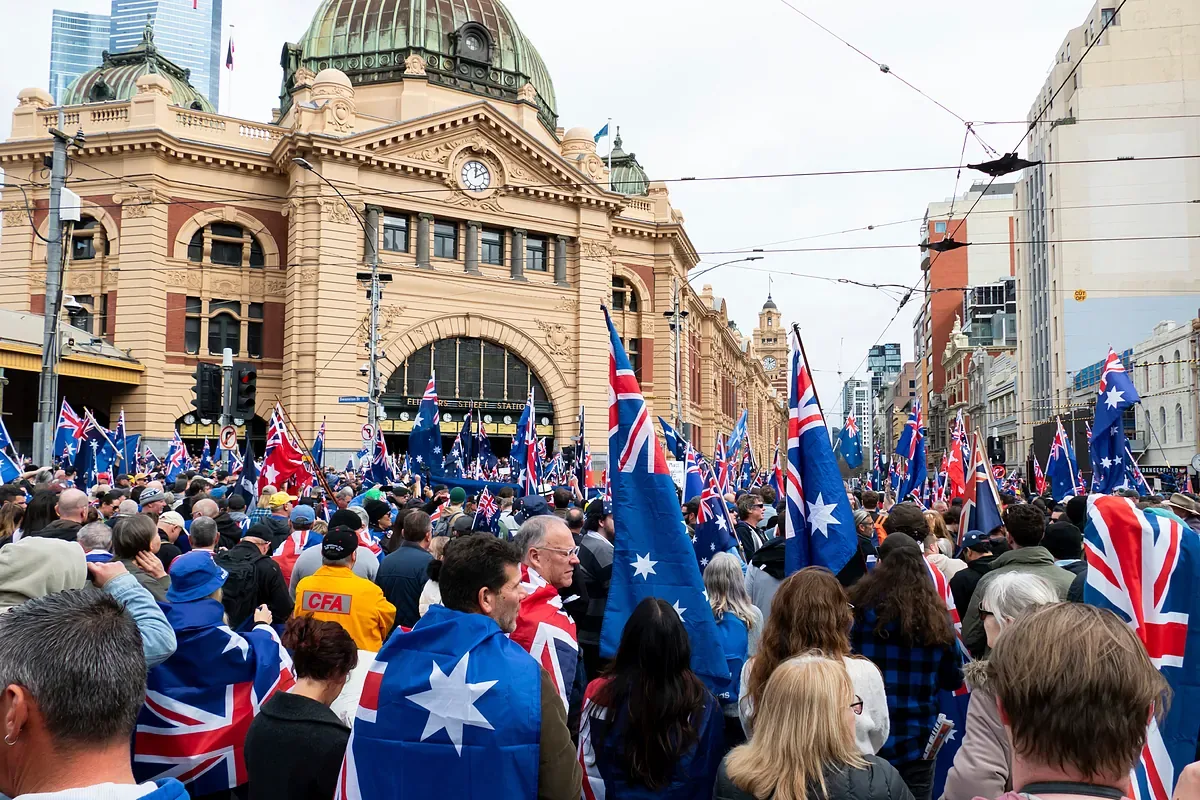
At first glance, Australia seems like one of the great successes of multiculturalism. Almost a third of its inhabitants were born in another country, and in cities like Sydney or Melbourne, around 300 languages are spoken. For decades, the nation has built an identity based on immigration and the promise that it was possible, though not easy, to start a new life in the antipodes. However, beneath that unmistakably cosmopolitan image, a question periodically arises that many Australians believed was resolved: who really belongs to Australia?
Read more Failed neighbor, abandoned children, real indifference
The controversy sparked this week after the release of a video in which a man made racist comments to an Australian family of Chinese origin has added fuel to a debate that goes far beyond an isolated episode.
The events took place in a park in Sydney, when a couple born in China, with Australian nationality, and their daughter—born in Australia—experienced a situation that made them fear for their safety, as the mother confessed. A man was walking his three dogs off-leash when one of them approached the little girl, who was on her bicycle, and instead of calling his pet back, the owner scolded the girl. When the couple started recording, the man urged them to leave “back to China” and return “to their prison.”
The experience has been widely shared on social media and shows how this hateful comment still resonates in a country whose modern history is marked by deep contradictions regarding identity, immigration, and race.
For much of the 20th century, Australia made exclusion a state project. The so-called White Australia Policy, approved after Federation in 1901, limited the arrival of non-European immigrants for decades with the explicit goal of preserving a predominantly white and specifically British nation.
This policy did not explicitly prohibit entry based on race, although there were more subtle forms of discrimination that ultimately achieved the desired result of having a white Australia. It was implemented through a dictation test in which officials could require a person to write a passage of 50 words in any European language that the official knew the candidate did not speak. This system ensured that those who did not meet the government’s criteria failed the test and faced denial of entry or deportation.
Although that legislation was dismantled between the late 1960s—when migrants’ skills began to matter more than race—and the early 1970s—when racial distinctions in immigration and citizenship were abolished—its legacy never completely disappeared. Rather, it remained latent and reappears in times of economic uncertainty, migration pressure, or election campaigns. Australia is currently going through one of those moments.
The migration and political climate
After the pandemic, the country recorded record immigration numbers to cover the labor shortage and sustain an economy in need of skilled workers and international students. According to the Australian Bureau of Statistics, between 2022 and 2023, international migration contributed a net increase of 518,000 people to the total population of 28 million. This was the highest estimated net international migration figure since records began over a century ago.
At the same time, as in other Western countries, the housing crisis, rising cost of living, and pressure on infrastructure and public services have fueled an increasingly widespread discourse blaming newcomers or Australians of international origin for problems whose roots are much more complex. In this context, migration has ceased to be seen solely as an economic driver and has once again become one of the most sensitive issues in political and social debate.
This tense climate is also reflected in politics. On Monday, the Federal Court of Australia confirmed that the leader of the far-right party One Nation, Pauline Hanson, violated the Racial Discrimination Act in 2022, following a comment on the social network X directed at Greens senator Mehreen Faruqi—born in Pakistan and naturalized Australian—telling her to “go back to Pakistan.”
Hanson appealed the ruling claiming it was a comment protected by freedom of expression, but the appeal was dismissed, and it was upheld that the message constituted a racist attack. After leaving the court, Faruqi said the ruling was “a victory for all people who have been made to feel that their belonging to this country is conditional.” She also added that “hate speech is not freedom of expression.” However, judging by the experience of the Aussie family with Chinese roots in a Sydney park on an ordinary Saturday, the ruling does not translate to the streets.
The decision comes at a time when Hanson, one of the harshest voices against immigration, is regaining prominence. In recent months, she has argued that Australia should restrict Muslim migration and, in a podcast with British far-right activist Tommy Robinson, attributed the increase in migrants to the abandonment of the White Australia Policy, although she denied wanting to reinstate it.
Support for One Nation, founded by Hanson in 1997, reached unprecedented levels in June, with between 26% and 31% of the primary Australian vote. These figures temporarily placed it as the most popular political force in the country, ahead of the Labor Party and the conservative coalition formed by Liberals and Nationals.
Support for multiculturalism remains the majority in Australia, although the coexistence between that diversity and growing economic anxiety is generating palpable tension.