








High Speed still has not managed to recover from one of the most serious accidents in its history. The impact caused by the derailment on January 18 in Adamuz (Córdoba) scared away its passengers not only in the first months after the accident but has left a more difficult-to-erase mark. The speed restrictions to review part of the 4,000 kilometers of tracks initiated by Adif after the rebellion of its workers have meant a loss of image that translates into fewer travelers. Beyond the impact of the accident in the first quarter, 1.22 million travelers stopped traveling on Renfe, Iryo, or Ouigo in the second quarter of the year compared to the same period in 2025.
And the tragic accident in which a Renfe Alvia train and an Iryo convoy collided, leaving a toll of 46 fatalities, uncovered a major crisis for the railway sector. Seven months after the event, the accident is still under judicial investigation and the crown jewel of national transport continues to deal with its aftermath.
After the accident, Adif was forced to partially halt the track as it passed through the province of Córdoba during February and March, in addition to decreeing temporary speed limitations on the Málaga network that significantly increased travel times and forced a considerable decrease in passenger flow during that first quarter.
However, the latest figures published by the National Institute of Statistics (INE) confirm that high-speed rail transport suffered a sharp decline, recording a rate of evolution that does not allow it to recover from this drop.
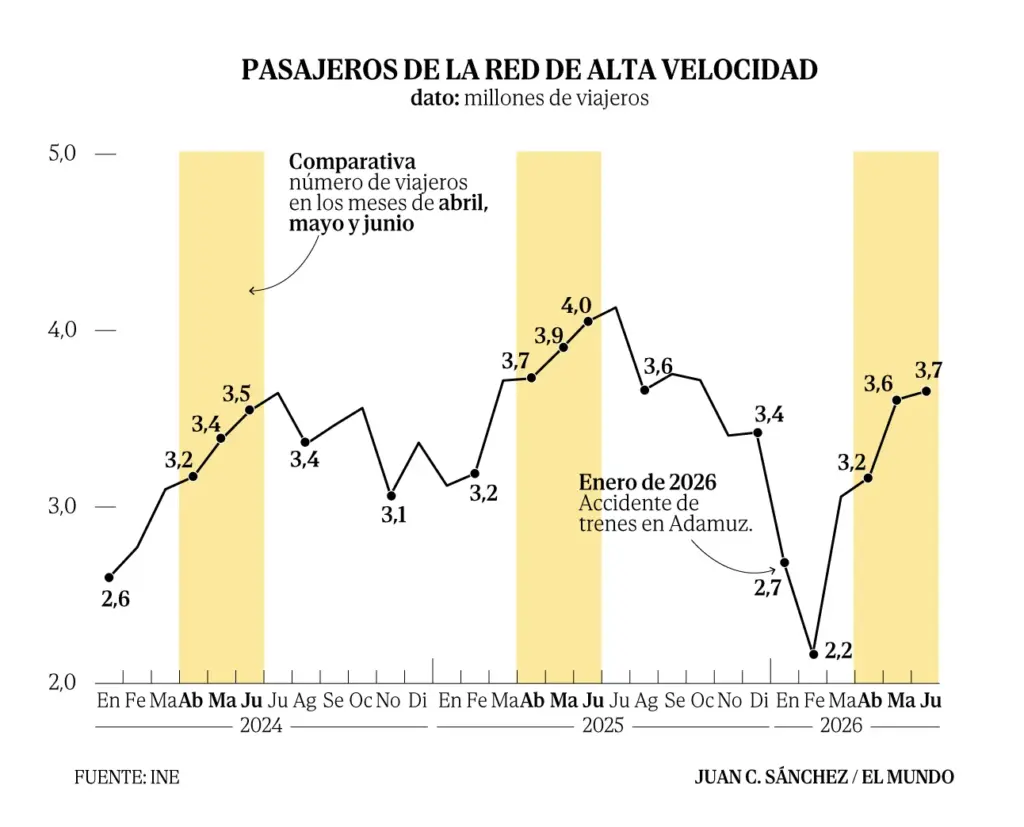
In the first quarter of 2026, the volume of high-speed passengers fell to 7.8 million travelers (a -21.26% compared to the 10,028,000 of the first quarter of 2025). The turning point was reached in February, the month in which demand hit bottom, registering barely 2.1 million users. It was expected that from the end of this period operators would begin to recover, driven by demand that leads other modes of transport such as air travel to record figures.
However, that recovery has not arrived. Between April and June 2026, 10.4 million passengers were transported, representing a decrease of -10.56% compared to the 11.6 million travelers in the same period of the previous year.
The crisis, which has lasted seven months, arrives in a tourist season projected to be record-breaking. The geopolitical instability derived from the war between the United States and Iran over the Strait of Hormuz has pushed thousands of international visitors to reelect Spain as their preferred vacation destination. To this situation, consequently, was added the high price of fuel, which theoretically should have encouraged the use of High Speed over private vehicles or airplanes; however, the “hangover” from Adamuz frustrated initially positive government forecasts.
The use of High Speed in Spain (which includes Renfe, Avlo, Ouigo, and Iryo) closed June with 3.6 million travelers. This translates into a loss of 396,000 passengers compared to the more than 4 million who used this service in June 2025, sealing a drop of -9.78%.
The Ministry of Transport itself, led by Óscar Puente, has had to face pressure from the unions SEMaf, CCOO, and UGT, which held up to three critical meetings in February to demand solutions to the lack of personnel and system maintenance. In the Congress of Deputies, Puente promised an ambitious fleet renewal with a million-euro injection of 1.2 million euros in Renfe rolling stock. This plan includes the arrival of 72 new trains for Cercanías, 24 regional trains, and 14 variable gauge convoys aimed at shielding regional and national connectivity, an attempt to recover the image of High Speed that has not yet succeeded.
While High Speed loses passengers, other alternative transport methods capitalize on the user exodus. The most evident contrast is found in intercity buses, whose use soared by 5.2% in June, surpassing 83.5 million travelers, consolidating as the preferred option for users who penalized the loss of punctuality and reliability of the railway.
Read more Spain suffers the most aggressive fuel price increase in 20 years for a ‘summer operation’