





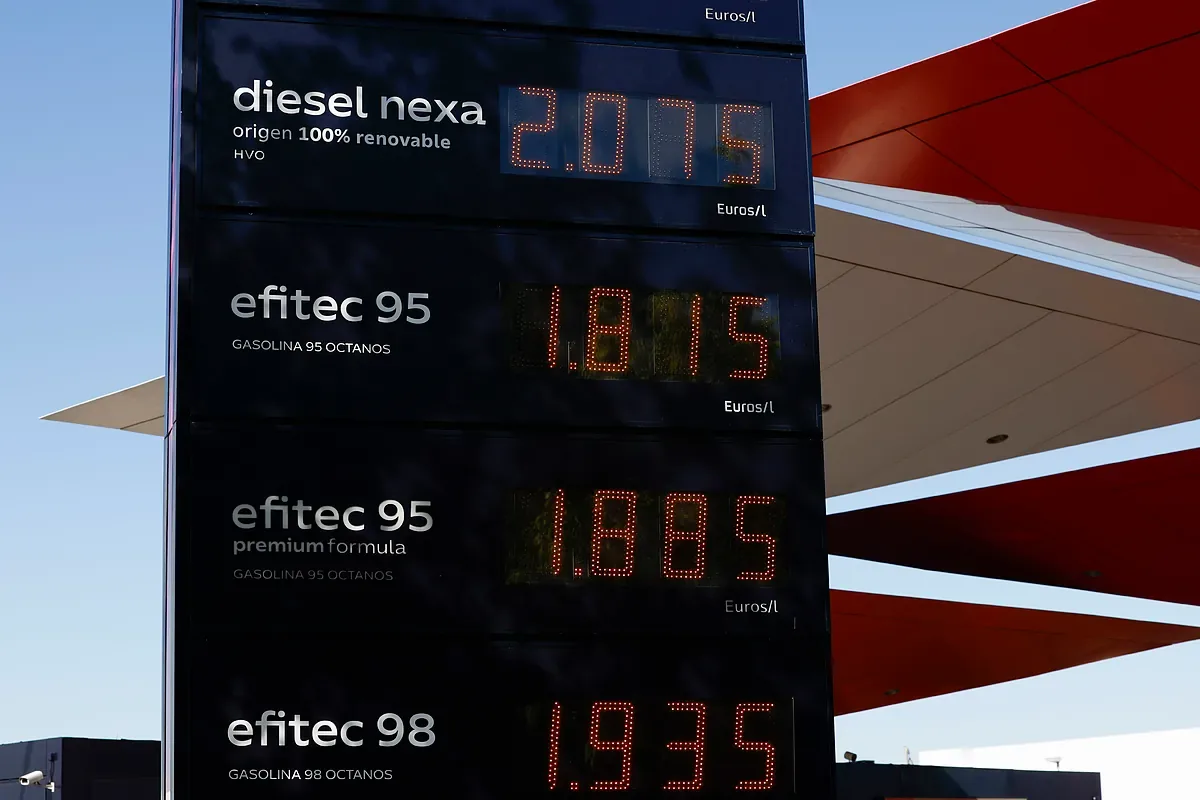
Bad news for drivers starting their holidays this August (and for those returning home). Filling up the tank is now almost 20% more expensive than at the beginning of July, marking the fifth consecutive week of rising fuel prices. It is the story of a predicted escalation. Transport employers and gas sector associations warned the Government in June that removing the tax cut on fuels activated due to the war in Iran would drive prices up during the ‘summer operation’. The result? The return of VAT on gasoline and diesel to 21% has triggered the most aggressive price rally of the last two decades between July and August, shaping the most expensive summer since the Ukraine crisis.
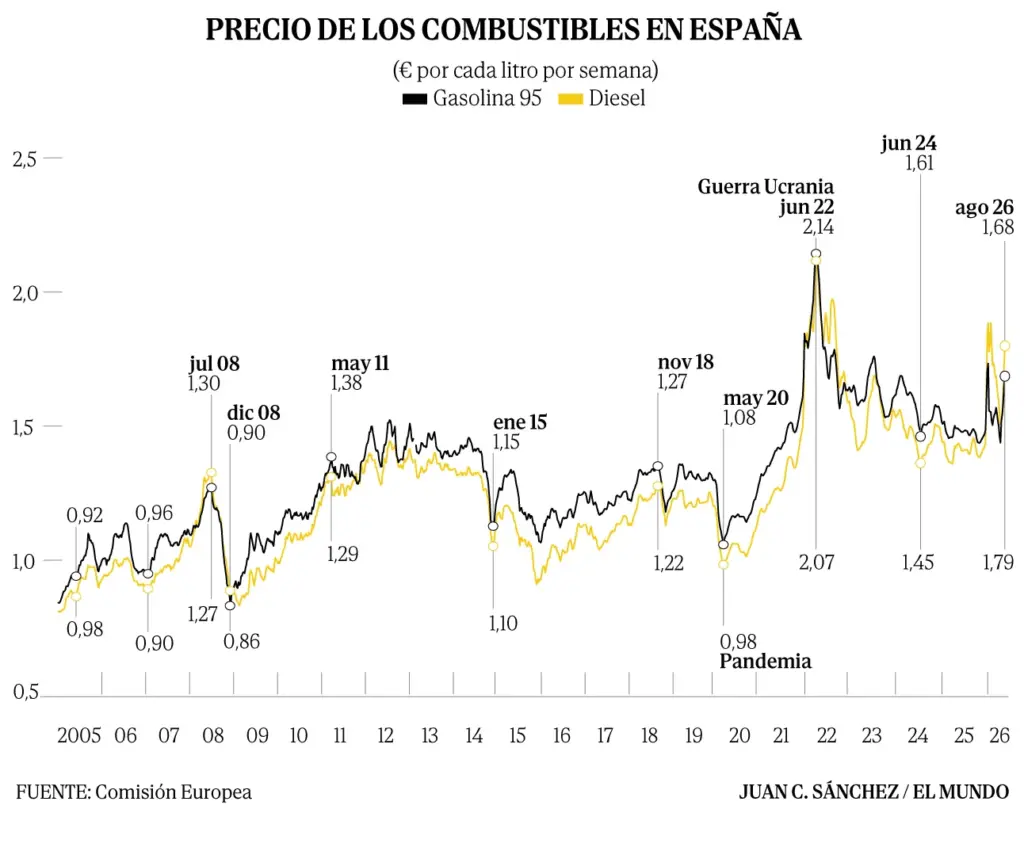
This was confirmed yesterday by the latest weekly update of the EU Petroleum Bulletin. Since June 29, the average price per liter of gasoline at Spanish pumps has increased by 25 cents, from 1.44 euros to 1.69. For diesel, the average jump has been from 1.50 to 1.79 euros, that is, 29 cents more. In percentage terms, this represents a rise of 17.3% and 19.3%, respectively.
The summer of 2026 has marked an absolute milestone in Spain: the most violent price increase in the entire historical series, three times sharper than any recorded so far in an equivalent period. In other words, in the last 20 years, Spanish drivers have never faced such a magnitude of escalation in the five weeks between June and August.
Despite the recent rise, final prices remain below the fateful 2022, when the war in Ukraine completely disrupted the European market. That summer, Spain started July with the liter of gasoline at 2.11 euros and diesel at 2.08. But even then, the summer trend was downward: in the first week of August both had already fallen below the psychological two-euro barrier. Today, four years later, that figure is hovering over the pumps again.
For a driver with an average tank (about 55 liters), filling the gasoline tank now costs 92.79 euros, compared to 79.08 euros at the end of June, almost 14 euros more in just one month. And the blow is even greater for diesel users, as refueling now costs 98.66 euros, 16 euros above the 82.72 it cost a few weeks ago.
This is the effect of an aggressively upward curve that, for now, shows no signs of exhaustion and has already placed diesel and gasoline at their highest levels for this time of year since the 2022 energy crisis. The peak also coincides with one of the busiest times on the roads. Just during August, the DGT expects 54.5 million long-distance trips.
TAX REBOUND
In the first half of the year, the conflict in the Middle East triggered a shock that remains latent in energy markets. Brent averaged 92 dollars per barrel between January and June, that is, 28% above the same period the previous year. Recently, the evolution of talks between the United States and Iran has brought crude below 80 dollars, a relief compared to the situation at the end of July, when it briefly surpassed the 100-dollar barrier again.
Read more Abelardo de la Espriella, a president willing to break all the molds in Colombia
Although crude has become cheaper since the first half of the year, drivers now pay more to fill their tanks. There are several reasons. First, decreases in raw material costs always reach service stations with a delay – unlike increases, which are immediately reflected on the price display. Partly because distributors sell a product affected by the geopolitical premium with some lag.
On the other hand, the cost of crude is only one component representing less than half of the price drivers pay for fuel; while taxes account for between 40 and 50% of the final cost. The latter have been especially relevant this summer.
On July 1, the VAT reduction to 10% that the Government activated in March to ease the effect of the Middle East conflict expired, a measure whose impact was estimated at 507 million euros. Additionally, the Government agreed to cut the special hydrocarbon tax (IEH) to the minimum allowed in the European Union, with an estimated relief of another 656.5 million.
The first measure ended on June 30, while the second. For the mentioned special tax, the Government agreed on a gradual reduction of the cut: to 15 cents in July, 10 in August, and 5 cents in September.
In short, the removal of this fiscal shield has caused a rebound effect at gas stations across the country. Added to this is the end of additional discounts that, alongside the Government’s lifeline, giants like Repsol or Moeve (formerly Cepsa) applied to cushion the impact of the war on their customers’ wallets.
Refineries boost margins on the eve of summer
- In the first half of the year, the war in Iran catapulted crude prices and strained the global supply chain. That context, which still sets the market pace, boosted the profitability of Spanish refineries on the eve of the ‘summer operation’. Repsol’s refining margin – the difference between the cost of processing crude oil and what is obtained from selling its derivatives – grew to 12.4 dollars per barrel, double compared to the same period the previous year (5.6 dollars). Meanwhile, Moeve reported a refining margin of 11 dollars per barrel, also above the average (7.9 dollars) recorded in 2025.
- The phenomenon is the result of higher price differentials for diesel, gasoline, or kerosene caused by the chaos in the Strait of Hormuz. And, to a large extent, it has driven the profits of the country’s two largest oil companies between January and June. Repsol increased its profits by 265% compared to the first six months of 2025. Moeve, for its part, achieved a net result of 641 million euros, that is, 2.7 times the figures from a year ago.