
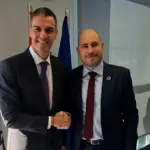


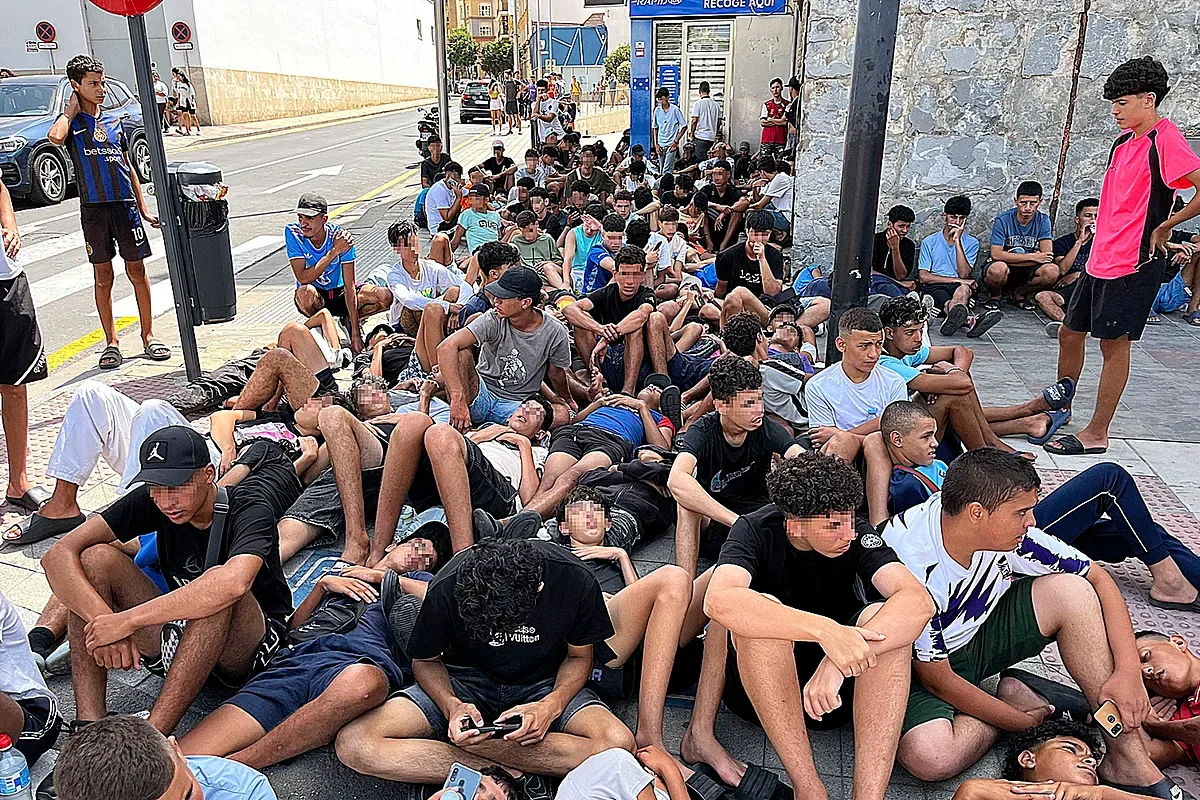
From the open dialogue with Rabat after the entry of 80,000 people into Ceuta, the Minister of Foreign Affairs, José Manuel Albares, praised yesterday that both countries are “committed” to “ensuring that every last person who has entered Spain irregularly returns to Morocco” – between 8,000 and 11,000 migrants would remain there, according to the Ceuta government -. However, Spanish legislation does not allow these returns to be carried out without first fulfilling a series of procedures and requirements that guarantee human rights, especially in the case of minors. The current regulations thus distance the feasibility of that repatriation of “every last person” who has entered Ceuta from finally becoming a reality.
Read more The Government now denies the «reception» of migrants and promises a tough stance to Europe
Minors
They are the most protected group, and for whom the repatriation procedure requires greater guarantees. The Minister of Territorial Policy, Ángel Víctor Torres, outlined the “family reunification” – that the boys and girls who arrived in Ceuta return with their families – as a “priority” the day before yesterday, but in parallel the Ministry of Childhood has initiated the process to relocate the 1,527 minors who remain in the city, aware that these “family reunification” processes take time and that not all children may be able to benefit from them.
The Immigration Law first establishes that in the case of “an undocumented foreigner whose minority cannot be reliably established,” child protection services must assist them, and the Public Prosecutor’s Office, together with health institutions, will initiate the process to determine their age. If, indeed, they are not 18 years old, the young person will be under the responsibility of child protection services.
At this point, it would still not be possible to initiate a repatriation procedure, but first it is necessary to obtain, from the country of origin, a report on the child’s “family circumstances.” If appropriate, then yes, the procedure will be initiated, which in any case must be individualized. The young person will be heard – if they have sufficient judgment – and child protection services and the Public Prosecutor’s Office will have to present their own analysis. With this, the State Administration will determine whether the return is appropriate or not, in which case Spain would take charge.
Albares assured yesterday that work is underway to return all migrants under the assumption that Morocco wants to receive them. However, this is not enough – the legislation is above, as he acknowledged – and, particularly in the case of minors, there is a precedent that confirms this. After the massive entry into Ceuta in 2021, “the minors – or at least some of them – were sent back to Morocco in groups of several dozen people” without evidence that an individualized analysis of their cases was carried out, “beyond taking note of the names,” pointed out the Supreme Court in the 2024 ruling that declared that return illegal – two senior officials were condemned -. It had been done under the 2007 Spanish-Moroccan agreement, but the High Court found it insufficient: above it was, and is, what the law establishes.
Read more Cover of EL MUNDO on Wednesday, August 12, 2026
Adults
The procedure is different in the case of adults – faster – although there are also migrants over 18 who may have the right to stay in Spain: those who are granted international protection – asylum -. “The first thing the Government has to do is to carry out triage,” explains Patricia Fernández, from the Pro Human Rights Association of Spain, and she explains that at this first point the aim is to “detect vulnerabilities” and two channels are opened, depending on whether the migrant states that they want to apply for international protection. If their intention is to seek asylum, all possibility of return is halted until the application is resolved. And, if they are ultimately granted it, they cannot be repatriated. Fernández points out that among the migrants still in Ceuta there are “clear cases of international protection,” such as “almost 600 Sudanese” or “almost 200 Yemenis.” People who, therefore, are likely to be granted asylum and be able to stay.
If the migrant does not apply for international protection or is not granted it, then a “return procedure” is initiated. For the evaluation of the case, the person must have, Fernández explains, legal assistance and an interpreter if required. If the authorities decide that the migrant should be returned to the country of origin, “that return decision must be executed within 72 hours” – counted from the start of triage, not from their entry into Spain -, as this is the maximum time for preventive detention. If it is not possible to carry out the return within that time, the migrant would be transferred to a Foreigners’ Detention Center (CIE) until they can be repatriated.
Thus, for every circumstance, the procedure is detailed in the law. And Rabat’s willingness to receive its citizens is, therefore, subject to the regulations.
Read more Jódar surpasses Fils and will compete in Montreal in his first Masters 1000 semifinals


