




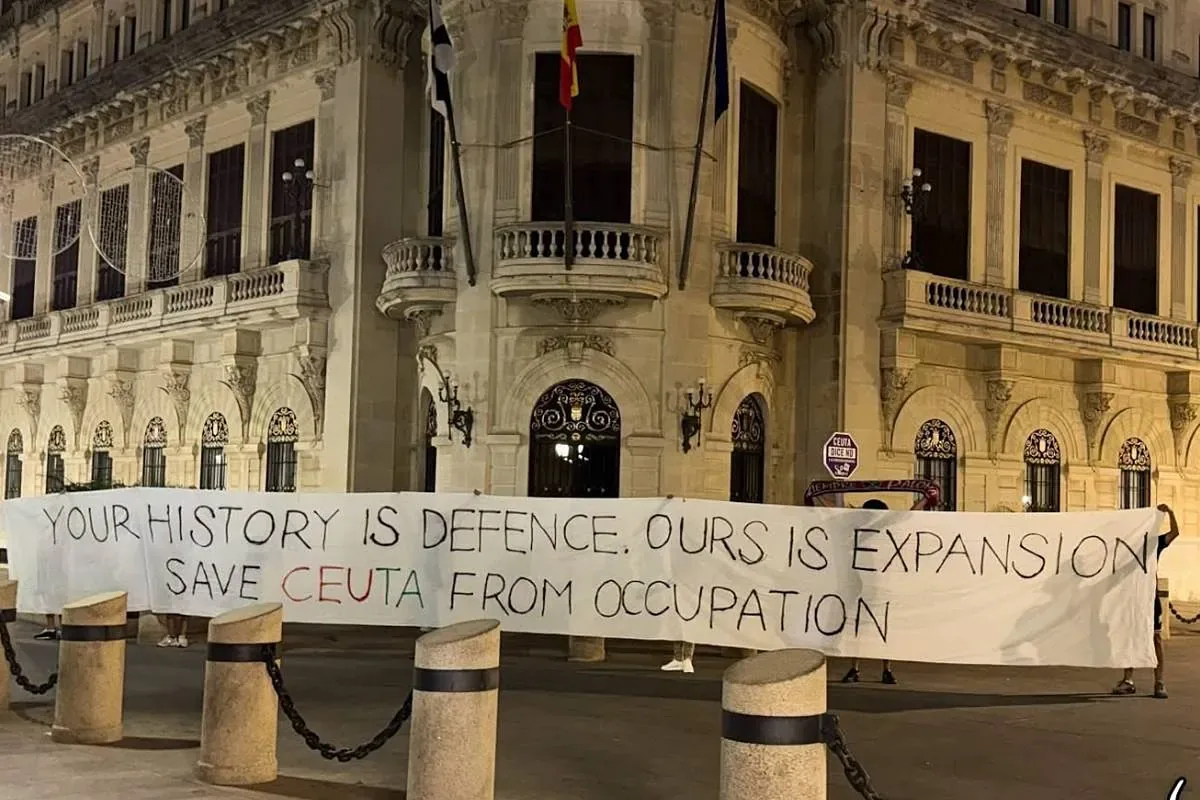
The crisis that Ceuta has been experiencing since July 30, when thousands of people, mostly Moroccans, broke into the city from Morocco, has created a scenario of tension and confusion that a group of Moroccan nationalists has taken advantage of to bring to the city’s institutional center a claim that goes far beyond the migration crisis. Members of Ultras Siempre Paloma 2006 have reached the main door of the City Hall and displayed there a large banner demanding Ceuta, Melilla, and the islets and other Spanish territories of North Africa for Morocco.
The exact day the action took place has not been disclosed. The Siempre Paloma Facebook page shared the photo in the early hours of this Tuesday, without specifying when it was taken. The ornamental lights visible in the background allow the scene to be placed in Africa Square and correspond to the decoration installed for the events in honor of the Virgin of Africa, patroness of Ceuta.
In the image, several group members appear in front of the main door of Ceuta City Hall, under the flags of Spain and the Autonomous City, while holding a banner in English: “Your history is defence. Ours is expansion. Save Ceuta from occupation”. “Your history is defence. Ours is expansion. Save Ceuta from occupation”. The message leaves no room for ambiguity. Spanish sovereignty over Ceuta is defined as an “occupation” and the city is presented as a territory that Morocco must recover.
Siempre Paloma 2006 comes from the environment of Moghreb Atlético Tetuán, one of Morocco’s historic football clubs and an institution especially well-known in the north of the country. Founded in 1922, the team has a deeply rooted fan base in Tetuán. Among its supporters are Los Matadores and Siempre Paloma, the latter created in 2006. The activity of these groups is not limited to the stands. Their banners, graffiti, chants, and public actions have also incorporated messages of political and social content. A sociological study published in 2026 on the ultras groups of Tetuán precisely analyzes the work of Los Matadores and Siempre Paloma and concludes that their graffiti transcend the sports framework to become a form of political and social discourse.
The ultra group had already used its mobilization capacity to intervene in matters beyond football. After the death of Ilias Tahiri, a young Moroccan who died in a juvenile center in Almería, the group carried out tribute actions and displayed banners denouncing racism and discrimination against Moroccans in Spain. The collective also directed its criticism against Vox at that time. In June 2020, the group posted a message on Facebook demanding justice for Tahiri and denouncing violence, racism, and discrimination against Moroccans in Spain.
That precedent helps to understand the dimension the group has acquired beyond the stands of Moghreb Atlético Tetuán. It is a fan structure that uses symbolism, banners, and public mobilization to express social and political positions. In February of this year, Siempre Paloma again publicly intervened in matters related to the club and demanded accountability from its management, showing the pressure capacity it exerts on the team’s public life.
The claim they have now brought to Ceuta has an openly territorial character. The text shared alongside the photo constructs a historical narrative that begins with Tariq ibn Ziyad and continues with al-Andalus, the Almoravids, and the Almohads. Its authors present the Strait as a space that for centuries connected the two shores and refer to the presence of North African dynasties on the peninsula to support a historical continuity that, according to their interpretation, reaches to present-day Morocco.
The manifesto also recalls the Rif War and the figure of Mohamed Ben Abdelkrim El Jattabi, with an explicit reference to the Spanish defeat at Annual in 1921. It then focuses on Ceuta and argues that its geographical location in Africa is an essential argument to question Spanish sovereignty. The Portuguese conquest of 1415 appears as the origin of the current situation, while the passage of time is considered insufficient to legitimize Spanish permanence.
Read more The Government now denies the «reception» of migrants and promises a tough stance to Europe
The text extends the claim to Melilla and the rest of the Spanish enclaves and islands in North Africa. Its conclusion is direct: “Ceuta, Melilla, and the rest of the enclaves are Moroccan lands and, no matter how much time passes, that will not change”. The claim directly questions Spanish sovereignty over Ceuta, Melilla, and the other territories.
The chosen location turns the action into a deliberate provocation. The banner has been displayed at the very door of Ceuta City Hall, opposite the facade of the Assembly Palace and under the Spanish and Ceutan flags. The fans of Moghreb Atlético Tetuán have placed their message before the institution that represents the people of Ceuta and have brought there a territorial claim that Morocco has maintained for decades.
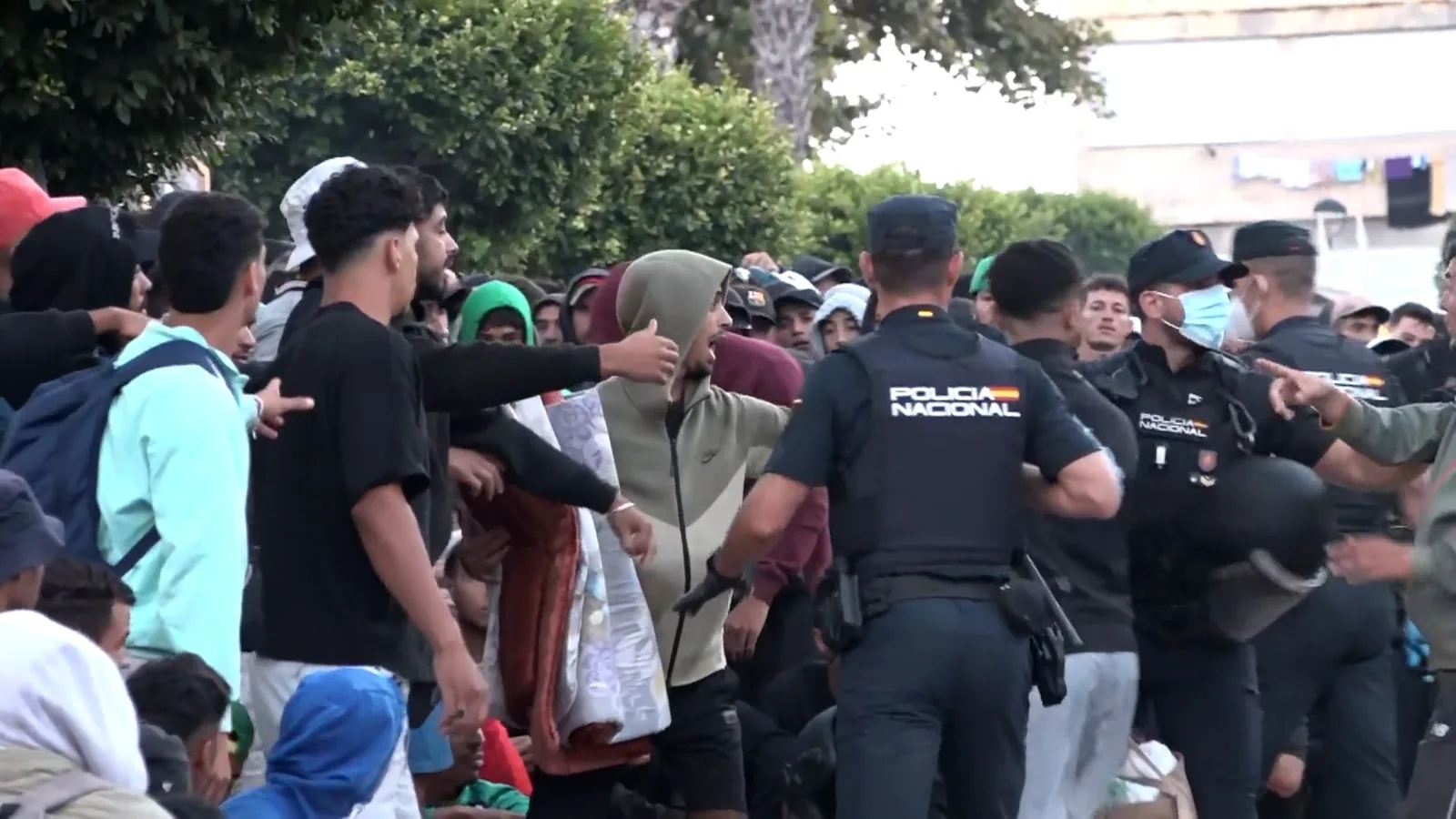
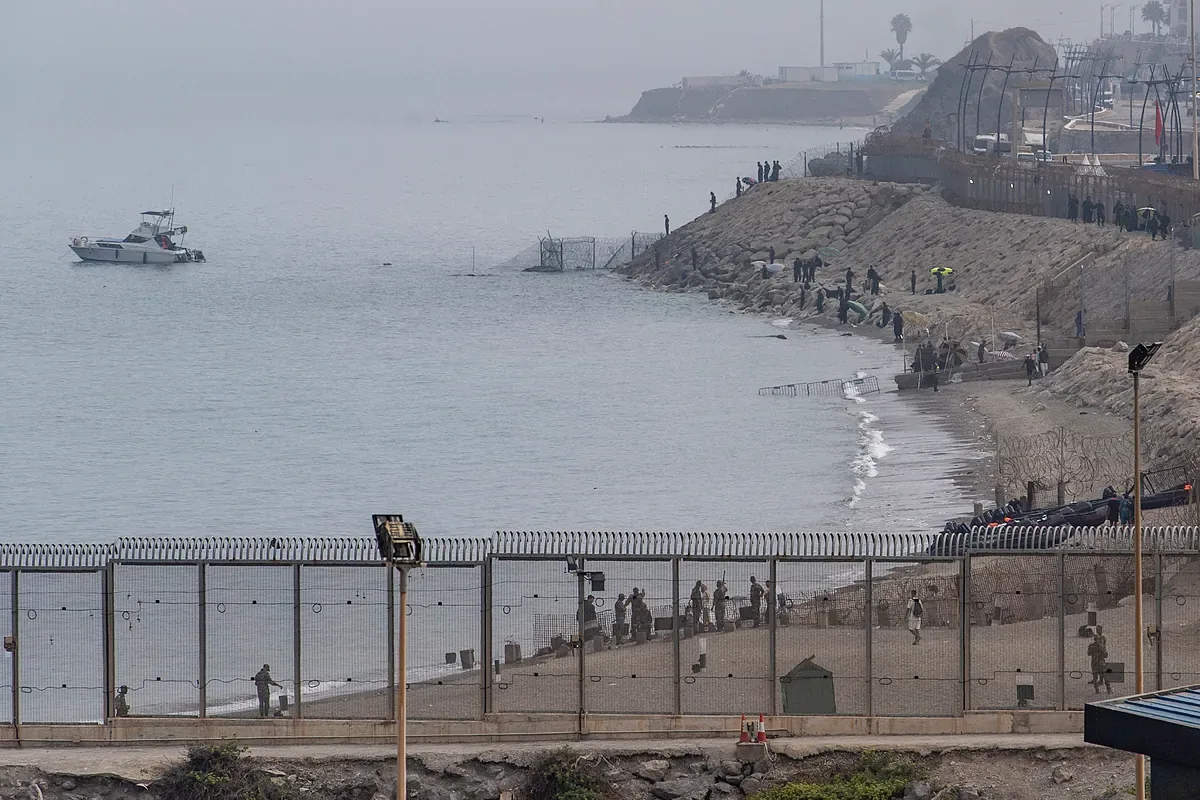
The action comes amid a border crisis, when Ceuta is still trying to recover normality after the massive entry of people from Morocco.
The choice of moment and place reinforces the political nature of the act: the nationalist message has been placed in Ceuta’s institutional center, when the border again occupies all attention. The massive entry on July 30 and 31 has been described as the largest migratory breach recorded in the city’s recent history, with estimates between 40,000 and 60,000 people.
The question now on the table is who is behind the action, how it was organized, and for what purpose it was decided to bring such a claim to Ceuta. Siempre Paloma is a group of supporters of Moghreb Atlético Tetuán, but the content of the banner and manifesto clearly places the act outside the sports realm. Football is the group’s origin; the message displayed in Ceuta belongs to the field of nationalism and Moroccan territorial claims.
The image leaves a scene difficult to separate from the context in which it occurs. While the city faces the consequences of a border crisis of enormous magnitude, an organized group of Moroccan nationalists has brought to the door of its City Hall a claim that questions Spanish sovereignty. In front of the flags of Spain and Ceuta, the banner summarizes their position: “Your history is defence. Ours is expansion. Save Ceuta from occupation”.