


For weeks Alberto Núñez Feijóo has focused his criticism of the Government over the Ceuta crisis on its failure to point to Morocco. But the knowledge, a few days ago, of the National Police report that indirectly points to Rabat’s involvement in the events has served the popular leader to reaffirm this stance even more. He made this clear on Thursday in Congress, when he confronted Pedro Sánchez accusing him of “covering up” the Ceuta crisis out of “personal fear” of Morocco, and again this Saturday it is the reproach he has expressed at a PP rally.
“They are tough against allied nations that protect their borders and submissive with those who break our borders,” Feijóo said about the Government at a rally in Getafe, and he added: “Distant with the King of Spain and reverential with the one from Morocco.” In this regard, the popular leader delved further into the criticism, with a certain ironic tone, by stating that the members of the Executive “are the most monarchist, but in the wrong country.” All this after a week in which the future trip of Felipe VI to Ceuta has marked the political debate, with the Prime Minister putting it on the table while, to justify not having done it earlier, he took refuge in the fact that the Crown has not gone to the city in the last 20 years and he has.
In this context, and insisting on the criticism of the Executive for its stance regarding Rabat, Feijóo has claimed that Spain “does not have to choose between having good relations with the neighboring country and maintaining our dignity.” “It does not have to ask for permission or forgiveness to maintain its territorial integrity. That is a State,” he defended, also accusing Sánchez’s Government of being “hostile to the invaded and docile with the invaders.”
Regarding the investigation into what was behind the massive entry into Ceuta, Feijóo has claimed the “right” of Spaniards to “know the truth” and, thus, has insisted on his demand for the director of the National Intelligence Center (CNI) to appear before the official secrets commission of Congress to, behind closed doors, inform parliamentary groups of the data available. In this regard, the popular leader also addressed the Minister of Defense, Margarita Robles, directly to urge her to authorize this appearance: “If you keep preventing it, even if you don’t applaud her, you are the same as Pedro Sánchez.”
Read more The Government takes control of the Port of Ceuta to accommodate migrants
Before Feijóo, the Madrid president, Isabel Díaz Ayuso, had left no doubt when also referring to what motivated the irregular entry of 72,000 people into Ceuta. It was, she assured, “an action that was perfectly coordinated, organized, by the Moroccan secret services.” “They did it in a calculated way while the shameless one from La Mareta, in flip-flops, was cutting his feet in the photos to say he was very busy in a videoconference,” Ayuso reproached, who believed Sánchez had no “right” to remain on vacation while the Ceuta crisis remained unresolved.
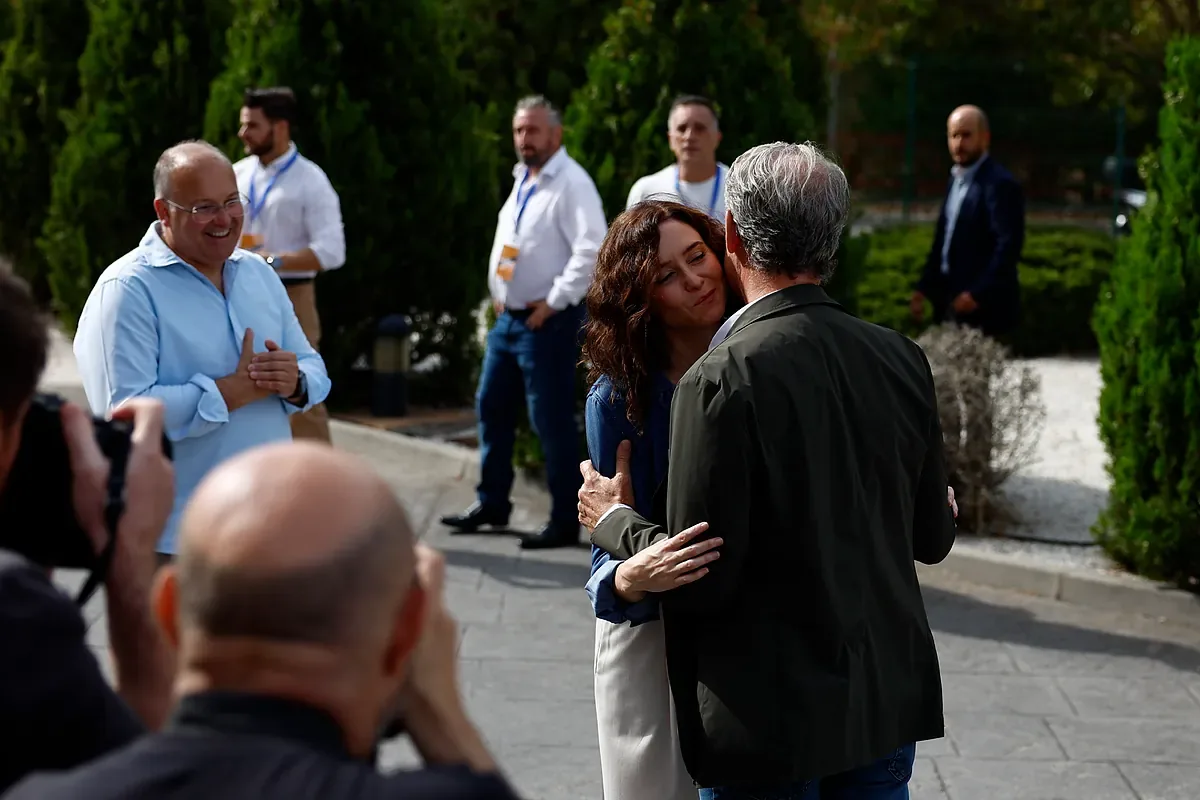
The Ceuta crisis thus took center stage at the opening event of the Madrid PP’s political season, which brought together the party’s national leadership in Getafe – with Feijóo were his second and third, Miguel Tellado and Alma Ezcurra – with the regional leadership, with Isabel Díaz Ayuso and her number two, Alfonso Serrano. The mayor of the capital, José Luis Martínez-Almeida, also attended at the start of a season that all popular members agreed was “intense” and “decisive”.
“We are increasingly close to the political change that Spain needs, but none of this is done,” Feijóo warned, calling on his Madrid cadres not to “settle or be complacent.” “We have to push, deserve it, and complete it,” he insisted. In this context, the popular leader called to “democratically and forcefully” throw Sánchez out of La Moncloa, and he did so after Ayuso referred to the central Government as “delusional” and with a “totalitarian project.”
Read more Costa warns of the «instrumentalization» of migration in Ceuta: «We have to fight against this»