



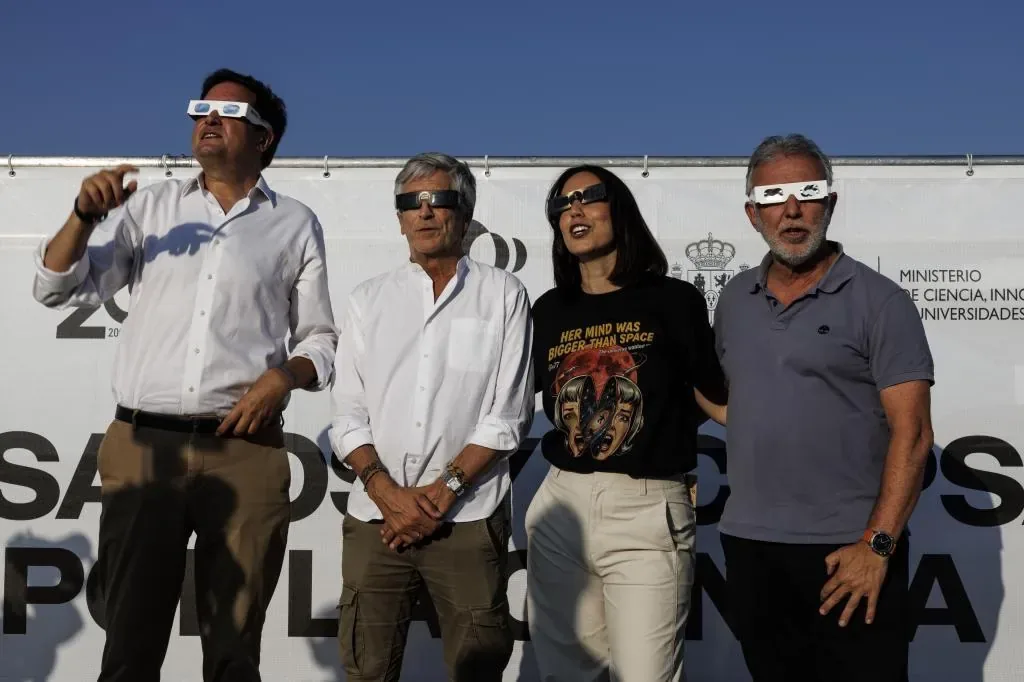
A forecast of 300 attendees, including four ministers, a “VIP area,” open bar, popular food, cocktail-style dinner, and a nine-hour program of activities, which concluded with a performance by the indie band La Habitación Roja. The bill amount: 72,358 euros. This is the budget allocated by the Government for the organization of the institutional event at the Yebes Observatory (Guadalajara) on the occasion of this Wednesday’s total eclipse.
Read more The solar eclipse from an Iberia plane full of astronomers: «Not even Ferran Torres’ goal, dude!»
The contracting process was carried out through the Spanish Foundation for Science and Technology (Fecyt), a public body attached to the Ministry of Science, Innovation and Universities. There was only one offer, from the company Fandom Comunicación, which offered to handle the rental, assembly, and disassembly of the temporary structure and facilities and the auxiliary services for the event for 59,800 euros plus VAT, 100 euros less than the bidding price.
In the document detailing the event description – accessed by EL MUNDO – two observation areas were established for the moment when the Moon came between the Earth and the Sun: a general one in the venue parking lot, and a “VIP” one on the rooftop for authorities, personalities, and media. Previously, from the opening of doors at 1:30 p.m., outreach activities, guided tours, projections in an inflatable planetarium, and workshops were held.
The institutional event was led by the Minister of Science, Innovation and Universities, Diana Morant, accompanied by the heads of the Interior, Fernando Grande-Marlaska, Digital Transformation, Óscar López, and Territorial Policy, Ángel Víctor Torres ministries. Although some media had published that Pedro Sánchez would interrupt his vacation in La Mareta (Lanzarote) to go to Yebes to see the eclipse, the Prime Minister neither attended nor was it ever planned for him to do so, according to Moncloa sources. The head of the regional government of Castilla-La Mancha, Emiliano García-Page, also did not attend, following it from the Regional Operations Center installed in Toledo.
Apart from the outreach content, the day at the Observatory included six hours of open bar drinks and four hours of coffee and water, as well as a meal planned for 300 people and two cocktail dinners, one for the general public and another for authorities and personalities, with an estimated 200 diners. To finish, a live concert by La Habitación Roja. Besides public officials, the attendee list included center staff and their families, national and international experts, and around 30 journalists.
To facilitate travel to the facilities, 80 kilometers from Madrid, a free transportation service included in the contract was set up, with three buses of 50 seats each. Departures were scheduled from Plaza de Cuzco, in the capital, in staggered shifts at 11:00, 11:30, and 12:00, and returns at 9:30, 10:30, and 11:00 p.m. A shuttle with two vans was also made available to attendees to connect the reserved parking in the municipality of Yebes with the scientific center, as private vehicles were not allowed access.
Read more The ‘haters’ of the eclipse
Terms and Conditions
The organization also established the requirement to have an ambulance with basic life support and two emergency health technicians. Additionally, a restroom area equipped with individual chemical cabins was set up, and non-potable water points were placed so attendees could “wash their hands and refresh themselves” during the day.
The breakdown of the expenditure, excluding VAT, was 9,000 euros for the two tents installed for activities and 12,500 for their adaptation (furniture, carpet, and graphic elements); 10,500 for catering; 10,300 for the human team – made up of about twenty workers – and associated resources; 10,000 for air conditioning; 4,600 for prevention, health, and safety; and 3,000 for the shuttle service for vehicle rental and driver salaries.
In the terms and conditions prepared by Fecyt for the awarding of the contract in May, it was argued that the trio of eclipses Spain will experience in three years – besides yesterday’s, there will be two more on August 2, 2027, and January 26, 2028 – represents “a unique opportunity to bring science closer to citizens, awaken curiosity, and promote scientific culture from a multidisciplinary perspective.” Regarding the Yebes Observatory, managed by the Astronomical Center of the municipality – belonging to the National Geographic Institute – it was indicated that its facilities are “unique,” “strategic,” and “offer essential services for frontier research in Spain.”
Due to “the insufficiency of adequate personnel,” the public foundation justified the need to outsource the organization of the observation event of the first of these solar phenomena. Only one company applied for the tender, based in the Madrid municipality of Alcobendas, which presents itself as “an agency specialized in generating brand content through a high-level consulting service” specialized in “branding, strategic design, inbound marketing methodologies, and cutting-edge techniques from the entertainment industry.”
Read more The eclipse captivates half of Spain