





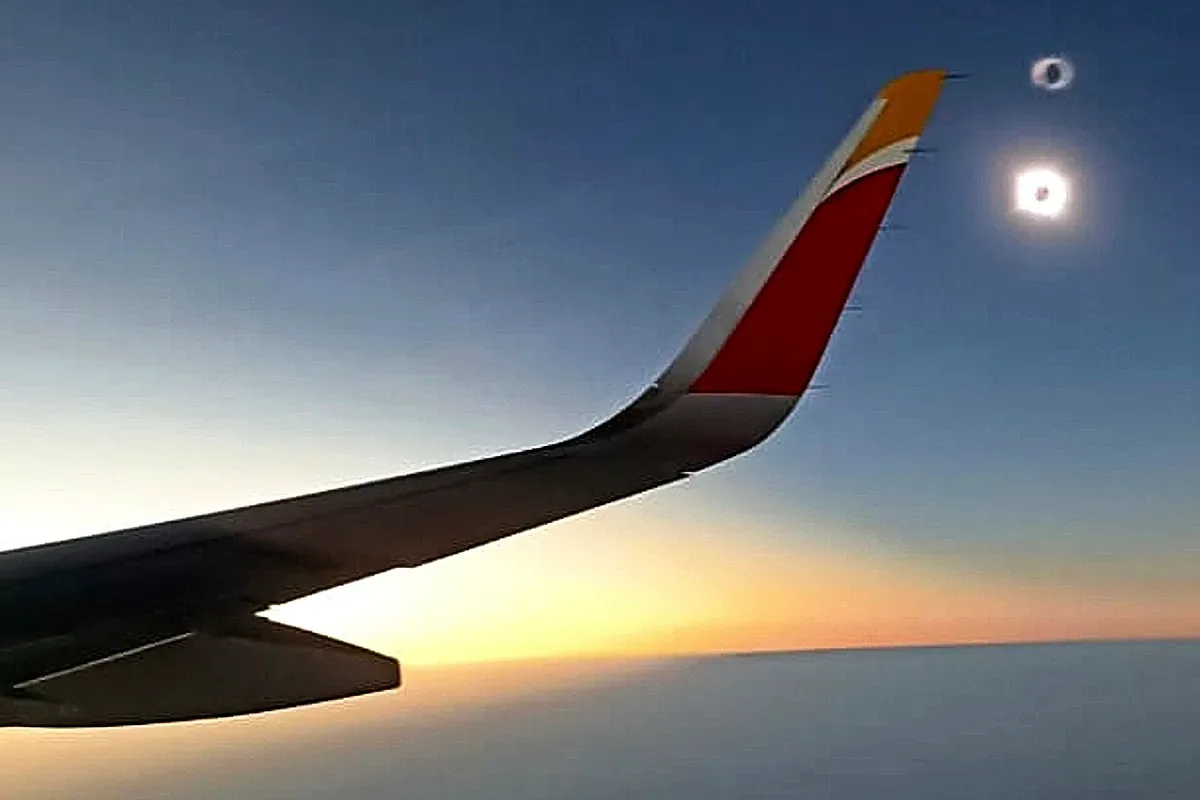
A euphoric howl ran through the 48 rows of flight IB1473 at exactly 20:38 in the evening: “Uuuuuuuuh! How awesome! How awesooooomeee!”
Read more The ‘haters’ of the eclipse
There was no room for poetic arabesques before the wildest spectacle provided by nature. Nor for deep reflections trying to explain the inexplicable. Only open-mouthed expressions and a crazy childish euphoria that one passenger encapsulated in six accurate words: “Not even Ferran’s goal, dude!”.
“How awesooooomeee!”, we repeated in a trance, the 99 travelers of the flight that had departed from Barajas T4 a couple of hours earlier. We all enjoyed a unique privilege: scraping a few additional seconds of total darkness from the most anticipated eclipse of the century.
At 20:38, we said, while the shadow of the eclipse galloped across the northern sub-plateau near Palencia, the Airbus A321XLR piloted by commander Javier Lopera Alcalá chased it at 700 km/h speed and 11,000 meters altitude. Yes, Nature was still traveling faster, but even so the power of the aircraft managed to scrape about twenty extra seconds from the most spectacular phase of the supereclipse that has paralyzed Spain.
“With an estimated totality of 127 seconds, we are the Spaniards who have enjoyed the longest eclipse“, boasted Miquel Serra-Ricart, scientific director of the mission, minutes after the experience that moved the 93 passengers and six crew members of the plane.
But that extension was only the first of three advantages that made this passenger plane the best possible observatory for the eclipse. The second was the almost guaranteed absence of cloudiness and pollution that distort the image of the Sun from the Earth’s surface. At its 11,000 meters, the plane flies above the tropospheric cloud layer (between 2,000 and 8,000 m) and the caps of suspended particles covering population centers. “We have seen the cleanest eclipse ever,” Serra-Ricart congratulated himself.
And the third advantage is the thinness of the atmosphere surrounding the aircraft: at that altitude, it has already been reduced by more than 75%. According to specialists, this drastically reduces absorption by ozone and the so-called scattering that reddens and blurs images and absorption by water vapor in the infrared. The result: sharper corona images, with greater contrast and better spectrophotometric performance.
Serra-Ricart, researcher at the Institute of Astrophysics of the Canary Islands, had already witnessed 15 total eclipses worldwide, including one aboard a plane in Antarctica in 2003. But this Wednesday was special and made his voice break more than once. “After traveling the world in search of totalities, I have finally experienced the greatest show on our planet… at home,” he said visibly moved.
But flight IB1473 went far beyond personal amazement, the selfie paradise, or the media microcircus caused by about twenty journalists. The mission also included a sophisticated scientific element, with four missions carried out onboard simultaneously during more than two hours of flight.
Read more The eclipse captivates half of Spain
First, a Seestar telescope led by Serra-Ricart recorded ultra-high resolution images of the solar corona. The compact format of this device makes it ideal for operating from an airplane window in field conditions, without the limitations of the so-called atmospheric seeing.
At the same time, two cameras (a wide-angle and a 360° one) captured the Sun’s surroundings throughout the eclipse sequence. With the solar disk hidden by the Moon, a wide field of the sky around the corona becomes visible, including nearby planets and stars. This makes it possible to document the solar environment with spatial context, such as the position of Venus, Mercury, and nearby stars.
Moreover, an extraordinary coincidence made the day even more interesting for scientists: the eclipse coincided with the annual peak of the Perseid meteor shower. During the two-plus minutes of totality, with the sky completely darkened, scientists enjoyed a unique opportunity to detect Perseids in the same field of view as the solar corona.

Third, a video camera with adjustable zoom broadcast real-time images of the eclipse through sky-live.tv, a live astronomy platform accessible to audiences worldwide. Its goal was to broadcast the total eclipse to a global audience from a unique aerial perspective.
Finally, there is the CORONA project (Observed Behavior and Response in Air Navigation), which seeks to document the experience of the total eclipse both from Earth and at 11,000 meters altitude. Its aim was to detect significant and measurable changes in the behavior of both passengers and ‘earthlings’: from increased spontaneous prosocial behavior to altered time perception, including group behavioral synchrony—applause, shouts, or collective crying…—or the creation of a temporary state of awe that modifies attitudes and behaviors during the hours following the flight.
“This way we will know, for example, if a collective experience like an eclipse can move us like the concert of our favorite band,” details Carlos Rodríguez Jiménez, PhD in Experiential Learning from the University of Extremadura, the lead researcher of the study.
-Or like the World Cup goal?
-It’s exactly the same! -he confirms-. The only difference is that the goal is unexpected and the eclipse you see coming. But the mix of joy and collective emotion experienced is very similar. And we are convinced our data will confirm it.