





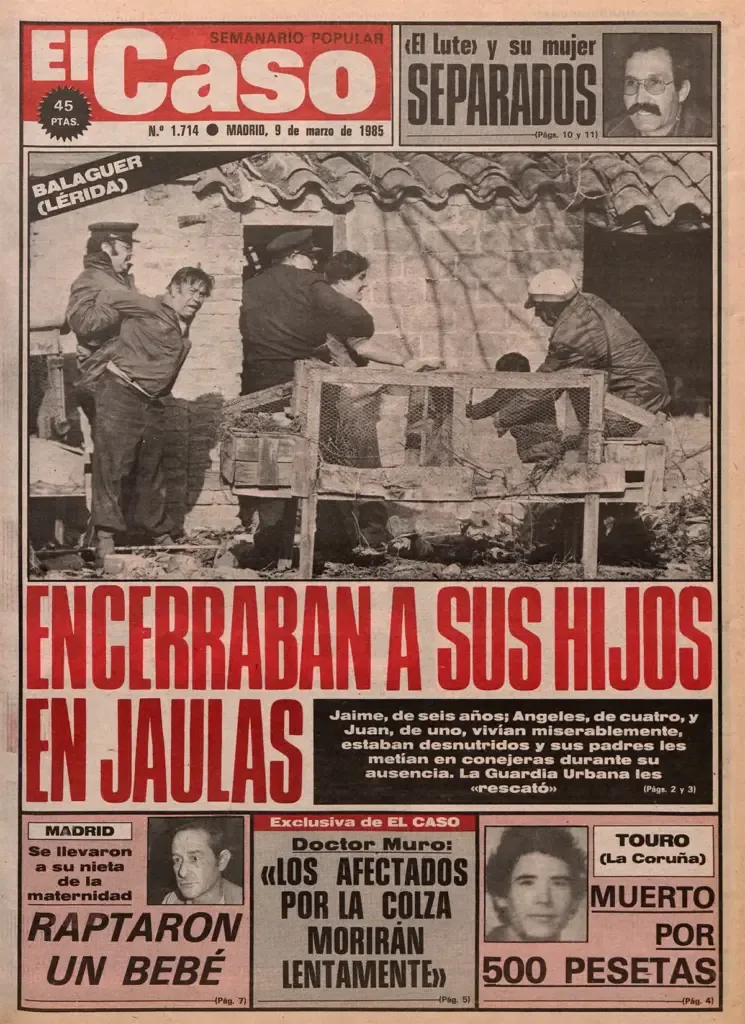
The boy who appears on the cover of El Caso on March 9, 1985, is named Jaime, he is now 47 years old and is imprisoned in the Mas D’Enric prison in Tarragona. In the photograph, you can see how a firefighter takes him out of a rabbit cage. He stretches his arms towards his mother, Soledad, who tries to reach him but cannot because the urban guard holding her prevents it. If the image had sound, you would hear her screams. One meter behind is the father, Juan, with his arms behind his back, also immobilized by another officer.
“They locked their children in cages,” says the headline. “Jaime, six years old, Ángeles, four, and Juan, one, lived miserably, were malnourished, and their parents put them in rabbit hutches during their absence. The Urban Guard ‘rescued’ them”, the subtitle elaborates, which contains an error, as the third child is not Juan but Juana.
This striking image, taken in Balaguer (Lleida) on February 27, 1985, was followed by the removal of the three children from their parents, who were admitted to a juvenile center. “Having a child taken from a mother… For me, it was a very big trauma that I have not overcome, it still hurts today, I can’t even think about it,” the mother, Soledad, who is now 66 years old and whom we visited in the coastal town of Tarragona where she lives, will tell us with sorrow despite the long time that has passed.
However, we did not expect to also have the testimony of Jaime, the eldest son, who contacts us from prison upon learning that we are preparing a report on the family history. “I also want to talk because because of what happened 40 years ago, I went down the wrong path and that’s why I am in prison now,” he tells us.
With this raw story, we begin this series of reports on the cases of El Caso, the historic weekly crime magazine published in Spain between 1952 and 1997 – revived in 2016 in paper and digital format – where the legendary Margarita Landi worked, for example, and which became so popular that it distributed almost half a million copies in the 1950s. “The newspaper of the doorkeepers”, it was called. The collection of El Caso issues is held in the library of CEU San Pablo in Madrid, the university to which the magazine’s founder, Eugenio Suárez, donated the archive.
“If I remember correctly, they said [in the El Caso article] that my parents locked us in cages. That is untrue. My father had a cage with rabbits, that’s true, and the rabbits made a hole in the wire mesh. My father was old and I was helping him sew it from inside: he passed me the wire and I returned it to him. At that moment the guards entered, my father got scared and put my sisters in the cage to protect them,” Jaime begins recalling the precise moment the local authorities entered the house.
“From there they took us to a center and we went from center to center until we were adopted by families from Mensajeros de la Paz in Barcelona. One day they gave me the choice to go back with my mother or stay with the adoptive family I was with. I chose to go with my mother and her partner and that’s when the hell began.”
By then, Jaime’s father, Juan, had already died. When they appeared on the cover of El Caso, the man was already 67 years old – compared to Soledad’s 25 – and had a sick heart. Later, Soledad herself will explain the reason for that marriage with such an age gap. After Juan’s death, she started a relationship with Frasco, with whom she had two more children. Jaime joined that household by his own will, according to his account.
“I chose to go with my mother and her partner and that’s when hell began,” he said. “Physical assaults, even with sticks, working day and night on pig farms… I started running away from home and the social workers put me in a center, in Garraf, in Sitges. There they made me shower with cold water, tied me to a bed, and locked me in a room called the containment room. At 14-15 years old, I started escaping from the center until they gave up on me and let me go. Since I had nowhere to go, I slept on the street, ate where I could. Then I started working at the bumper cars at fairs and I began stealing motorcycles, then cars, robbery, burglary… and from there to big time, drug trafficking,” he recounts his rapid fall into the criminal world.
“I went to prison for the first time at 17, in preventive detention, for robbery with intimidation at a jewelry store, that’s what the judges call it, a robbery, basically. From there I went to La Trinidad – I was 19 and thought I could conquer the world – then to La Modelo at 21-22 –there I met El Vaquilla, may he rest in peace – then to Brians, then to the prison in Lleida, from there to Cuatro Camins, to La Roca, where I participated in the 2004 riot,” he lists one after another the penitentiary centers he has been through.
-And he says he started committing crimes because of that social services intervention 40 years ago.
-Yes, of course. I’ll tell you one thing, people who have been in centers ended up as criminals, prostitutes, or junkies. I say this because I’ve seen many who were with me in centers – he concludes.
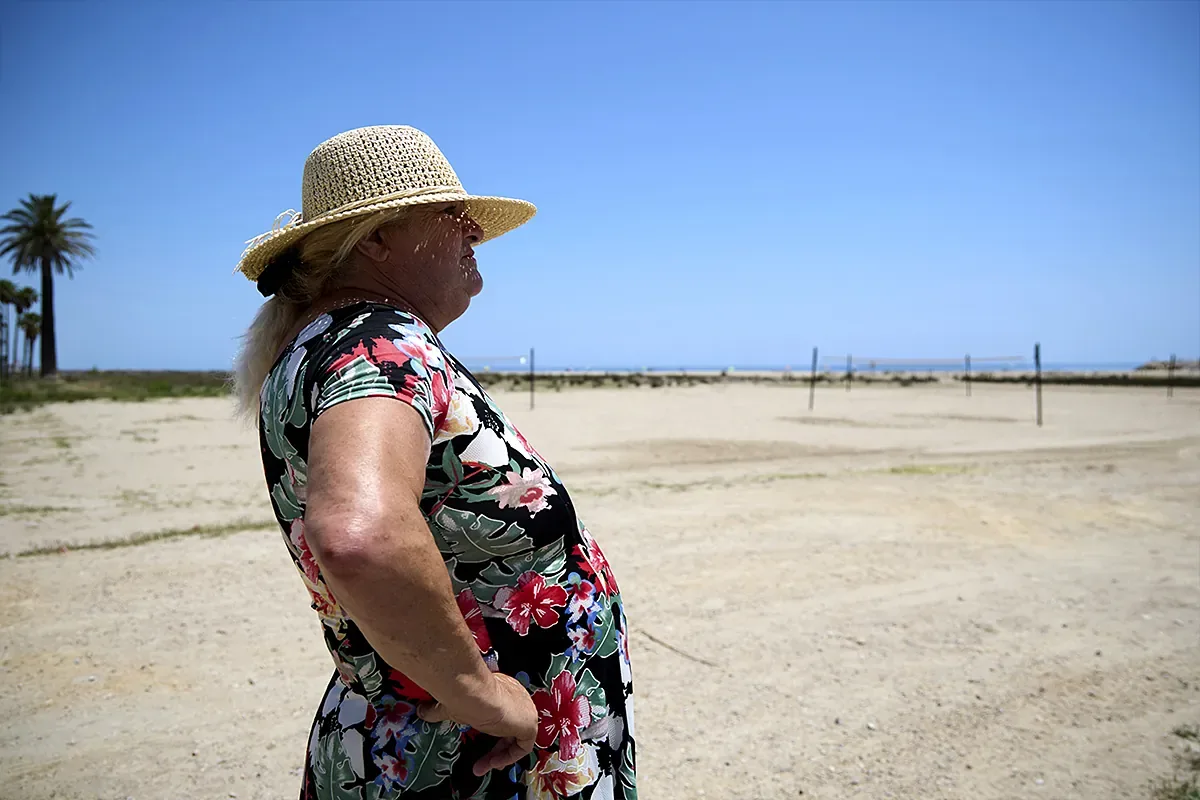
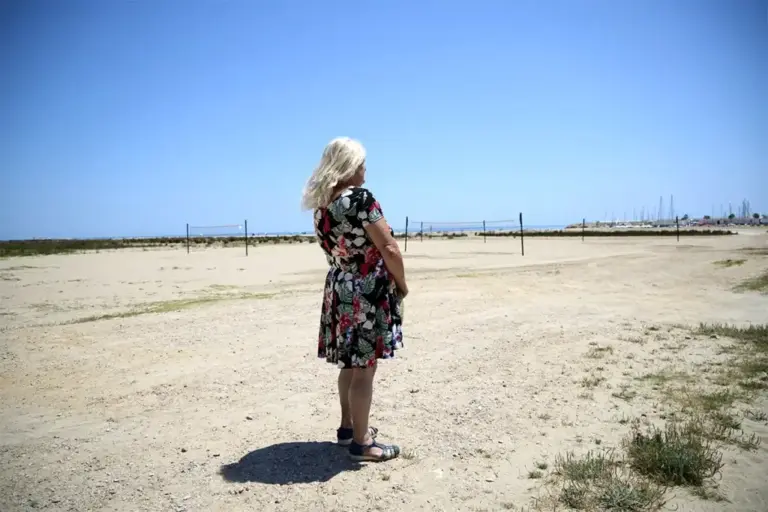
His mother, Soledad, met us at the door of a Carrefour located at the entrance of the town where she lives, whose name she prefers not to reveal. The neighbors are unaware of her past and she wants it to stay that way. It is a place on the coast of Tarragona, as mentioned before, where she lives quietly and alone.
Already seated at a beach bar, we begin by asking her the basic details of her biography: when was she born?, where?, what did her parents do? And immediately the stormy childhood she lived in the early 60s in Lleida emerges.
-My parents? They did nothing, just got drunk. We [she was the eldest of six siblings] were indeed abandoned. They would go on benders and come back after three or four days. We had no food and, poor us, we would catch the chickens and rabbits and, in our own way, kill and fry them. One day, my little brother was put in one of those rocking chairs and fell into the fire. We grabbed him by the feet and dragged him out. His whole face was burned. People gave money to take him to surgery in Madrid, but they didn’t take him, they spent it.
-So that’s how you lived…
-Locked in a room in the middle of winter, sleeping on a pile of straw and they were drunk. That is truly a death sentence. Those wine jugs from before? One in the morning and another at night.
-And where did your parents get the money?
-My father worked at the Lleida cemetery. He went at night and dug up the dead and took their jewelry. We found out because they put surveillance and saw him and took pictures without him knowing. They called him to court and he said he hadn’t done it and then they showed him the pictures on a screen. I don’t know if he had to pay or not…
-Did you go to school?
-Yes, yes, I went to school.
-Do you have EGB or similar?
-No, because my father started saying my mother was sick and that I had to take care of my siblings and he took me out.
Soledad cannot specify at what age, after receiving a beating at home, she ended up at the Civil Guard barracks and there found a way out of the hell she describes.
-My father beat me and one day they took me to the Civil Guard. I said I didn’t want to see my father, I didn’t want to see my mother, I didn’t want to be with them. I stayed at the barracks until the social worker came. And they took me to a center in a town in Almería. I was very happy there, very happy. They taught me everything, hairdressing, sewing and embroidery, cooking… cooking is my thing. I stayed there until I was 21, the age of majority.
-And when you left the center, what did you do?
-I went back to my parents. I was that good.
-And how did you marry a man 42 years older than you?
-My father told me: “Get married, get married”. “No, I’m too young, no”. He introduced him to me.
The couple settled at number 22 Urgell Street in Balaguer (Lleida). According to Soledad, they paid 800 pesetas (4.8 euros at current exchange) in rent. The house was described in El Caso as: “In one of the most central and modern streets of Balaguer, a town with a long historical lineage and great economic strength in agriculture and livestock, there is a large four-story building, with spacious courtyards and a garden and sheds at the back. It belonged to two elderly single ladies, one of whom died after being run over by a vehicle. The other soon followed her to the grave. The huge building was left uninhabited.”
-The article says there were several reports warning that the children were not in good condition and that the day before the City Council intervened, they had caused a fire with matches while alone at home.
-That’s a lie. Nothing ever caught fire there.
-That a neighbor had to rescue the children from the fire…
-Lie.
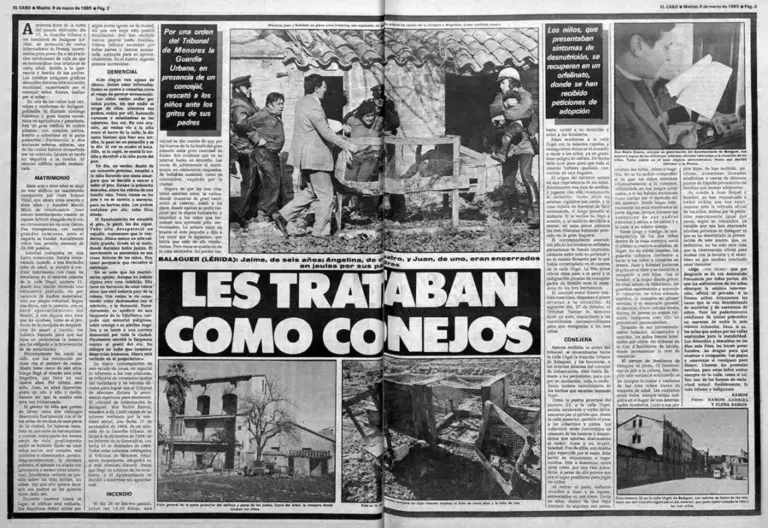
-The article said: “The lifestyle these two spouses like to lead strongly contrasts with that of the thousands of neighbors in this part of the city. Had they settled in a ravine and cave area, among people of the same lifestyle, possibly no one would have noticed dirty, poorly dressed, poorly cared for and fed children…”.
-That’s a lie. Poorly fed… They would love to eat the food I make.
-About the vegetables you had in the garden, a neighbor said: “They water them with sewage water. They must be infected. Whoever dares to eat them risks dying poisoned.”
-Oh, you can’t eat them? And when manure is put on gardens, can you eat the vegetables or not? What do they know! It was good water.
-I read you another excerpt: “On one occasion, a neighbor saw the girl in the street mud; she felt so sorry that she made an omelet, put it in a bun, and gave it to her. When her mother saw the sandwich, she took it, ate the omelet and gave part of the bread back to the girl”.
-What a liar. I would go hungry to give it to them. What a liar.
-“One day, a neighbor, owner of a nearby shop, heard the girl crying with such bitterness that he decided to enter and go upstairs. The poor girl was barefoot, among the shards of a broken bottle. She had cuts on her feet and did not dare to move, so as not to hurt herself more. The parents were somewhere, God knows where.”
-Oh my God, what a liar!
-Didn’t you read all this at the time?
-Noooo.
-It was also said that the City Council painted and furnished the apartment and that you sold everything: “Now they had only one large mattress, thrown on the floor, where they all slept together. The couple entertained themselves in front of the children. There is so much filth that it turns the stomach.”
-What a liar. That they furnished the apartment. I furnished it myself, I bought a bed myself.
-And that the firefighters wanted to take care of your children: “The entire Balaguer fire station, 15 men, led by their chief, have submitted a request asking to be granted custody and care of the three children until they reach adulthood. They would all take care of them, although they would be hosted in the homes of three specific firefighters, alongside their own children. Numerous phone calls and letters have also been received from various parts of Spain from families wishing to adopt them.”
-No. All that is worth reporting, huh?
Soledad assures that they had enough resources to cover the children’s needs and that they were well cared for. Her husband, Juan, who before meeting her had been a transporter and had several trucks – the business collapsed – was then employed at a sawmill. “I worked in the fields, in fruit warehouses, collecting cartons… My children lacked nothing, neither milk nor anything. They had everything. I took them to school in Balaguer, to the nuns. I took them in the morning and picked them up in the afternoon. And the next day, again. They went to school and everything.
-So then, why were the children taken from you?
-One day someone came with a social worker. And I said: “Hey, did I call you or what?”. “No, but the City Council told me you need help.” “Listen, I don’t need help. My husband works and we have the fridge and freezer full. Do you want to see how the house is? Well, look.” She went up and said: “What a beautiful house, how clean you have it, with bleach and all that.” “Of course, I have to keep the house clean, especially with children.” They left and two or three days later they came with the urban guard and everything to take my children. With the councilor, whom I didn’t even know was the councilor [referring to the then councilor of Governance of Balaguer, who led the intervention].
-It was said that they found the children locked in cages.
-We were in the garden doing things and they were playing in a cage, they were playing rabbits. I told my husband: “Let them be, they are entertained and that way they don’t destroy the garden. They played there. How could I lock the children in rabbit cages, for God’s sake? So many things have been invented.
-And where were the children taken?
-They took them to Alpicat, there is a school called Madre Esperanza. [The Madre Esperanza Home, located in Alpicat (Lleida) and managed by the Missionary Slaves of the Immaculate Heart of Mary, still exists. It is dedicated to the protection and education of minors in situations of neglect or risk].
-Did you try to get them back?
-Yes, but the City Council told us that if we reported it, we would go to jail.
-And then your children didn’t return to you?
-The eldest, Jaume [that’s how he calls Jaime], returned, the other two did not. They left school at 18 and left.
Soledad’s account matches what her son says. At a certain age, they were given the choice to stay with the families that had taken them in or return to Soledad. Jaime, who was 6 when separated from his parents, chose the latter; his sisters, younger, 4 and 1, did not.
-The girls don’t want anything to do with me. They’ve been in Barcelona for years, but I don’t bother them at all, huh? Once the little girl, Joana, came looking for me. I was living in [the La Mariola neighborhood], in Lleida. And I didn’t recognize her, honestly. She says: “Don’t you know me?”. “How could I know you? Who are you?”. She came with her husband and the girl. “I am Joana, your daughter”. “And how did you find me?”. “Through the social worker.” She left and never came back…
-Haven’t you seen her again?
-No.
After her children were taken from her custody, Soledad says she needed medical help.
-I was left with a very strong damage. I went to a psychologist, but I quit: “Look, don’t make me any more little drawings, don’t do anything to me, this is not going to go away.”
Soledad and her husband, Juan, left Balaguer and settled in another nearby town. Shortly after – she cannot specify the date – Juan, who as mentioned was more than four decades older than her, died.
-What did your husband die of?
-Heart. The doctor told him: “Don’t drink, because at the slightest drink of a mixed drink, you die.” I didn’t believe it and, well, he drank a mixed drink and that night to the hospital. And he died there.
Soon after, Soledad started a relationship with another man named Frasco, with whom she had two more children, Francisco and Joan.
-He got together with me and had 100 euros in the bank. He had a pig farm and made us work a lot. I told him: “Don’t take the children, because they will get hurt and you will have problems with me. I don’t know if it was Juan or Francisco, one of them got hurt and he heard me. He had us very bitter.
-When you say he had you very bitter, you mean you, Juan, Francisco… and Jaime too?
-Also, yes. He threw ashtrays and everything. My God. I confronted him, pulled out a knife: “You are driving me crazy.” Then the Civil Guard came and said: “No sir, since she has small children, you are the one who has to leave the house.”
-What happened to him?
-He died too. I found out about that. When he died, the little one was in the belly, I was five months pregnant.
Then began a quieter life that she continues to enjoy. She says she gets by with the 950 euros she receives from her late husband’s widow’s pension – she did not marry Frasco -.
-What would you change about your life?
-I wouldn’t change anything now, because they have already hurt me. That has stayed with me forever and that’s it.
