









The unilateral decision by the socialist sector of the Government to extend the activity of the Almaraz nuclear power plant until 2030 is the latest in a long list of clashes between the PSOE and Sumar and again, as in many previous clashes, it tests the resilience and reaction capacity of the minority partner, who yesterday jumped like a spring and with unusual force when they found the measure published in the BOE. It made clear that they consider it a “mistake” and presented the outcome as a result of the Ministry of Ecological Transition having yielded to the interests of the “energy oligopoly.”
Beyond the theatricality with which politics plays to convey messages, Sumar’s huge anger has solid arguments. Because Pedro Sánchez made a commitment to Yolanda Díaz to gradually close the nuclear plants. It is a goal that the vice president extracted from him in negotiations and that is now worthless. And it is no small matter when it comes to an issue that is a banner of a left that seeks its place and to stand out in the midst of a refoundation process for the elections.
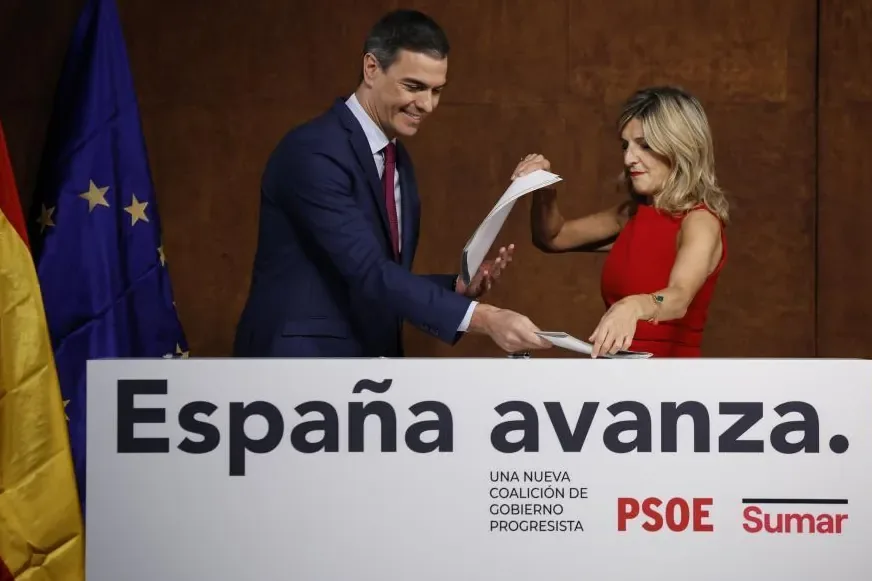
The pact between the PSOE and Sumar by which the coalition government was formed, signed and presented by Sánchez and Díaz on October 24, 2023, includes in one of the points of its 48 pages the following promise: “We will carry out a planned, safe, orderly, and socially just closure of nuclear plants, phasing out the operation of all Spanish plants between 2027 and 2035, continuing the instruments already developed in the Just Transition Strategy.”
This, with the extension of Units I and II of Almaraz until June 8, 2030, when the schedule planned their closure in 2027 and 2028, respectively, sinks that commitment before the Spanish people and drags Sumar into non-compliance, to the displeasure of its most anti-nuclear sectors, striking at the renewal of a political project that is making ambition with the energy transition one of its distinguishing marks from the PSOE and, on the other hand, torpedoing the “eco-socialist laborism” label with which the Movimiento Sumar party – one of the parts of the alliance – wants to build its new identity post Yolanda Díaz.
This explains the forcefulness with which Sumar reacted yesterday, distancing itself from its government partner by expressing its “absolute disagreement” with the extension of Almaraz, denouncing “a profound rupture” of consensus within the Government with the decision taken and accusing Sánchez of “following the path of the right and the far right” by accepting the extension.
When consulted yesterday, official sources from Sumar did not clarify whether they knew the news in advance or if they came across it when it appeared in the BOE during the August holidays and on the doorstep of the weekend with more patron saint festivals.
Read more A strong magnitude 5 earthquake shakes Granada at dawn and causes material damage
Izquierda Unida, a key player in the present and future of Sumar, verbalized that the PSOE’s “mistake” “breaks with the roadmap” that the Government had set and shows an “incoherence” with renewable energies. But beyond these criticisms, IU leader Antonio Maíllo glimpsed with his words the fear within the alliance that Almaraz is not an isolated case and that, in reality, the PSOE may be quietly making a course correction on its approach to nuclear power. After all, the debate about this type of energy has been heavily influenced in the last year and a half by the great blackout of 2025, which the PP and Vox use as an example of how much Spain needs to continue relying on these plants.
The fact is that Maíllo called to “address a shielding strategy” within the Government so that Almaraz is not “the beginning of a modification of successive extensions” of other nuclear plants, because the PSOE is sending the “message” that these changes can happen, and that “just as Almaraz’s has been modified, others that close in 2028, 2029, or 2030 can be modified.” It remains to be seen if this call provokes consequences among the Government partners. For now, nuclear plants are added to corruption, housing, rearmament, workday reduction, or time control on the list of fractures within the Government.
The commitment
Nuclear closure. In the 48 pages of the government pact between PSOE and Sumar, there is an explicit promise about nuclear power within the section on the “green agenda to guarantee the sustainability of today and tomorrow.” “We will carry out a planned, safe, orderly, and socially just closure
phasing out the operation of all Spanish plants between 2027 and 2035, continuing the instruments already developed in the Just Transition Strategy,” says the document signed and presented by Pedro Sánchez and Yolanda Díaz on October 24, 2023, by which they formed the coalition to govern.
Read more Morocco announces that it has thwarted an attempt by hundreds of sub-Saharan migrants to reach Ceuta