





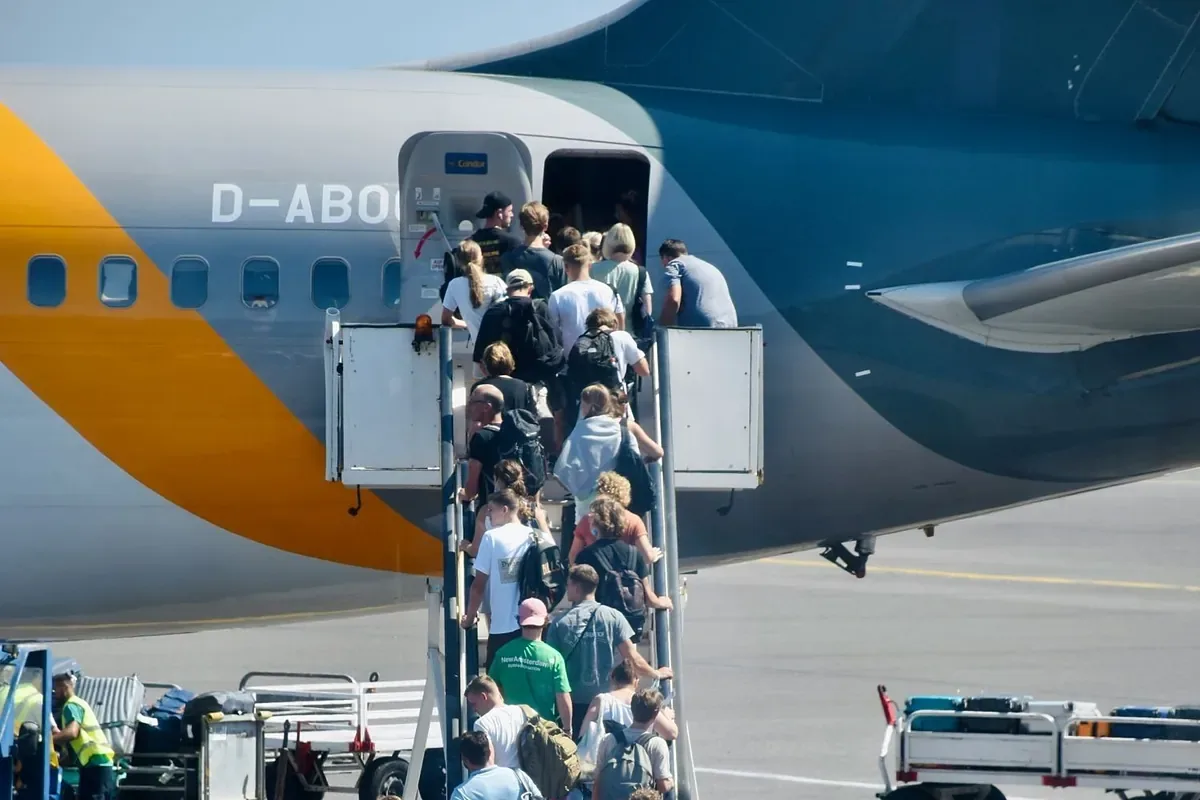
Twice a month, Thomas, an employee of one of Europe’s leading aerospace groups, boards a plane and travels wherever he wants. Part of the time in Europe, often in Asia or America. With teleworking, distance ceases to be a problem. The only real obstacle is time zones and, during peak seasons, seat availability. No problem: he can change his destination even while already at the airport, without paying penalties. “The important thing is not to go from a warm climate to a cold one or vice versa, because there is no time to go back and repack,” he explains.
Read more Barcelona closes the signing of Rodri for four seasons after paying 75 million to City
Thomas almost always travels in Business class, sometimes in First Class. He pays very little. His last trip to Singapore cost him about €120 round trip, including more than €70.54 just in airport taxes, compared to a commercial ticket for that route costing €10,123. As an airline employee, Thomas enjoys one of the most valued—and least publicly discussed—advantages in the sector: flights at very low prices, last-minute booking flexibility, free upgrades, discounted rates at partner hotels, and significant discounts for family and friends throughout the year.
Welcome to the world of “no income” passengers, that is, those from whom the company practically makes no profit. “Of course, you don’t accumulate miles for loyalty programs or have access to VIP lounges, but these are limitations we gladly accept,” he says while waiting to board his flight to New York, for the umpteenth time this year, for the weekend. A few minutes before the boarding gate, he is already preparing for his next trip: he logs into the employee portal, enters his credentials, checks flight availability within his group and partner airlines, and purchases with just a few clicks. A confirmation email reminds him that he has chosen the “waiting list” option.
Agreement between carriers
Worldwide, approximately three million workers—active or retired—enjoy these benefits, to a greater or lesser extent, simply by working or having worked for an airline. Added to these are approximately five million direct family members—parents, spouses, and children—who receive extended discounts. Then there is a third, more informal circle of friends and acquaintances who, in some cases, can fly once a year with reduced fares thanks to those working in the sector. The larger and more profitable the airline, the more generous the benefits package.
This system is based on an international architecture little known to the general public, founded on bilateral agreements between airlines and a fare system called “Zed,” an acronym for “Zonal Employee Discount”. It works like this: an employee of one airline can fly on the routes of another partner airline paying a fare much lower than the commercial fare, with prices varying according to distance and the level of agreement between the two companies.
There is no universal discount, say 90 or 95%. Conditions, taxes, and surcharges vary radically from country to country, as Corriere has found. For example, on the Paris-Singapore flight, taxes and airport surcharges for Business class flights reach 220.75 euros (of which 176.57 are charged by French authorities), triple the cost of the Milan-Singapore flight with the same airline. For the London-Singapore flight (same premium class and same airline), taxes alone amount to 399.69 euros (of which 355.51 are charged by British authorities).
This explains, for example, why many French or British employees traveling to Asia or America first book a flight—always discounted—to Italy and then continue to their intercontinental destination: in their home countries, airport fees applied to Business class flights are considerably higher. Changing the departure point can reduce the total cost (already discounted) by up to 80%.
Waiting list or confirmed
The main difference for those using these benefits lies in the distinction between a waiting list ticket and a confirmed ticket. With a waiting list ticket, the employee holds a valid travel document—paying a little more than airport taxes—but does not have a guaranteed seat. They are only allowed to board if, once all paying passengers and higher priority categories have been accommodated, there are free seats left. In practice, they can arrive at the boarding gate with their ticket in hand and find out a few minutes before departure if they will be allowed to board.
In some airlines, seat assignment is received only five or ten minutes before takeoff. On flights between Italy and the United States during peak hours, there were up to 25 passengers on the waiting list on the same flight. “Those who use these benefits must plan their trip based on availability, priority, and total flexibility,” confirm more than one beneficiary. They do not just book “Milan-New York with a one-way flight on August 25 and return on the 29,” adds another, “they study flight occupancy, evaluate alternatives, and are prepared to change plans.”
Regarding the Milan-New York flight, using the specific platform, a waiting list ticket in Business class costs an employee €286.33 with Emirates. For the average traveler, the price is €3,590. A Paris-Muscat flight, also in Business, costs €284.06 compared to €1,845. A Munich-Hong Kong flight, also in Business, costs €298.10 compared to the normal fare. Selecting a seat in Economy is even cheaper. “Also, you are usually on the waiting list for upgrades to Business if there are free seats,” employees explain.
The confirmed ticket is the true privilege of the system: it guarantees a seat but costs more. It is not a universal standard: some airlines only offer the option to travel on the waiting list, while others also allow confirmed tickets on certain routes or classes. Some airlines even offer more generous internal programs: one free confirmed ticket per year, another with a 75% to 95% discount if always confirmed, and unlimited waiting list travel.
The interface that drives it all
The platform that powers much of this system is called “MyIdTravel”, developed by the Lufthansa Group, which charges a commission (at least €3-4) per transaction. It is a portal reserved for employees of participating airlines, eligible retirees, and, in most cases, authorized family members and companions. It allows searching for flights, checking plane occupancy through an emoticon system (green: seats available; yellow: few seats; red: plane almost full), issuing tickets, and managing changes and cancellations independently.
According to industry estimates, the platform serves more than 350 airlines worldwide and potentially more than ten million users, including employees and family members. British Airways chose to develop its own internal system to avoid charging commissions to its rival Lufthansa. In the last two years, some airlines have even closed deals with private jet operators: employees can book a seat on a luxury plane (which travels empty to the city after the client disembarks) under the same advantageous conditions.
Eligibility usually begins after six months of service. Beneficiaries vary according to the contract: normally, the spouse, children up to 21-24 years old, parents, and, in some agreements, a companion or friend designated by the employee. Boarding priority is hierarchical: first the employees of the operating company, then those of partner airlines, then family members, and finally holders of companion passes, which are personal passes that can be transferred to friends.
A benefit and (sometimes) a risk
Even with a confirmed ticket, specific rules apply: determined boarding times, dress code in some cases, and luggage restrictions. The result is a benefit that can be worth thousands of euros a year, especially for those who travel frequently or take long-haul flights, but requires a completely different mindset from the traditional passenger. “You don’t buy a ticket: you play with availability, priorities, and time,” beneficiaries explain.
Because in high season or on busy routes, traveling on the waiting list becomes a lottery. “It works if you are single and have maximum flexibility,” says one employee, “but when you have a family, it gets complicated to change plans at the last minute, possibly losing a day because planes are full on that date, or when you are already there, ready to board, and you can’t get on because one of the four requested seats was booked at the last minute by a customer.”
“Until the last minute, someone could steal your seat because they bought the flight at full price,” reasons another employee, “and the airline, rightly, favors the customer, not those who paid less.” But when do you know for sure you have made it? “When the plane door closes and the flight attendant says ‘boarding complete’,” almost everyone agrees. Until then, “they can ask us to disembark.” But, as Thomas says, “it’s an acceptable sacrifice, considering we can travel the world for 100 or 200 euros.”
Read more One dead and three injured as a UME fire truck overturns in the Las Peñas de Riglos fire