




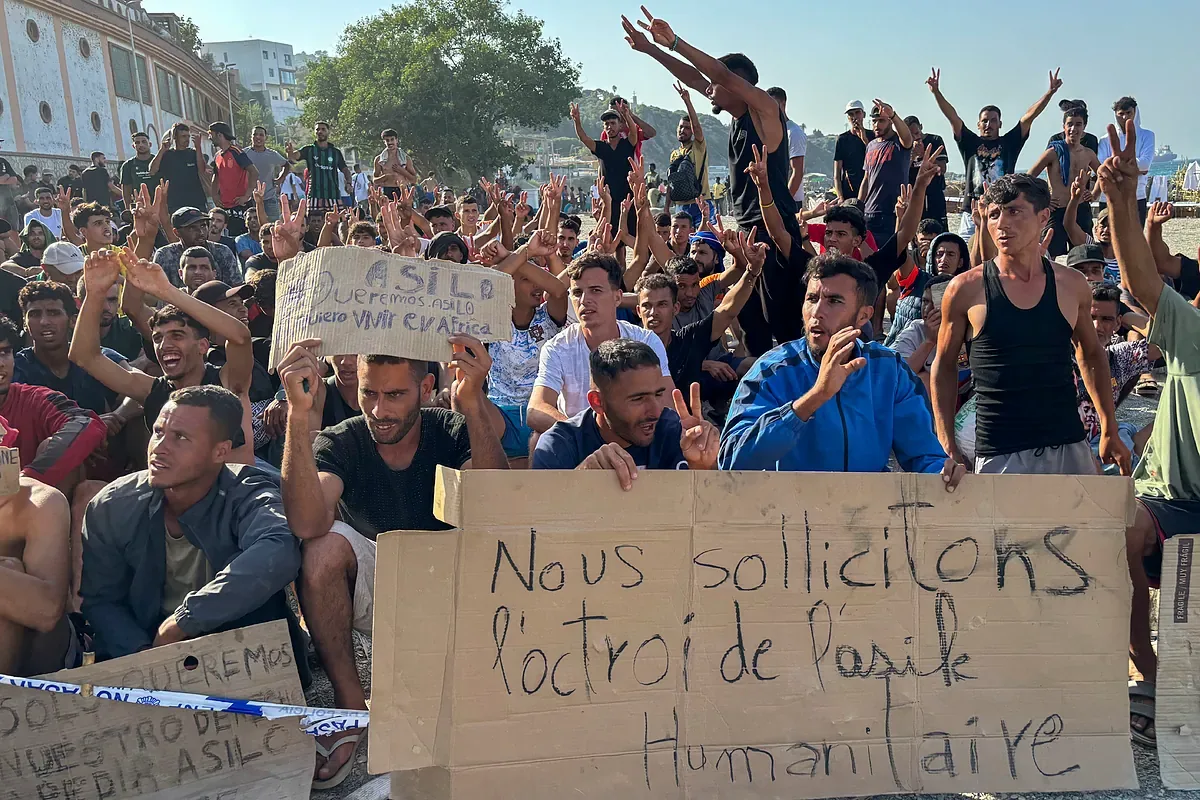
The crisis in Ceuta has many dimensions: the accommodation of more than 10,000 migrants who still remain in the city, the growing concern about the health impact of the very poor conditions they are in, and a topic that will grow in intensity and provoke a strong political clash between the Government and the autonomous communities, what happens with the unaccompanied minors who remain in the autonomous city.
At least it is known that there are 2,168 minors. These are so far the ones the National Police have managed to identify from July 30 until early Tuesday, according to official sources from the Ministry of the Interior. However, it is believed that there are many more in Ceuta, because there are those who hide to avoid being registered for fear of being expelled to their countries of origin.
Pressure is beginning to be applied from Europe on Spain so that “all” migrants are returned, once Morocco agrees to cooperate. The European Commission defended this Tuesday that it also wants this to happen with minors and argues that European Union law also contemplates their return.
“We continue to insist that the expectation is that all those who remain illegally in Ceuta will be returned,” said the Commission’s spokesperson on Internal Affairs, Markus Lammert, at a press conference from Brussels, reported by Europa Press. In this appearance, he welcomed the intention of Pedro Sánchez’s Government that no one who remains illegally in Ceuta be transferred to the Iberian Peninsula.
Asked whether when he refers to “all” he also includes minors, disregarding the special protection attributed to them by community law, the spokesperson replied that “this is regulated by EU law” and that the Return Directive approved in June includes provisions for the return of migrants in irregular situations, “including unaccompanied minors.”
“So this is also covered by EU law,” Lammert added, insisting that the expectation of the community Executive is that “all those who remain illegally in Ceuta will be returned” and that Spanish and Moroccan authorities work to ensure that these returns take place “effectively.”
What the EU directive says
What the European directive referred to by the Commission states is not that the return of minor migrants is automatic, but that it must occur under specific and security-guaranteeing conditions for minors, such as that Spanish authorities would have to ensure in this case that minors return with their parents, families, or guardians in their countries of origin.
It happens that with Morocco it could be easier to locate the families of the minors, given Rabat’s announced willingness to cooperate with Spain, but in principle it would be more difficult or slower with other countries in the case of sub-Saharan Africans.
Specifically, the European directive explains in the section of the text referring to the “return of unaccompanied minors” that the minor will be “heard,” either directly or through a representative or qualified person, even in the context of determining the best interests of the minor.
Read more The five crimes in the Huelva clan war since the strange fight at Alimentación Moriña
“At the latest before transferring an unaccompanied minor outside the territory of a Member State, the authorities of that Member State must ensure that the minor will be returned to a family member, a designated guardian, or suitable reception facilities in the country of return,” it says.
Before this, it is emphasized that a legal representative must be appointed for the minor who will look after their interests, assist them, and act on their behalf, ensuring at all times that communication between both can occur, even through the use of interpreters, so that the minor understands the situation.
This series of conditions obliges Spanish authorities to proceed case by case to comply with the directive. This is something already contemplated by Spain’s own immigration law, which safeguards the rights of minors and the individualization of cases.
The European Commission spokesperson, who did not comment on these details of the directive during the press conference but did defend that there is legal protection to proceed, took note of Morocco’s intention to facilitate the returns of all unaccompanied foreign minors.
From there, she reiterated Brussels’ offer to “facilitate and support” this process and welcomed Spain’s announcement to increase reception capacity to address the “humanitarian situation” of irregular migrants.
Before the existence of the European directive approved last June, the Supreme Court ruled that the mass return of minors to Morocco carried out after the 2021 migration crisis was illegal.
The High Court pointed out the “absolute disregard” of the guarantees established by immigration law, such as conducting a case-by-case study of the individual circumstances of each young person. This procedure is thus to safeguard the best interests of the minor at all times.
All these guarantees would have to be respected despite there being an agreement like the one reached with Morocco in 2007 for the concerted return of minors, which was what the Government relied on in 2021.
Read more Ten sexual assaults among migrants and two expelled for Islamist radicalization since 30J in Ceuta


