






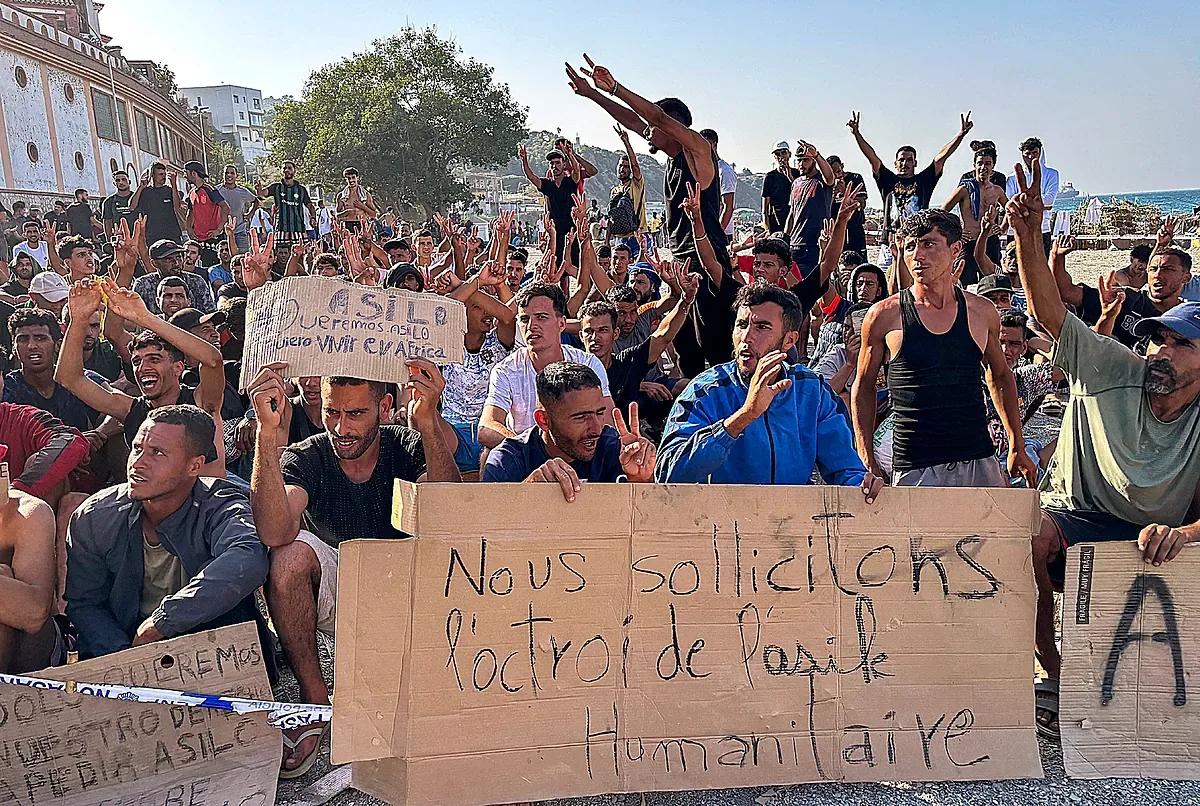
Brussels is closely monitoring the migration crisis in Ceuta and how the Spanish Government is acting. It is estimated that more than 10,000 migrants remain scattered throughout the autonomous city, in very poor sanitary conditions after 19 days exposed to the elements, and the questions hovering over any political analysis of the situation are what will happen to them and when they will be returned to their countries of origin. In this regard, the European Commission has taken the official statements of the Spanish Executive very seriously, in which it is assured that none of the thousands of people still in Ceuta will be transferred to the Iberian Peninsula, binding Pedro Sánchez to fulfill that commitment.
This has been publicly stated by the European Commission, which said it is “important” and that it “takes note” of the statements by the Foreign Ministers, José Manuel Albares, and Interior, Fernando Grande-Marlaska, who conveyed the message that “no one who is illegally in Ceuta will be transferred to mainland Spain.”
The person responsible for emphasizing this phrase was the European Commission spokesperson on Internal Affairs, Markus Lammert, who said yesterday at a press conference in Brussels that they now have “the expectation” that “all those who remain illegally in Ceuta will be returned” to their countries of origin. Including minors.

Brussels therefore takes the statements of Albares and Marlaska as a commitment and “will closely follow the situation.” It is well known that many European countries are wary that the migration and humanitarian crisis in Ceuta could lead to a significant number of migrants arriving on the other side of the Strait, and that they might end up entering their countries.
The truth is that the words of Albares on August 11 and Marlaska on the 13th are clear on this matter. “Those who enter irregularly in Ceuta and Melilla should know, because Spain and Morocco work together on this, that they will be returned. They will not be able to reach the peninsula, nor the European continent, nor stay indefinitely in Ceuta or Melilla,” said the Foreign Minister.
“No person who enters or intends to enter Ceuta and Melilla irregularly […], certainly none of them will stay in Ceuta, none of them will go to the peninsula,” assured Marlaska, who also added that “none of them will be regularized.”
This Government commitment faces enormous challenges, such as managing the return of minors, which will not be easy due to the guarantees in the Spanish and European systems, which require authorities to study cases individually. This will cause even the seemingly simplest cases to undergo a lengthy bureaucratic process with uncertain execution times due to the overload. It is known that there are 2,168 minors in Ceuta. These are the ones identified so far by the National Police from July 30 until yesterday, according to official sources from the Ministry of the Interior. However, it is believed that there are many more in the city, as some hide to avoid being registered for fear of being expelled. Some NGOs raise the figure to 4,000.
Aware of the problem, Brussels is beginning to pressure Spain to ensure that “all” migrants are returned, once Morocco has agreed to cooperate, expressly emphasizing that this “all” includes minors. The Commission spokesperson responded that “this is regulated by EU law” and that the Return Directive approved in June includes provisions for the return of migrants in irregular situations, “including unaccompanied minors.” “So this is also covered by EU law.”
This European directive maintains the line also expressed in the Spanish Immigration Law regarding how to expel minors. There is no automatic or general procedure; on the contrary, there are specific and protective conditions that require authorities to individualize cases and ensure that repatriations safeguard their well-being.
“Before transferring an unaccompanied minor outside the territory of a Member State, the authorities of that State must ensure that they will be returned to a family member, a designated guardian, or suitable reception facilities in the country of return,” the text says. That is, if Morocco cooperates seriously, it can help locate families or offer places in suitable reception centers. With other countries, this will be more difficult and creates a crossroads.
Read more Felt a new earthquake of magnitude 3.4 with epicenter in Ogíjares (Granada)