




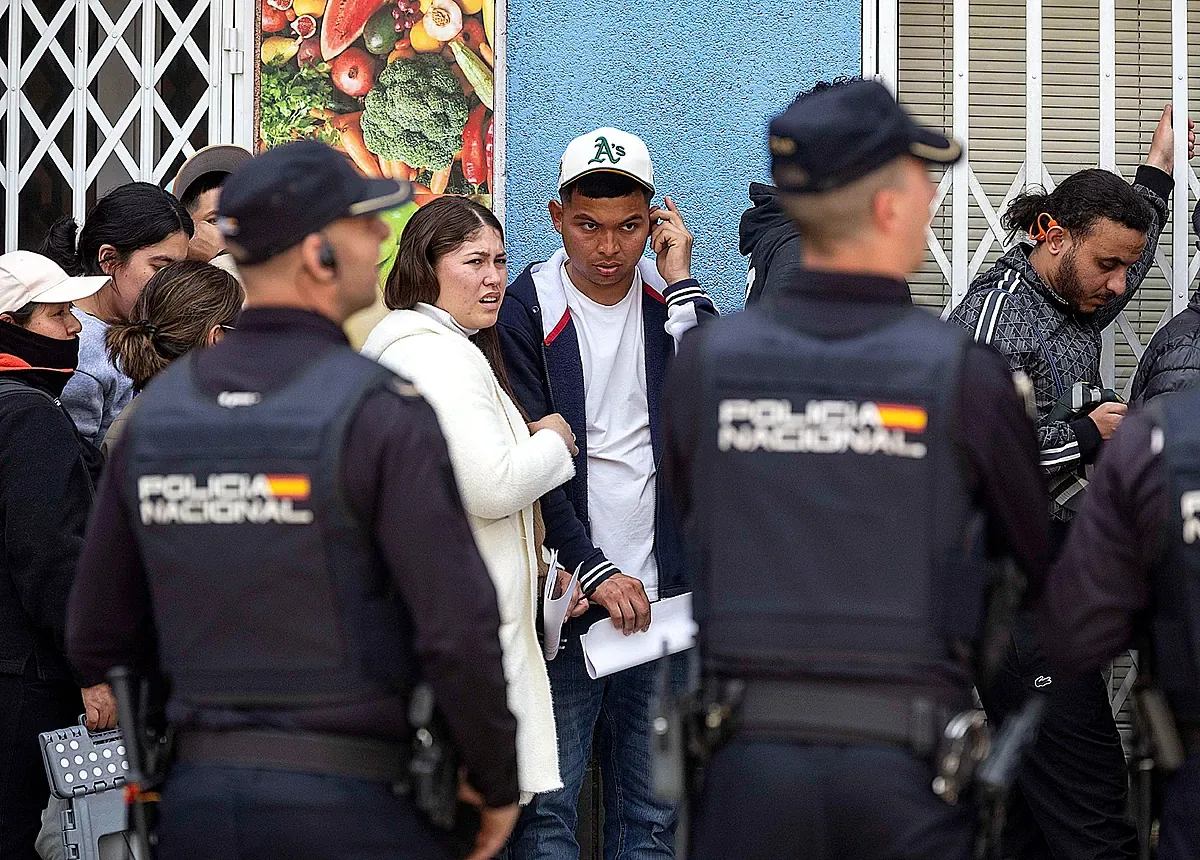
Spain will take in three million immigrants in legal status with their families in one year through the extraordinary regularization process promoted by the Government. This is estimated by senior Immigration officials, who base their calculation on the effect of family reunifications expected to be requested by the 1,200,000 applicants. This issue worries experts in the area a lot. “For every person whose status is regularized, at least three others are added if a reunification is requested and granted.”
Read more Volkswagen warns that it could cut up to 100,000 jobs in total
Furthermore, the heads of the area harshly criticize the Executive of Pedro Sánchez for, they denounce, deliberately sidelining the National Police from controlling the procedures – which is their competence – to leave it in the hands of the Ministry of Migrations. In their opinion, this decision weakens the mechanisms for verifying the authenticity of documents concerning the people in the process and opens the door, they warn, to erroneous checks, for example, of criminal records. The confusion about who was going to handle the processing of files has been constant throughout the process. The intervention of the Immigration brigades is thus reduced, the same sources reveal, to merely administrative tasks. “The Police will be limited to documenting the cards validated by Migration.”
The discontent is evident as they consider that the ministry staff led by Elma Saiz “is not qualified” to process the applications because they lack “training.” “The Government’s will is for everyone to get in,” conclude the senior National Police officials. The Ministry of the Interior, for its part, refers to the Royal Decree. “A police report will be requested as indicated by the Royal Decree” without specifying anything else. The procedure that will be closed, according to the police leadership’s estimates, with a volume of regularizations that breaks any Government forecast. “The system is going to break.” The registered requests overwhelmed the Central Government and gave reason to the National Police, who from the beginning of the process placed them between 1.2 and 1.3 million, more than double the nearly 500,000 that the Government estimated when approving the measure.
“This process is something that no one in their right mind would start. Spain is an exception, that’s clear,” argue the senior officials consulted. They fear that mafias will see a goldmine in family reunifications that, they again indicate, will once more blow up the forecasts. “There may be cases where people from foreign countries pay those already in legal status to let them pass as family members like a child or parents. That is, paying for papers and certificates. Such cases are already seen now, in which they even bring witnesses, but it is quickly detected because there are not that many applicants.”
The General Immigration and Borders Police Station of the National Police warned from the beginning about the scenario that the central Executive put in front of it. It lamented not having received guidelines on how to face this structural reform, qualified by the Government as a “social urgency,” and even drafted a forceful report in which it made clear its total distrust of the process and denied, with data, the “urgency” on which Pedro Sánchez relied.
The document was signed by the central operations chief commissioner of the General Immigration and Borders Police Station of the National Police, Alfredo García Miravete. “Since this project takes as a direct precedent the popular legislative initiative taken into consideration by Congress on April 9, 2024, a need detected almost two years ago, it does not seem to be a sudden situation, nor can it sufficiently justify urgent processing,” reasons a dossier whose conclusions do not see the process clearly. It warned that a regularization of such magnitude could bring “significant negative effects.” Among them, it cited a possible “pull effect” for new irregular migratory flows, as well as social tensions, citizen security problems, and public order issues. It even spoke of the “social distrust” generated, it pointed out, “about border management.” It also insisted on the risk of saturation of public services such as health, education, and social services and predicted that they might not have sufficient capacity to meet the increased demand in a short period. “There is fear in broad layers of the population that a massive and rapid entry of new immigrants will increase the burden on the health, education, and social services systems, which might not have the necessary absorption capacity. The number of foreigners and the very short deadlines that the regulation foresees to perfect the regularization is inversely proportional to the absorption capacity of the Spanish State,” it stated.
It contemplated that if the citizen claims to have requested the certificate of antecedents from their country and states that they have not received it, the procedure may continue while the Administration tries to obtain the documentation. During this time, agents have counted “many” cases of people who have tried to enter the process fraudulently. Immigration even issued an internal alert through an official letter.
Read more Trump reinstates naval blockade on Iran and says he will charge 20% for protecting ships in Hormuz