




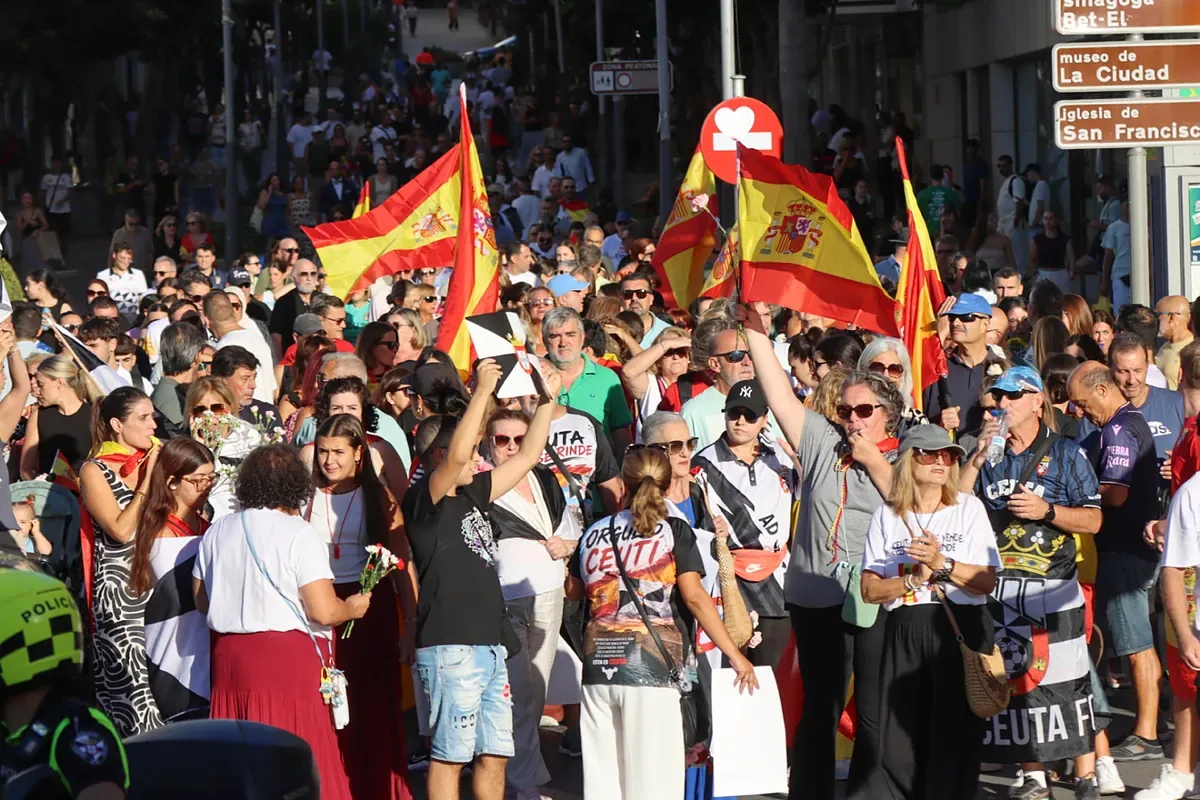
Spaniards almost unanimously consider that, contrary to what the Government defends, Morocco is directly involved in the massive entry of immigrants and subsequent invasion that took place in Ceuta on July 30 and that, a month later, is about to lead the autonomous city to social outbreak, after the incidents that took place the day before yesterday and included the burning of shanties of foreigners.
Read more The Government drops the case against Holaluz and halts the transfer of its customers
The latest barometer from Sigma Dos for EL MUNDO indicates that 90.4% of Spaniards believe that the Moroccan regime is behind the irregular incursion of up to 72,000 of its citizens into Ceuta. This opinion is also shared by voters of the parties that make up the Spanish Executive: 91.3% of PSOE voters and 92.9% of Sumar voters point to the State of Mohamed VI as responsible and, therefore, reject the Government’s argument, which continues to publicly and repeatedly exonerate Morocco, applauding its “cooperation” in resolving the crisis. Only 3.8% see it the same way. Just yesterday, the Foreign Minister, José Manuel Albares, defended that Moroccan aid is proving “essential” to “stop the crisis” and to “prevent a similar situation in the future,” in addition to blaming the July episode on “rumors” on social networks.
This theory is widely dismissed by the Spanish public: 52.6% are convinced that Morocco “knew about the migratory movement” “and allowed it to happen without defending the border,” and 37.8% maintain that it even “has encouraged the entry of irregulars into Spain.” In another question of the survey, when asked to rate the irregular entry of immigrants into Ceuta, 59.7% see it as “a way for Morocco to pressure and blackmail the Government.”
Beyond clearly pointing to Morocco’s responsibility, Spaniards very largely observe that the Government of Pedro Sánchez “has not done enough” to resolve the unsustainable situation in Ceuta. This is understood by 82.2% and is also the position of more than half of PSOE and Sumar voters, specifically 56.9% and 52.7%, respectively.
Faced with the Executive’s inaction, Spaniards believe that the King should visit Ceuta, a scenario not at all desired by the Government. His presence in the autonomous city is demanded by 66.9% of those questioned by Sigma Dos in the survey for this newspaper, which was conducted between August 20 and 26.
The return of foreigners who arrived illegally in Ceuta territory is a priority for citizens, who also demand the return of unaccompanied Moroccan minors who have settled in the city. 77.2% agree with this approach, compared to 13.8% who propose distributing them among the rest of the autonomous communities. As with the other issues raised in the barometer, the majority of voters who supported Sánchez in the last general elections also support the view of the bulk of Spanish society, since 59.1% of PSOE voters favor initiating the forced return of these unaccompanied minors to Morocco.
Spanish society is more divided regarding the level of solidarity that the rest of the State’s citizens are showing towards Ceuta: 47% believe that sufficient support is being given to compatriots affected by the arrival and stay of thousands of Moroccan immigrants in their city, while 52.9% consider that this support should be greater.
The survey reflects that Spaniards also disagree with continuing to treat the southern neighbor with kid gloves, as the Government proposes. When asked how to guarantee border security in the future to avoid new mass incursions of immigrants, allowing multiple answers, 55% ask to militarize it, 52.8% to sanction Morocco, and 45% to speed up expulsions. The demand for more EU involvement is also among the most supported options; it is necessary for 48%.
The end of the friendship with the African country must also be evidenced by the breaking of future and shared projects between the current partners. This is how a large majority of Spaniards judge it, since 84.4% reject continuing with the joint hosting of the 2030 World Cup with Morocco. FIFA foresees that the next edition of the World Cup, to which the national team will attend as reigning champion, will take place in Spain, Morocco, and Portugal, without the final venue, to which Casablanca also aspires, having been officially announced yet.
TECHNICAL SHEET
Reference population and geographic scope: People aged 18 and over residing in Spain with the right to vote.
Information collection technique: Mixed methodology: telephone (CATI) and online (CAWI) through the Sigma Dos Panel by Trust Survey.
Sample sizes: 2,173 interviews.
Selection of sample units: In the telephone interview by random household selection and application of sex and age quotas in the selection of the last unit. In the case of the panel, proportional assignment by sex and age group has been applied. The sample distribution has been proportional by autonomous community in both samples.
Margin of error: The absolute sampling error can be bounded by ±2.1% for a confidence level of 95.5%, and assuming variables with two equally distributed categories.
Read more One of the three Spaniards missing in Nepal is found alive as the disaster death toll surpasses 580
Fieldwork date: August 20 to 26, 2026
Conducted by: SIGMA DOS SL Calle Velázquez 50, 2nd Floor (28.001-Madrid).
Technical direction: José Luis Rojo Gil / Ignacio Javier Clemente Sierro