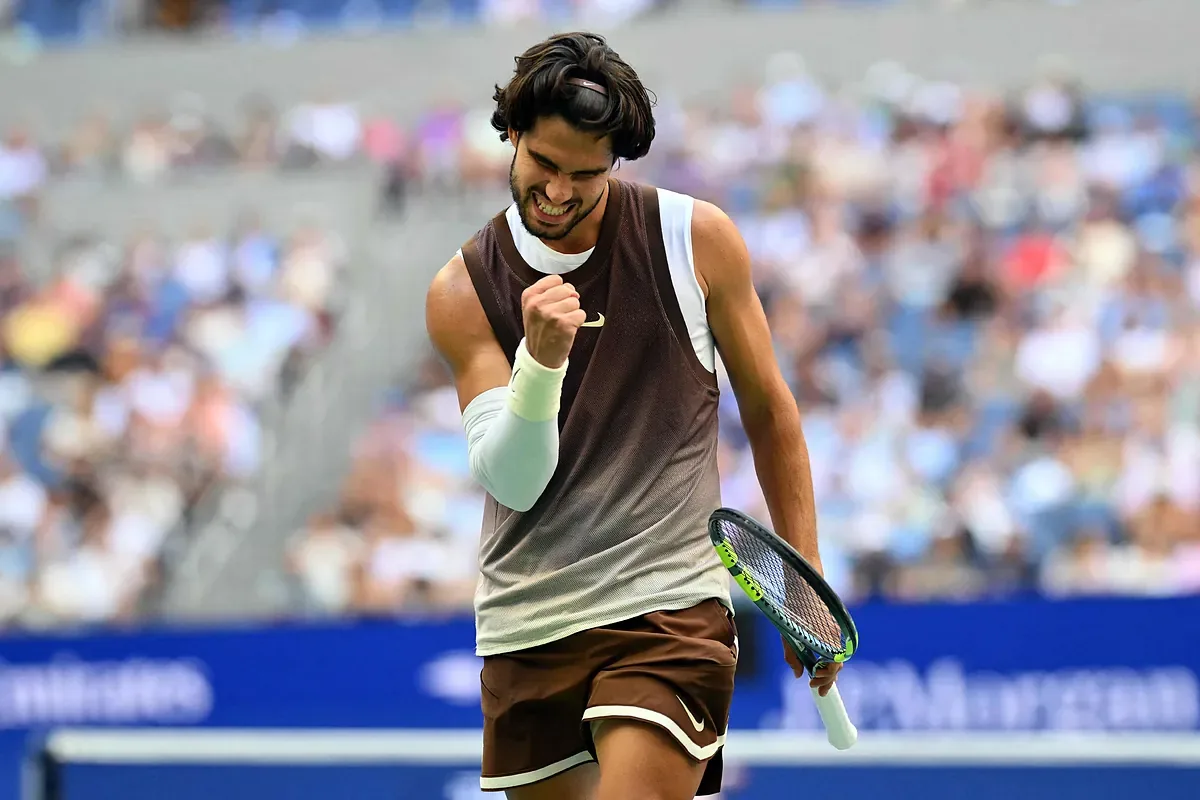




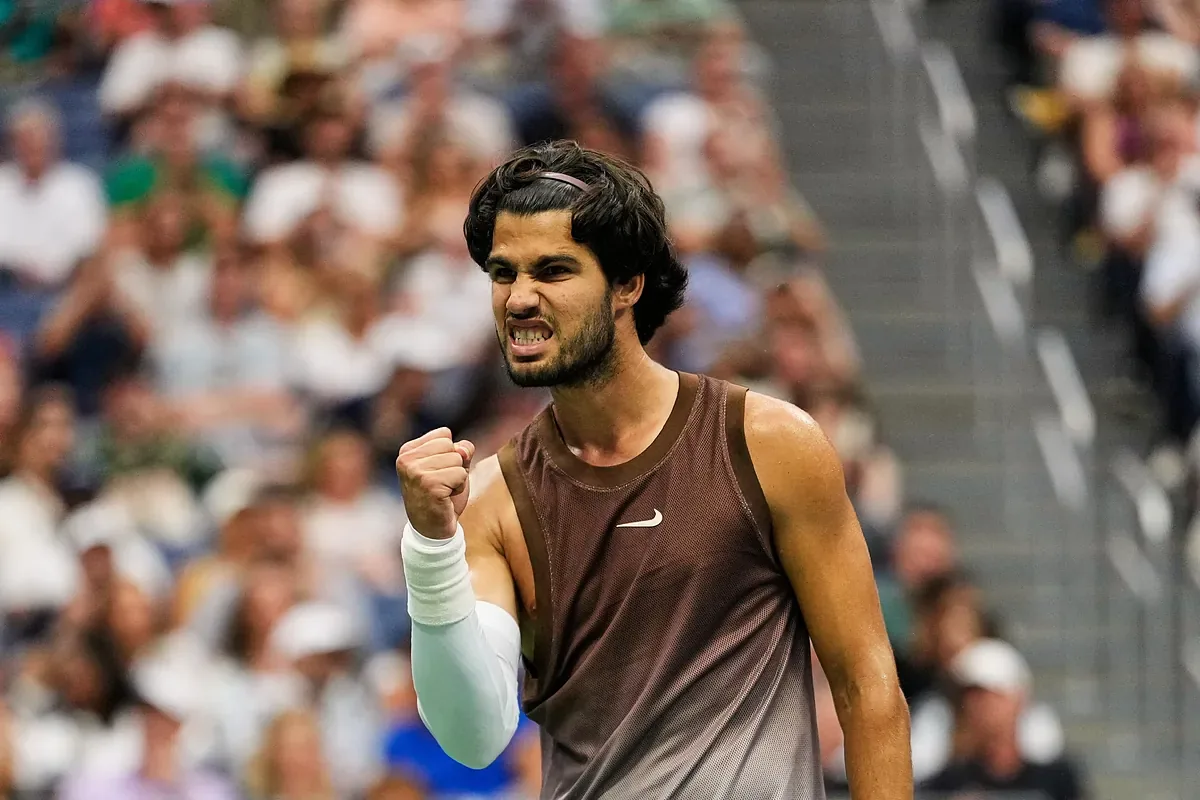
Uncertainty was visible in the eyes of Carlos Alcaraz when he entered the US Open center court without a smile, with the focus of a final, far from his usual relaxation in the early rounds of a Grand Slam. 138 days later, this Monday he returned to play tennis. 138 days later he returned to compete, to demand the maximum from his body, to hit with everything. Not even he knew what was going to happen, as his own team admitted during the warm-up, although he was confident. So much patience to recover from his right wrist injury, so many days of rest, so many measured training sessions, so much caution should allow him to enjoy without pain, without even having to think about it. And that was the best news of his victory over the Russian Roman Safiullin, by 6-4, 6-4, and 6-4.
Beyond wearing a protective sleeve, Alcaraz was able to forget about his long injury and win his comeback match with some comfort. There was tension on the Spaniard’s face, in his gestures, in his celebrations, but there was no discomfort at all. Not once did he touch his right wrist, much less make a grimace.
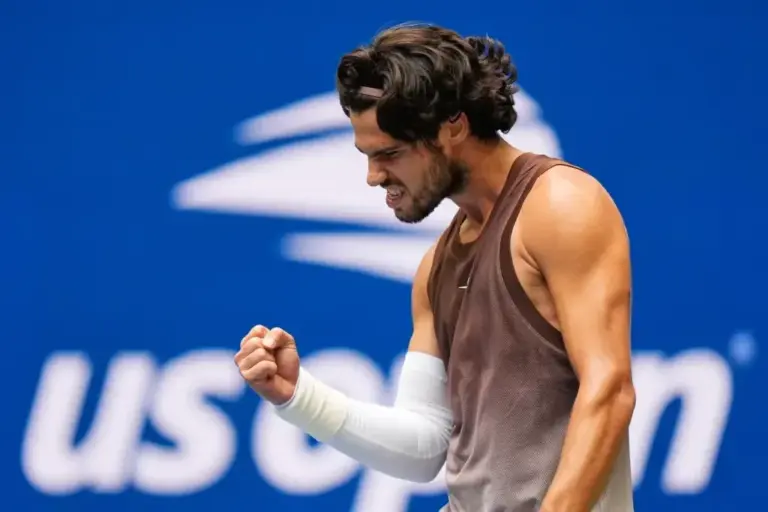
For two hours and 21 minutes he hit the ball with his racket again and again, in every possible way, without any problem. There are many steps left in his evolution and much to consider before calling him a title contender at this US Open, but the path is the right one. Whatever comes now, let it come.
Less speed on the serve
If Safiullin was a concern as an opponent for the comeback, there was no reason for it. The Russian was a quarterfinalist at Wimbledon a few years ago—when he beat Alcaraz himself—and reached close to the top 50 in the ATP rankings, but last year he suffered a complicated hip injury and since then his movements have been slow. He presented as a trap, and nothing could be further from the truth. A rhythm-lacking Alcaraz faced an opponent in even worse condition and suffered just enough. The current world number two barely needed to take risks in his exchanges to dominate them, let his forehand run to impose himself when he considered it, and was never pressured on his backhand. From his first break, the possibility of defeat was always far away, as was the need for overexertion. Even in the last game, with everything already decided, he freed himself from pressure, left a fantastic volley, and pointed his index finger to his ear, euphoric, to once again feel the addictive admiration of the world.
If Alcaraz suffered, it was in one aspect only: his serve. The stiffness from inactivity was noticeable in his service, and each game with it demanded a lot of concentration. Although his first serve percentage was good—ending at 70%—he could get into trouble because, inevitably, he lacked speed. His average on first serves was 180 km/h, when before the injury it approached 200 km/h.
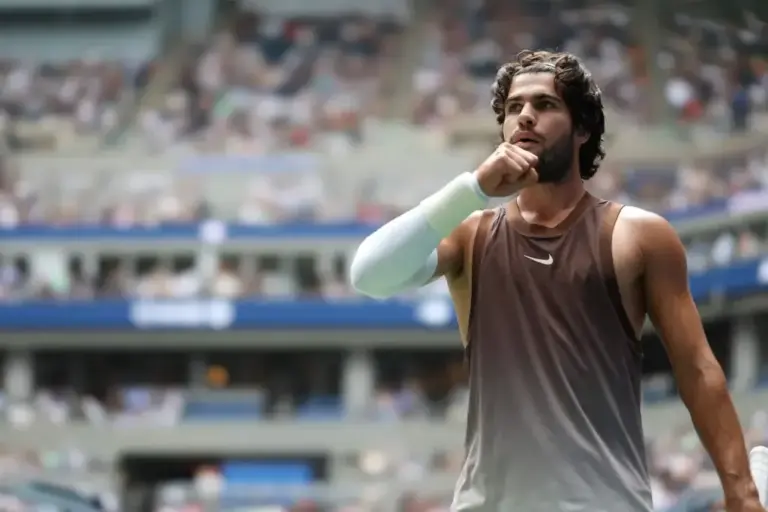
Thanks to this, Safiullin took a break at the start of the second set and forced a comeback, but he could not take further advantage: of the other five break points he enjoyed, Alcaraz did not concede him a single one. In the matches to come, the Spaniard will have to gradually increase power. As he promised, he has not changed his strokes—neither forehand nor serve: he remains himself. He only needs more match practice.
“I have had doubts”
“These have been very tough months, but I am very happy to be here, to compete again. I missed the crowd and the competition and I am really happy,” said the current world number three after the match before admitting some problems: “During the match I had doubts. I didn’t know what would happen if I had to play four or five sets. But I tried to focus on enjoying, on playing my game, on letting myself go. Physically I felt good and that is very good.”
His next chance to improve will be on Wednesday in the second round against an opponent, the Portuguese Jaime Faria, who could prove tougher than Safiullin. A conqueror in the first round of the American Jenson Brooksby —he had a clash with the local crowd, with whom he even confronted—his youth and competitiveness will force the Spaniard to greater effort to achieve victory, although nothing he cannot do. The defeat of Stefanos Tsitsipas by Arthur Fils, one of his possible rivals in the quarterfinals, clears the way but step by step. For now, he has already returned being himself. The path is the right one. Whatever comes now, let it come.
Read more The Ceuta disaster sinks Sánchez and his partners, who have already lost 2.2 million voters