





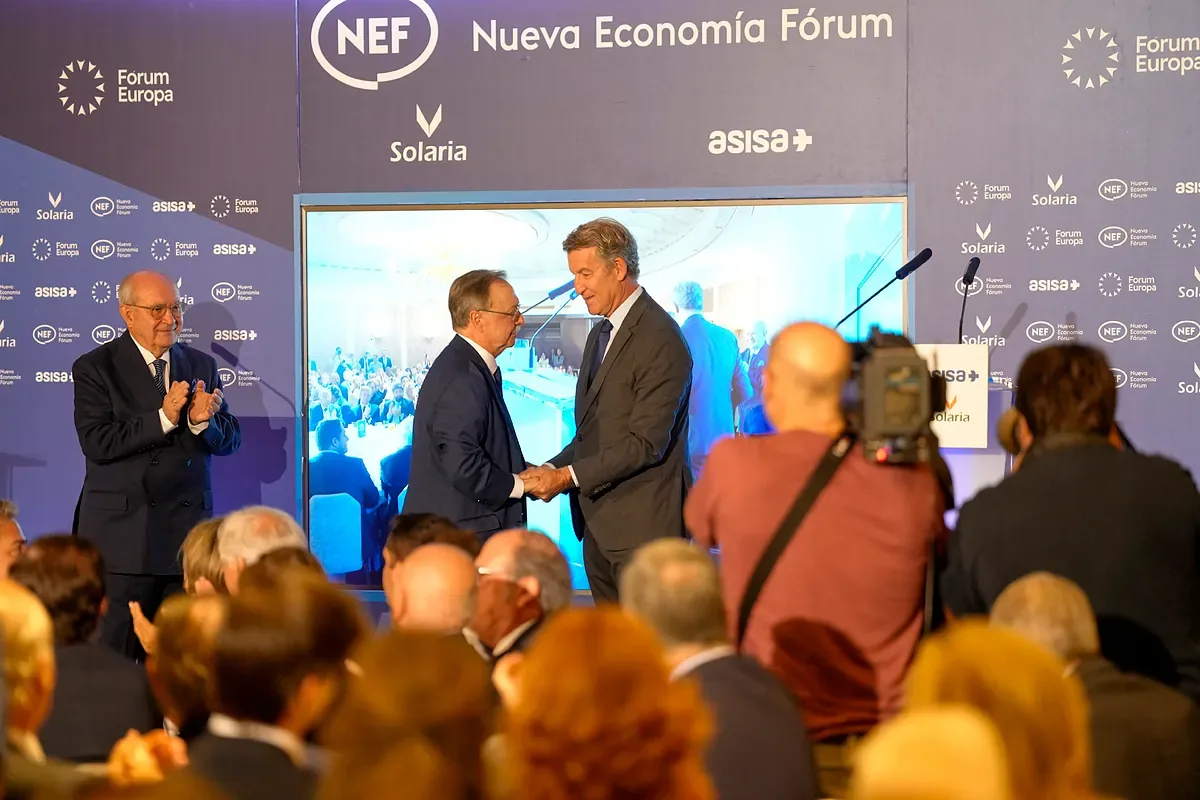
“We are living in a situation of maximum alarm for national security. Ceuta is a pressure cooker that can explode at any moment. Ceuta cannot keep holding on!”. With this SOS, Juan Jesús Vivas summed up the “existential crisis” of his city during an informative breakfast of Nueva Economía Fórum held in Madrid.
The president of Ceuta, introduced by Alberto Núñez Feijóo, warned that if the “return” of “all” the immigrants who entered the autonomous city on July 30 does not happen now, a precedent will be set and there will be a next time. And then it will not be 80,000 “invaders,” he said, but “200,000 or 300,000.” That is, an almost definitive avalanche.
The president of the PP, in his presentation speech of Vivas, assured that this “invasion tolerated and sponsored by Morocco” has clearly worsened due to the “abandonment” of the central government, which “lost its dignity a long time ago.” This “State crisis,” therefore, “is going to last a long time” if the government does not radically change its roadmap.
Such is the distrust of the PP in the government’s response and Morocco’s plans that, according to Feijóo, Vivas has “frustrated” a “plan” that had three acts: “It started with the invasion, continued with resignation, and ended with some kind of concession to the neighboring country” by Pedro Sánchez. But without specifying which one.
Asked explicitly about the latter, Vivas assured that such “concession” will not happen as long as the “cornerstone of our Constitution” is maintained, which is the indivisible unity of Spain: “Our territorial integrity is guaranteed by the State, by the Constitution, and by Europe, and therefore, I believe that neither the Constitution nor the State would ever allow Ceuta to lose sovereignty.” That said, making it clear that the “State” is not only the central government.
Vivas wanted to make it clear that “all indications point” to Morocco, which has always sought to “corner” Ceuta and Melilla. And it “has succeeded very well” this time. “The matter goes beyond the local scope. It is not a migratory crisis, it is an existential, State crisis that affects the sovereignty and territorial integrity of Spain,” he emphasized once again.
Before his fellow party members, the president of Ceuta recalled, first of all, that this is a crisis of Spain and Europe, and that defending the country’s “sovereignty” is “above the acronyms.” “This is not a matter of being right or left,” he said, but of defending “the cornerstone of our Constitution: the indivisible unity of Spain.”
Of the 80,000 people who entered on July 30, 10,000 have stayed, and therefore, “Ceuta has ceased to be what it was.” “It is a huge trauma; the people of Ceuta have lost their peace and joy, they live with their souls in suspense.”
“There is no other way out,” in Vivas’ eyes, than “the return” of “all who entered” Ceuta. “If there were another way out,” he emphasized, we would be encouraging “the avalanche to be repeated,” “but not with 80,000, but with 200,000 or 300,000.” And he demanded “a date” for that exit of all returns. “We ask the government to specify the date on which Ceuta will return to normality.”
Asked about the declaration of the “state of exception,” to be able to return all the immigrants who entered Ceuta at once, Vivas said that it is not up to him to say what instrument to use, but the State “has” levers to do so, and it is a matter of “political will.”
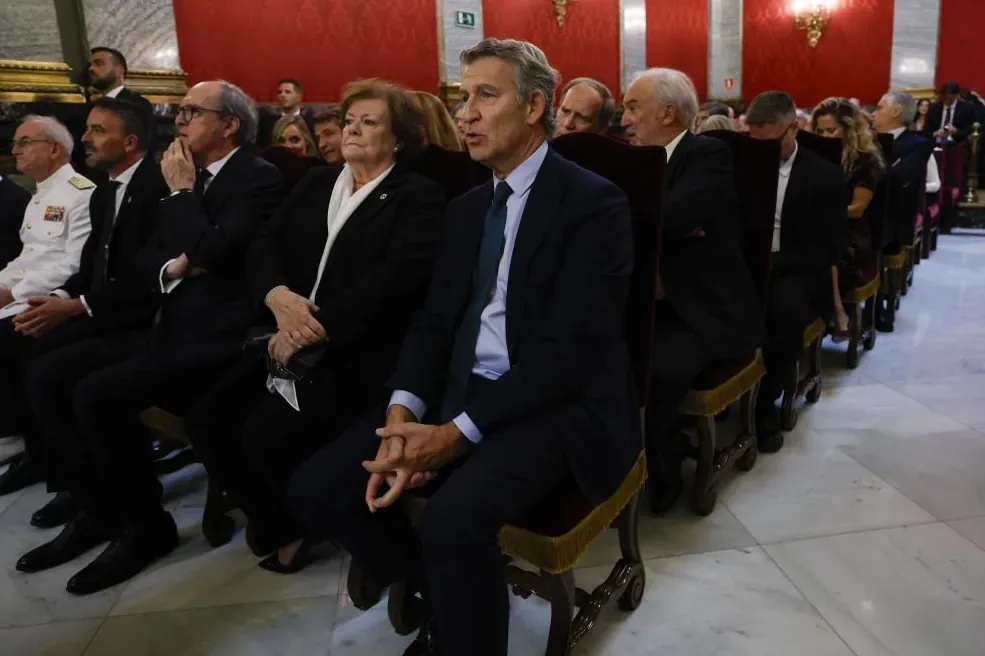
The entire PP, as a block, wanted to support Juan Jesús Vivas this Monday in the deepest crisis in the recent history of Ceuta. In addition to Feijóo and the entire Génova board, led by Miguel Tellado, seven regional presidents attended the breakfast: Juanma Moreno (Andalusia), Isabel Díaz Ayuso (Community of Madrid); Alfonso Rueda, president of the Xunta de Galicia; Fernando López Miras (Murcia); Alfonso Fernández Mañueco (Castile and León), Juanfran Pérez Llorca (Valencian Community) and Juan José Imbroda (Melilla).
The latter took the floor to assure that “the worst thing is not having a plan” and that “it is a big mistake” that Spain only dedicates itself to “conceding” with Morocco. “We still do not know why we left the Sahara.” And, moreover, he lamented, Pedro Sánchez “does not call” Feijóo and behaves in an “ineffective” way.
“Ceuta is burning right now, and it can explode, and Morocco claims Ceuta and Melilla,” but the government does nothing, he stressed. For Imbroda, Sánchez has given “a slap” to all Spaniards when, in the middle of the crisis, he was “bathing in the Canary Islands.” “We still have a failed government,” he concluded his speech.
Ayuso also took the floor, wondering how far Morocco’s threat will go, and focused on “security,” because it is not known who has entered, at a time when Spain is “in jihadist alert.” Sánchez, she said, “is responsible for what happens from now on, because something is going on for it to be a carpet with Morocco,” from agriculture to the World Cup, passing through the Sahara and, obviously, Ceuta.
Also attending the event were the mayor of Madrid, José Luis Martínez-Almeida; Mar Vaquero, vice president of the Government of Aragón; Javier de Andrés, president of the PP of the Basque Country; Alejandro Fernández, regional president of the party in Catalonia; Paco Núñez, president of the Popular Party of Castilla-La Mancha and Álvaro Queipo, president of the PP of Asturias. Even Albert Rivera, former president of Ciudadanos, attended.
This informative breakfast takes place one day before the president of Ceuta meets in Brussels with the European commissioners for Interior and Migration, Magnus Brunner, and the Mediterranean portfolio holder, Dubravka Šuica, with the aim of addressing the situation of the autonomous city after the unprecedented invasion of more than 70,000 immigrants. Likewise, Juan Jesús Vivas will also meet on Tuesday with Manfred Weber, president of the European People’s Party, and with Roberta Metsola, president of the European Parliament.
The King insists on going
“I am going to Brussels to explain what has happened in Ceuta and to seek the technical and political assistance of the EU,” emphasized the president of the autonomous city, who again predicted that the King will visit Ceuta “soon.” Felipe VI himself told him this on August 6, in Marivent. “And he told me again on September 2 when he called me to convey affection to the people of Ceuta,” he revealed.
What Vivas has most demanded is that there be “a before and after” in his city. “And that consists of Morocco having to respect us,” he developed his argument. “The border must be in the hands of Spain and Europe; the State cannot withdraw in Ceuta; on the contrary, it must be reinforced.”
But Sánchez’s government “has not been up to the constitutional obligations attributed to it.” “Neither before nor after” the “invasion.” Because “intelligence services indicated even the day the barbarity, the invasion, was going to occur.”
“Indolence, irresponsibility, or that Morocco is not bothered… it may be part of all three, but none of them justifies that Ceuta is going through this torment,” he lamented. In that sense, the truth must be known, because only from the truth can “return to normality, with tranquility, calm; that ordinary life returns.”
For Feijóo, “Ceuta needs investments, infrastructure, and opportunities,” but “above all it needs defense, with a border that is not plastic.” And with “moral” certainties, he stressed. “The current government does not guarantee security. But there is a nation that is not seen, that does not back down. From Sumar to ERC they have understood that the one who should have led this crisis first went on vacation and then came back lying,” he criticized. Everyone will think in the future, he said, that Sánchez “was not up to the task“.
The president of the PP put on the table three commitments of his party for Ceuta: “normality,” “truth,” and giving “national priority” to that city. “That the State is present, listening to the city, not imposing, as it did this weekend,” he criticized, referring to the use of the Ceuta port as a place to deploy tents to house immigrants, “against everyone’s criteria.” “Locating 1,000 migrants a few meters from the cruise ships is a great irresponsibility.”