







In Congress, the president wielded the Treaty of Wad-Ras as indisputable confirmation of the Spanishness of Ceuta and Melilla. That agreement ended the African War in 1860, a century before the birth of modern Morocco, and meant, among other things, the acceptance of a larger perimeter for Ceuta and Melilla by the sultan. But history moves and does not stop in the archives. Constantinople fell and Rome fell, Cuba and Sidi Ifni — whose sovereignty was also guaranteed in Wad-Ras — were lost, without any rigorous jurist being able to object much. And Ceuta and Melilla will fall if there is no real will to defend them.
Read more Marlaska exonerates Morocco from the Ceuta crisis despite reports pointing to its gendarmes
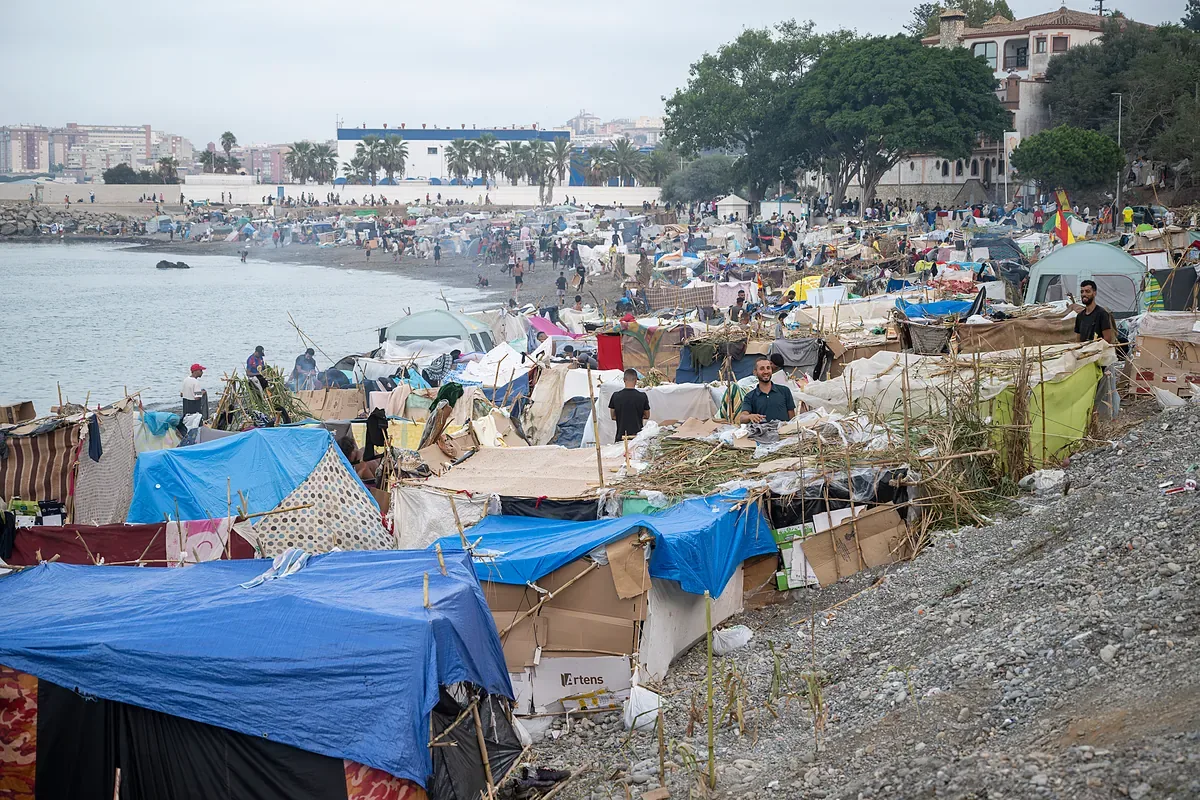
The first step to face a threat is to recognize it. So far the Spanish Government has denied that there is evidence of a new version of the Green March, while it is evident to many experts and to the rest of the political forces in Parliament, including the government’s minority partner. In the absence of more precise details, what happened leaves two main hypotheses: either it was a colossal exercise in incompetence — hardly believable in a regime like Morocco’s — or a directed and planned attack, perhaps out of control, in which human ammunition was used to break down the border.
It is not necessary to go back too far in time to find striking precedents clearly linked to Rabat, such as the 2021 assault in that same setting. Morocco has the patience to dispute every inch and to dose conquests over years or decades, until there is nothing left to defend or it becomes too costly to do so. The defense of our borders in Africa is completely in their hands, in those of a country that openly aspires to control Spanish territory. A bad deal.
In the Ceuta attack there were desperate masses. In Germany, ghost drones that try to leave no trace. So far German authorities have faced this low-intensity war cautiously, generically pointing to foreign powers although all suspicions focused on Moscow. This time they have openly pointed to Russia and Brussels has backed them. The warning serves Berlin to Europeanize the response.
In Spain, the same has not happened. How to obtain that support if the victim reduces the attack — as President Sánchez called it at first — to a migratory crisis, later comparing it to the waves of small boats arriving in the Canary Islands? Appeasement grants several rewards to the aggressor: it exposes Spain’s subordination at its own border and the State’s inability to speed up triage and the possible expulsion of those who entered illegally. The result is a local, national, and European crisis and the validation of the attacker’s strategy who will be able to repeat it in the future because it finds no response or punishment. Not even an accusing finger.
Read more The jihadist twin Chakir… and the other 13 radicals expelled after sneaking in through El Tarajal