









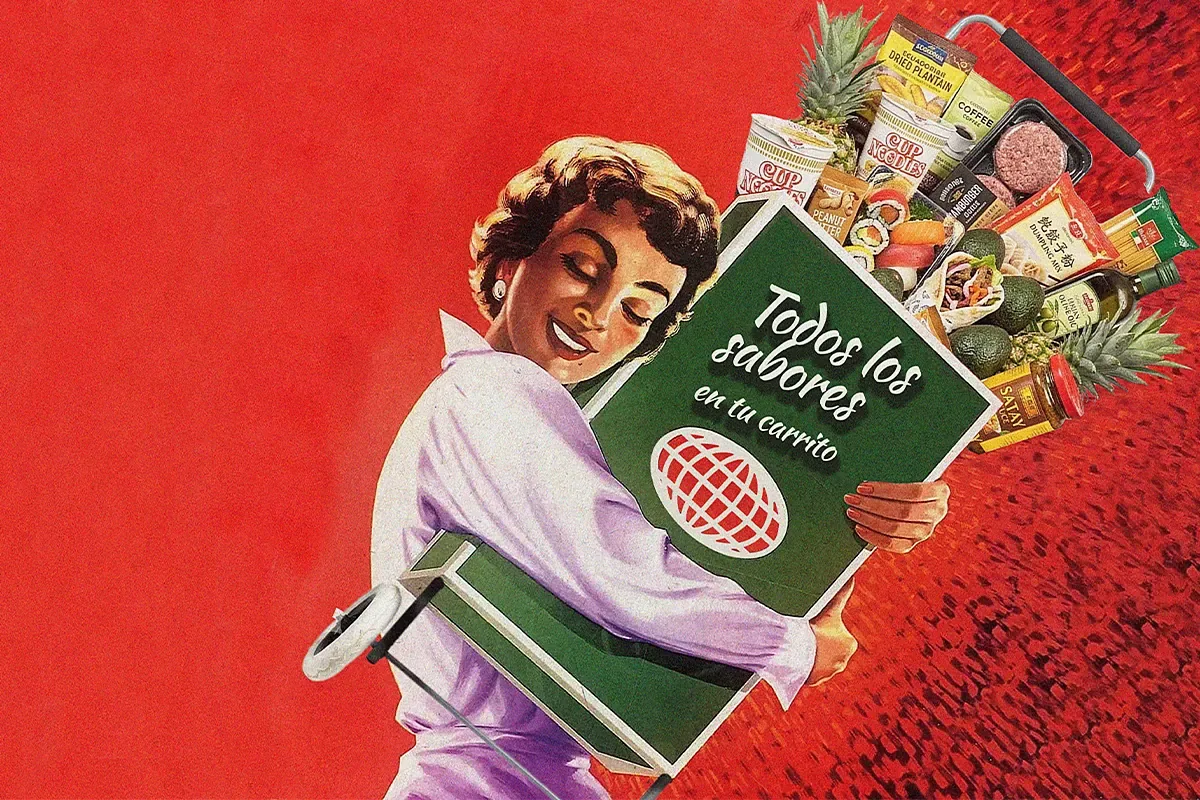
Tastes change. Habits too. And behind them, something deeper is changing: the way Spain buys, eats, and decides what to spend its money on. Wine has given way to specialty coffee; beer now competes with its own non-alcoholic version; the traditional stew coexists with ready-made lasagna that heats up in three minutes; and supermarket shelves feature products like kefir, cottage cheese, or Dubai chocolate, which barely existed in Spain a couple of years ago and today are growing at a pace that sometimes overwhelms their own manufacturers. Others like avocado or mango, once almost exotic products, are now part of the regular basket of millions of households. There is even speculation about a possibility that would have seemed absurd not long ago: that the house of the future will do without the kitchen as we know it.
Read more The Sultan’s Word
Spain is changing from within, and these changes end up appearing in the shopping cart. An older and more diverse population, smaller households, less time to cook, prices that force choices, growing concern for health, and social networks capable of turning an unknown food into a mass phenomenon in a matter of weeks are reshaping consumption. For large retailers, it is no longer enough to know what the consumer buys. You have to understand why they have stopped buying what they used to buy, what has taken its place, and how much they are willing to pay for it. Because behind every new product, every growing category, and every food that disappears from the basket, there is more than a trend. There is a transformation of the consumer. And with it, a battle for the bottom line.
And the first change is also the most obvious: Spain has more consumers than ever. At the close of this article, the country has not yet reached 50 million inhabitants, but it is about to cross that threshold. According to the Continuous Population Statistics of the INE, the resident population stood at 49,801,559 inhabitants as of July 1, 2026, a historic high, after adding more than 100,000 people in just the second quarter of the year. The engine of that growth has a name: immigration. For the first time, more than 20% of residents in Spain—about 10.3 million people—were born outside the country, while the population born on Spanish soil continues to decline quarter after quarter. This is not just a demographic fact but also a market fact. Every new resident is, from day one, a consumer who buys clothes, does the weekly shopping, decides where to eat, and what brand of coffee to take home.
This increase in the number of consumers is not an abstract figure. It is already noticeable on the shelves. And the egg is perhaps the clearest example. Since 2025, it has become one of the products that have most increased the cost of the basket at certain times, and behind that pressure is more than just a growing population; Spaniards are also eating more eggs. Household consumption has increased by around 20% since 2019, driven, among other factors, by a change in nutritional recommendations, which have gone from limiting consumption to two units per week to even allowing daily presence in the diet. “Eggs are in fashion,” summarizes Mari Luz de Santos, director of Federovo, the federation that groups producers in the sector. More consumers, each buying more, have also encountered a supply shock derived from various avian flu episodes that forced the culling of part of the laying hen census in Spain.
Households born in Spain show clear signs of exhaustion, with widespread declines in the purchase of goods. Those formed by foreign residents, already 14% of the total according to the report Seven Million Reasons to Grow by Worldpanel by Numerator, do just the opposite; they have become the great engine of domestic demand. In textiles, they grow by 11% compared to a 5% drop among native households; in beauty, they advance 4% versus a 4% decline; in major household consumption, +12.4% versus -2.4%. They only agree in one area: caution in hospitality and leisure outside the home, where both profiles hold back, which has caused a shift in leisure hours. According to data from the payment platform Sipay, lunches generate almost twice the revenue of dinners, and it is even more pronounced after midnight—the classic time for drinks—whose revenue is ten times lower than that of three in the afternoon. In that shift, the “tardeo” has found its place, socializing that starts mid-afternoon and gradually takes ground from the night.
That “tardeo” is not just a change in schedule; it also involves another change in habits. Socializing that was previously concentrated at night and around drinks is now spread over time slots where alcohol weighs less and less, and here appears the most cited symptom of this whole transformation: the withdrawal of alcohol from the daily life of Spaniards, especially the youngest. The latest report from the Ministry of Health confirms the farewell to alcohol among young people, with a 60% drop in habitual consumption among 15 to 24-year-olds in the last two decades, but the full picture is more complex. Spain leads abstinence in Europe, at 33.4% versus the 26.2% average, and at the same time ranks second continentally in daily consumption, only behind Portugal, a market polarized between those who do not drink at all and a core of habitual consumers who concentrate most of the volume.
These pattern changes are already felt in sales figures. In 2024, per capita beer consumption fell by 4.9% and wine by 5.2%; beer sales dropped 0.2%—the second consecutive annual decline, something not seen since the 2008 crisis—and spirits sales fell 3.7% in volume, although sector revenue managed to hold around 7.2 billion euros thanks largely to nearly 100 million foreign tourists who visited the country. The sector does not attribute the phenomenon to a single cause but to a combination of factors ranging from geopolitical uncertainty and rising leisure costs to weather, and a generation that simply socializes differently, with less street and more screen. And here lies the key that connects this first movement with all the others: when the way of relating changes, so does what is bought, when it is bought, and from whom it is bought.
Read more Marlaska exonerates Morocco from the Ceuta crisis despite reports pointing to its gendarmes
The business response to the alcohol slowdown has been quick and, above all, diversifying, and in that diversification the rest of the report can already be sensed. Mahou San Miguel has offset part of the beer decline with the growth of its bottled water Solán de Cabras and has expanded its portfolio to energy drinks, wines, and even specialty coffee, with the launch in 2026 of Café 170º. Damm has built a portfolio ranging from tonics to dairy and soft drinks, and Hijos de Rivera, parent company of Estrella Galicia, has added waters, ciders, wines, and, in the last year, spirits. The message is unanimous: those who manufacture alcohol in Spain no longer just manufacture alcohol; they manufacture whatever the new consumer is asking for. And what they increasingly ask for is the non-alcoholic version of the usual. Spain already leads the production of 0.0 beer, which represents 14% of the total marketed and 16% of home consumption, with brands like Tanqueray 0.0—close to 20% of total gin sales by Diageo in Spain—or the Spanish premium non-alcoholic gin Nordés confirming that abstinence is no longer a niche but a business category with its own trajectory.
That same consumer who drinks less and at different times is almost always the same one who cooks less. “By mid-21st century, there will be no kitchens,” predicted Mercadona’s president, Juan Roig, in 2019, a provocative phrase that, however, finds support in the figures. The Ready to Eat section of the Valencian chain, launched eight years ago, is already present in nearly 1,500 of its 1,674 stores and contributes about 1 billion euros to the group—3.3% of its total revenue, more than its entire online channel weighs. The rest of the industry agrees with the diagnosis, although it nuances it: the kitchen will not disappear, but it will change function, being reduced to weekends and special occasions, while during the week time is scarce and cooking becomes a leisure activity rather than an obligation. The prepared food market—refrigerated and ready to take away—already moves almost 3.8 billion euros and grew 11% compared to 2024, double the overall food distribution growth. Spanish households consumed a total of 715,052 tons of prepared dishes in 2025—about 18 kilos per person per year—and behind that leap are structural drivers repeated in almost all chapters of this transformation, starting with the rise of single-person and single-parent households, which according to the INE will represent a third of the total in 2039, teleworking, population aging, and a generation accustomed to the immediacy of digital consumption, which transfers to the fridge the same “want it now” logic applied to a series or an online order. Mercadona dominates this board with a 19.7% value share—ahead of bars, cafes, and independent restaurants—followed by Carrefour and Lidl, while Dia has boosted its category sales by 36%, and even century-old brands of canned goods and spices, like Carmencita or Carretilla, have been forced to reinvent themselves.

The time no longer spent cooking is not necessarily recovered by saving but reinvested, either in health or experience. Coffee is the example of a product going from everyday to one for which young people are willing to pay up to nearly six euros per cup, distinguishing between a gourmet profile seeking sophistication and a functional profile opting for capsules, a category in which those under 35 weigh 13% more than the market average, with coffee bean consumption already growing 14%. Health is the other side of that reinvestment, and it is best seen in categories that a few years ago barely appeared on the average Spanish shelf. Kefir grows 46% in volume and cottage cheese 58%, a sign of how the search for foods that combine health and convenience is reconfiguring entire categories beyond the classic focus on fresh fruit and vegetables.
Cottage cheese is, in fact, one of the clearest cases of this tension between demand and supply. Its consumption soared 61% in 2025, driven by viral recipes on social networks and the rise of protein-rich diets, a boom that even caused supply problems at Mercadona. In response to that demand, Entrepinares, the largest cheese supplier to the Valencian chain, has announced an investment of more than 20 million euros to launch a new production line at its Villalba factory to supply an appetite that, just a couple of years ago, was practically nonexistent in Spain. Dubai chocolate, which went viral on TikTok, also caused stock shortages and supply tensions for pistachios.
Lack of time has also changed the way we shop. More local stores and fewer hypermarkets are forcing chains like Carrefour or Alcampo to change their model. Price pressure has done the same with private labels, which have ceased to be the cheap option to become the default choice for many households.
All this readjustment—more population and more diverse, less alcohol, less cooking, more health, more private label, more proximity—is not only fought on supermarket shelves but also in the structure of the large multinationals operating in Spain. Coca-Cola Europacific Partners, the world’s largest Coca-Cola bottler and of Spanish origin, celebrated in 2026 a decade since the integration of three European bottlers that gave rise to the current group, now present in 31 countries with more than 20.9 billion euros in revenue. Its turnover in Iberia has grown 31.5% since 2016, reaching 3.429 billion euros, and its market capitalization has more than doubled in the same period. Its president, Sol Daurella, summarizes a thesis that could well apply to everything described so far. It is possible to grow internationally without losing proximity to the markets, customers, and communities in which you operate. That combination—global size, local roots—is, at heart, the same one being gropingly pursued by the brewer launching coffee, the supermarket opening franchises, the century-old cannery starting to sell refrigerated dishes, and the spice brand reinventing its catalog to avoid disappearing.