


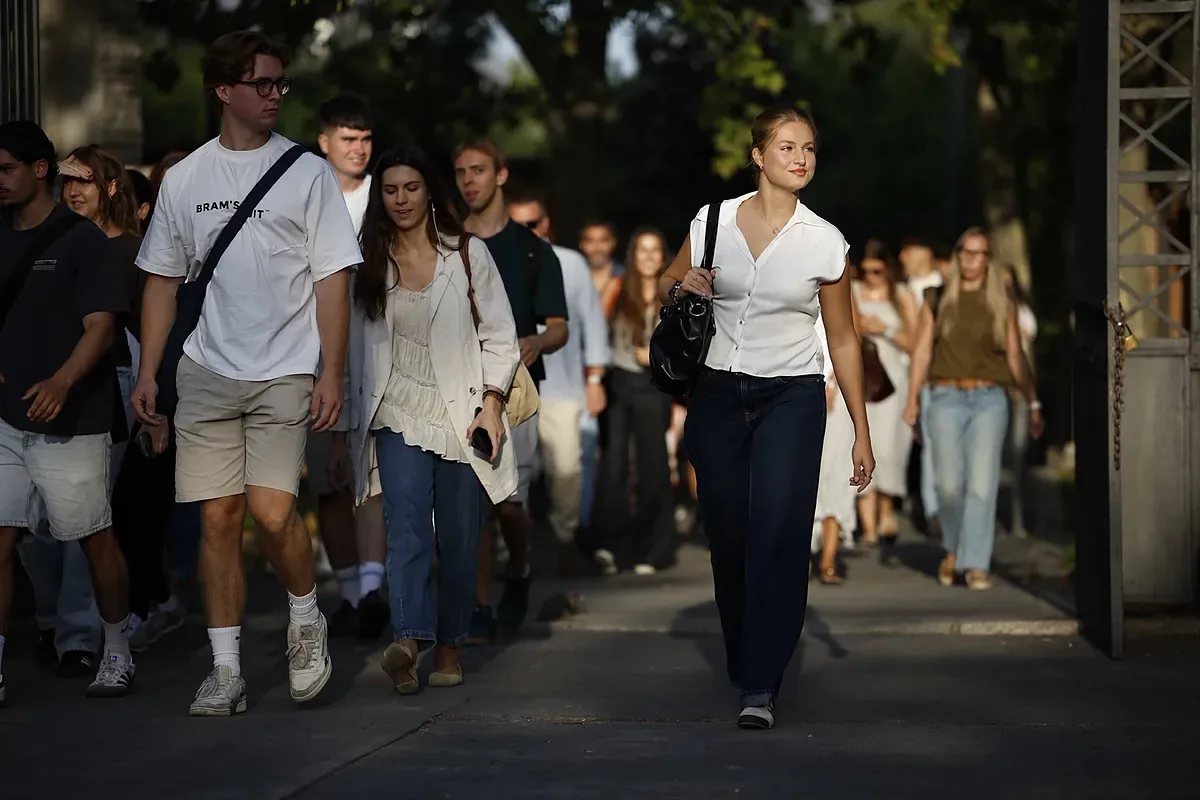
A shy smile appeared on the face of Princess Leonor upon her arrival at the Universidad Carlos III de Madrid (UC3M). With her handbag in hand, dark blue jeans, sneakers, and a steady gaze, she stepped onto the Getafe campus for the first time. Her father, King Felipe VI, once chose the Universidad Autónoma, where he studied Law. “The university stage is a turning point in the life of any student,” the monarch stated more than three years ago during the XXX anniversary event of his faculty, from which he keeps “a collection of invaluable memories from that time.”
Read more Iran expands its military standoff with the US in the Persian Gulf
And now, after 12 years of reign, Don Felipe witnesses the new step his daughter, the heir, is taking, who today traveled for the first time the little more than 20 kilometers that separate the Zarzuela Palace from her new campus in Getafe, where the next four years of her university life will take place while she pursues a degree in Political Science after successfully completing her military training over the past three years. Doña Leonor will follow the same curriculum as the rest of her classmates.
The Kings announced at the end of April the higher education chosen by the heir who, as expected and just as her father did, has opted for a Spanish public university after completing the International Baccalaureate in Wales. The decision on the degree was made by the Princess of Asturias herself with the approval of Felipe VI and Queen Letizia.
At the university center, Leonor was welcomed by a wave of students who, amid the excitement and uncertainty of what it will be like to share a class with her, could not help but approach and witness her arrival. Everyone wanted to be present, and no one seemed to mind that it was 9:00 in the morning. They needed to be part of the exact moment when the future queen stepped onto their university for the first time.
But within those groups formed among the students who, like the Princess, begin their university life today, there are various opinions about what that “normality” that Carlos III has wanted to emphasize from the start will be like. “I feel sorry for those who enter. They will not know what normal life is,” say Lucía Jiménez and Sara López, fifth-year students of the double degree in Political Science and International Studies. Word of mouth has taken over the campus, and the idea that the university itself restricts the use of mobile phones in classrooms is considered “a show.”

In contrast to this is Inés Garnica, who initially went to choose the same degree as the Princess but finally opted for Economics and Law. “I think I have her in class and I don’t focus on the desk,” she said, highlighting “the shock” she experienced on her first day of class. “We welcome her with much affection,” says another student.
The university rector, Ángel Arias, welcomed the Princess at the entrance of the facade where Leonor will study, emphasizing the “maximum normality” with which they intend for her to spend her four years of undergraduate studies and trusting in “the responsibility of the students.” “I am convinced that she will have excellent classmates who will be very respectful, as they always have been,” he stated, also highlighting what the arrival of the princess means for a public university “increasingly demanded and valued by society.”
In the coming days, the Princess of Asturias will start classes at 9 in the morning, finishing the day at two in the afternoon. “Some days earlier, other days later, depending on the schedule fit,” said the dean of the Faculty of Political and Social Sciences. Additionally, it is not ruled out that the heir’s trajectory will include complementary training in specific subjects (especially related to Law), to which a master’s degree abroad could later be added, emulating the current monarch’s path. At this point, she will differ from her father, who studied Law at the Universidad Autónoma de Madrid (UAM) and complemented his training with Economics courses.
But now, without looking at schedules and with the greatest “normality,” Leonor leaves behind her military education of the last three years. Institutional speeches and what was experienced in the three armies remain stored in the same handbag she carried today on her shoulder and with which, with the conviction and weight of being the future queen of Spain, she becomes part of that “turning point in the life of any student” that her father once described and lived.
A DEGREE FOCUSED ON ANALYSIS AND PUBLIC SERVICE
To formalize her admission, the eldest daughter of the Kings processed her application through the early admission process, a route through which a reduced percentage of students enter UC3M, where barely two out of ten are Spanish. According to Zarzuela, her file received the favorable resolution from the Evaluation Committee, which assessed both her previous academic record and her grades.
In the case of classmates who entered through the ordinary EBAU route, the cut-off score set by UC3M for this course in Political Science was 10.728 points, which represented an increase of 1.19 points compared to the 9.542 recorded in 2025.
UC3M expressed its “great joy” after confirming the heir’s choice of “one of the most prestigious public universities” in Spain, assuring that she faces this stage “with great enthusiasm and a high sense of responsibility.”
The degree, established in 2008 and with a quota of about 30 new students per year, aims to “train specialists and professionals prepared to understand and analyze politics in all its complexity, with rigor and depth,” according to the institution’s website.
The program promotes critical thinking and directs its profile towards public administration and political analysis, registering an employment insertion rate of 94.8% in related positions during the first year after graduation.
The curriculum, structured in four years of two semesters, combines basic training subjects with mandatory and elective courses.
The latter, which include subjects such as Fundamentals of Political Science, Theory of Law, Constitutional Law, Public Management and Administration, or Political and Social History, are mainly concentrated in the first year, with some spread into the second.
Regarding the mandatory subjects, they are mainly taught in the second and third years, although there are some in the first year, and include disciplines such as Expression Strategies, World Politics, Political Behavior, Administrative Law, or Humanities.
In the final year, students will have to complete the 48 elective credits included in the degree, as well as carry out and defend the Final Degree Project (TFG). It will then be when Princess Leonor, according to her interests, can choose from a wide range of subjects such as Fundamental Rights and Their Guarantees, Politics and Gender, Immigration, Multiculturalism and Human Rights, Conflict and Violence, or Climate Change and Social Transformation.
Additionally, students have the option to take several of these subjects in English, including World Politics, European Politics, Principles of Economics, Humanities, or Interpersonal Professional Skills.
Read more Less alcohol, less cooking, and TikTok decides what we buy: this is how consumption has changed