







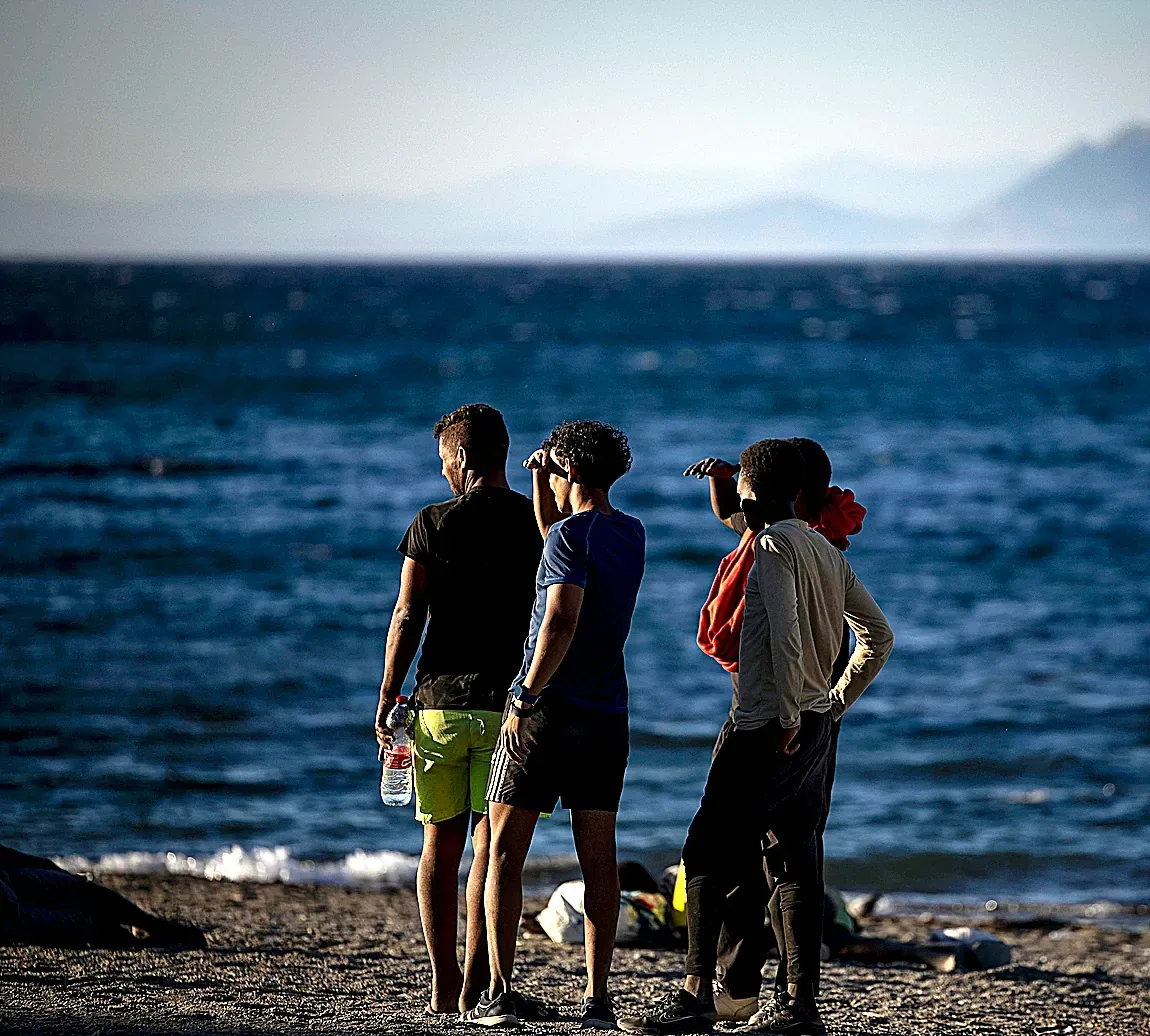
Persecution for being homosexual or for political reasons. These are the reasons cited by the vast majority of Maghrebian immigrants in Ceuta for trying to stay in Spain, according to what immigration officers and members of the Asylum and Refuge Office (OAR) have gathered in the initial interviews, as EL MUNDO has learned from sources involved in the ongoing processes.
Read more Alberto Núñez Feijóo: «Morocco’s aggression continues and Ceuta will be Sánchez’s epitaph»
A piece of news that, for those usually involved in these procedures, will not be so surprising: “It’s what migrants always do, coached by NGOs: invoke political or LGBTI persecution,” police sources from Immigration explain to this newspaper. “NGOs tell them, or they tell each other. It’s their way of trying.”
As has been recorded in the first interviews with immigrants who arrived in Ceuta during the massive assault on July 30 and 31, and who remain in the city—between 8,000 and 10,000, depending on the source—the most cited reason so far is persecution due to discrimination for belonging to one of the groups encompassed by the LGBTI acronym, along with suffering political persecution.
Whether there is trickery or not, it is not surprising in the first case: homosexuality is a crime in Morocco, where consensual sexual relations between people of the same sex are still penalized, and more than 80,000 immigrants stormed the El Tarajal border from that country without the gendarmes opposing or trying to contain them.
The article 489 of the Moroccan penal code punishes so-called “unnatural acts with a person of the same sex” with prison sentences ranging from six months to three years, and even fines. Homosexuality, moreover, remains logically an absolute taboo in the society of the neighboring country as in the rest of Muslim countries. Discrimination based on sexual orientation is commonplace, according to all international organizations.
However, this same cause also often works in the opposite way, police officers with extensive experience in Immigration admit to this newspaper: “When some claim to be persecuted for their sexual orientation, and apparently do so deceitfully, we warn them that it might eventually become known in their circles in Morocco, and some back down. That’s how this issue is lived there. However, this is changing with the younger generations.”
Since the group of immigrants who arrived in the autonomous city of Ceuta left about 10,000 floating in the city in the first week of August, intending to regularize their situation and manage to travel to the Peninsula and their goal of reaching Europe, observers from all fields agreed on the same analysis: while sub-Saharan Africans would have chances of obtaining asylum once the required files began, coming from countries with high rates of conflict and political persecution, Maghrebis would have a harder time.
Algerians and Moroccans, who actually make up a very high percentage of the immigrants stationed in Ceuta seeking the European dream (perhaps about 80% according to some estimates, although after 40 days since the assault there are still no official figures on how many irregular immigrants remain in the autonomous city), come from countries without armed conflict, which makes it more difficult to claim and/or prove political persecution.
On the other hand, the list of sub-Saharan African countries currently experiencing active wars is overwhelming and ensures better prospects for nationals of those countries who entered Spain with the unusual surge at the end of July.
In Sudan there has been war since 2023, and its newborn neighbor, South Sudan, has never achieved real stability since its birth as a country in 2011. Eastern Congo is a powder keg, with a string of armed groups fighting each other and also the uncertain state. Somalia suffers from the insurgency of the armed group Al Shabaab. Mali, Burkina Faso, and Niger harbor Sahel jihadism. Nigeria has Boko Haram. Mozambique also suffers from an active jihadist group, as do the Central African Republic and Ethiopia.
Interviews to obtain international protection, moreover, have already begun, according to sources involved in the process, with the usual situations in migratory avalanches of this type—and even without them: many immigrants who initially request international protection then do not show up for the first interviews, “which will significantly delay the process because their cooperation is needed for this to move forward,” these sources explain, “and if it is already difficult usually, it is much more so with the urgency to process everything as quickly as possible to avoid public order problems in Ceuta,” they conclude.
Read more A dazzling Madrid takes advantage of Rayo’s innocence and calms the waters of the Bernabéu


