

All the lightning and thunder of Spanish politics fall on the La Moncloa palace. Sometimes the power’s lightning rod is able to stop the damage from the impact, and other times the Presidency of the Government suffers serious political damage.
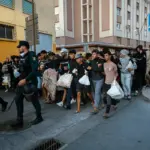
On Wednesday, September 9, the latter happened. They are still thinking in Moncloa about how what happened could have happened. In fulfillment of the commitment made by President Sánchez to declassify documents from the CNI and other intelligence agencies to demonstrate that no one warned the Government about the arrival of the avalanche of 80,000 people who surged into Ceuta, Wednesday was the day set to make those reports public. An example of transparency, the Government boasted.
The signals began to light up when the media—all of them, left and right, print, digital, radio, and television—declared in headlines: “The CNI warned the Government of calls for assaults on Ceuta by fence and sea. The CNI alerted the Government and Morocco of massive calls for an assault on Ceuta.” It was happening. The media were tearing apart the narrative of the president and his Interior Minister. The Defense Minister had already warned that the declassification of secret documents was not going to yield a good result. With alarms sounding, disorder broke out in Moncloa.
From the President’s Cabinet, a WhatsApp message was sent to the media: “There was no formal communication to the chain of command. An agency that believes a massive entry will occur the next day does not communicate it by instant messaging: it escalates it, that is its responsibility and competence. Either the CNI did not see it coming or if it did, it made two mistakes: not saying it clearly in black and white and not informing anyone in the chain of command. Declassifying documents is of little use if those documents are not read.”
But the perfect storm over the Government did not abate. They had to try to get the CNI, somehow, to deny the headlines. Moncloa sent a communication under the heading “CNI Sources” in which, theoretically, the Intelligence Center assumed the Government’s thesis, that is, that no one anticipated the magnitude of the avalanche. The Ministry of Defense accepted that statement, understanding that the Government’s credibility was being seriously damaged.
Almost at ten o’clock at night, the president posted a tweet on X in which he wanted to explain what is read in the documents: “The CNI merely relayed information about a call to enter the city illegally in Facebook groups totaling 180,000 followers, by message and brief phone call to the Government delegation’s Cabinet, and did not issue any major alert to its chain of command of the Armed Forces, the National Police, or the Ministry of Defense.” Two days later, the chief of staff of the Government delegate in Ceuta resigned, accusing his boss of not telling the truth. Miguel Ángel Pérez Triano maintains that his chief of staff did not inform him of the CNI alert.
This sequence of events has plunged the PSOE into perplexity and astonishment, and the Government into impotence and anger from a sharp and resounding blow to the credibility of its narrative about its management of the Ceuta crisis.
“They thought the crisis would end in a few days and we have had 45 days of worsening. That the President of the Government has to post a tweet at ten at night to clarify what the declassified CNI documents say because the vast majority of public opinion has understood the opposite of what the Government maintains shows where we are. The morale of the socialists is at rock bottom. Ceuta has swallowed all politics and until normality is restored, there is nothing the Government can do to change this dynamic. We see no direction, leadership, or strategy to get out of this. We see no capacity to react. Ceuta is being a very hard blow, the narrative has been adulterated, and we no longer know which version to believe.” This is a widely shared reflection within the PSOE, according to consulted sources.
Read more Abdellatif Hammouchi, the man who could have prevented the assault on Ceuta
From the heights of the Government, things are seen somewhat differently. Moncloa does not hide the damage in terms of image. “We did not see it, and in that we are guilty. Maybe we were naive. We wanted to clarify the crazy interpretation that the opposition and the media were making of some documents that showed exactly the opposite of what was being spread. They were managing to push the discourse that the Government knew because the CNI had warned it. It is not credible that a CNI agent informs by WhatsApp and a phone call to the chief of staff of the Government delegate of a massive entry at the border and does not alert the Ministry of the Interior and the Ministry of Defense, which are the appropriate channels if the situation was so serious. We would not even need to talk about the need for a sealed envelope—the Government delegate said so in a press conference—just apply common sense and the chain of command of State Security. No one could foresee the magnitude, neither the CNI nor anyone. This scandal they have created has very short legs. The CNI warned of what? An assault of 80,000? That is a lie,” say official Government sources.
The same sources attribute the resignation of the chief of staff of the delegate in Ceuta to the interested party’s fear of the judicial case opened in the National Court to determine the responsibilities of the assault. The case opened by Judge María Tardón explains many inexplicable things happening these days. “If the situation was so serious, why did he not inform through the appropriate channels? He will have to tell the judge when she calls him to testify,” they maintain in the Government.
And even more. The president’s collaborators point out that when Ceuta recovers normality—in three months, they estimate—“citizens will recognize the success of the Government’s management.” “From here, the only way out is through management, housing the migrants, processing the files, and finding a solution for minors who cannot return. The city government is putting up all the obstacles because it is interested in this image of chaos to sink the Government. The Ministry of the Interior has done an extraordinary job to guarantee security. There have been no significant disturbances. The Government managed in the first two days after the avalanche to have most of those who entered return, which is a merit that is not recognized.”
What the Executive rules out is a disruptive decision that is being demanded by the left and unions to transfer immigrants to some place on the Peninsula and thus ease the unbearable social pressure that Ceuta is suffering with dozens of unhealthy settlements. “They are asking us for very difficult, almost impossible things. While no one asks the Ceuta Government for responsibility for the minors who are on the street, who are under its legal protection. The Government will comply with the law, house those left on the street, and process the files; we understand the anguish of the Ceutans and will follow the planned plan normally,” they assure.
The PSOE is concerned about those images of Ceuta’s beaches and the danger of a social outbreak due to the thousands of people still wandering the streets and beaches. “We do not know when normality will be restored in Ceuta and we do not see the Government in good political shape; the internal image conveyed to us is one of chaos. The ministers are in a save yourself if you can mode. The Government delegate does not admit that his chief of staff warned him of that CNI communication because he does not want to take the blame, just like many others do. There is the director general of the Civil Guard, who does not consider resignation and is charged in the Leire case. Why would the Government delegate be different?” says a socialist parliamentarian.
Puente and Cuerpo, succession signals
The ghostly succession of Pedro Sánchez has slipped into public discussion during the Ceuta crisis. In the interview he gave to TVE, the socialist leader emphatically stated that if his party so decided—which no one doubts—he will be the candidate in the next elections that he himself must call by July 27 at the latest. There are signals on the matter. The media and social media prominence of the Transport Minister, Óscar Puente, along with his statement that he does not shy away from the possibility of being the candidate, is one of those signals. Another is an article published in the newspaper El País by the prestigious intellectual Ignacio Sánchez-Cuenca, professor at Carlos III and very influential on the Spanish left, in which he proposed as successor the first vice president, Carlos Cuerpo.