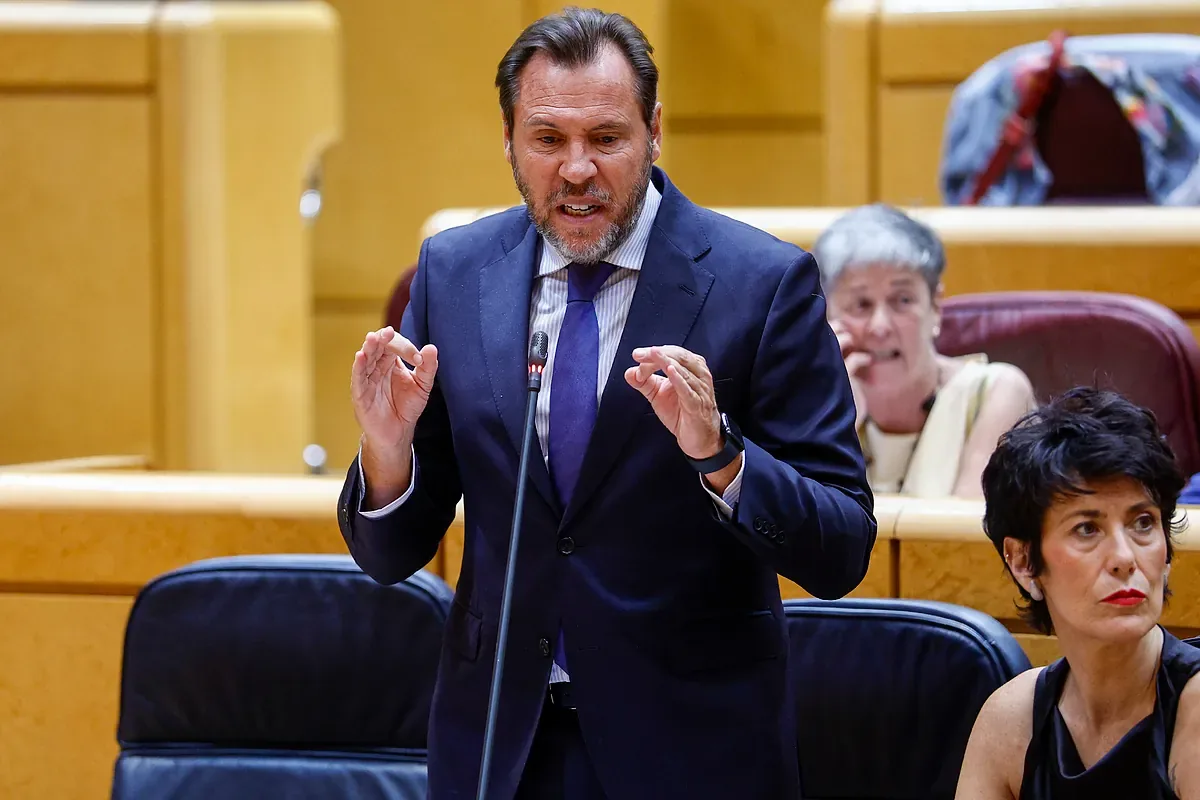







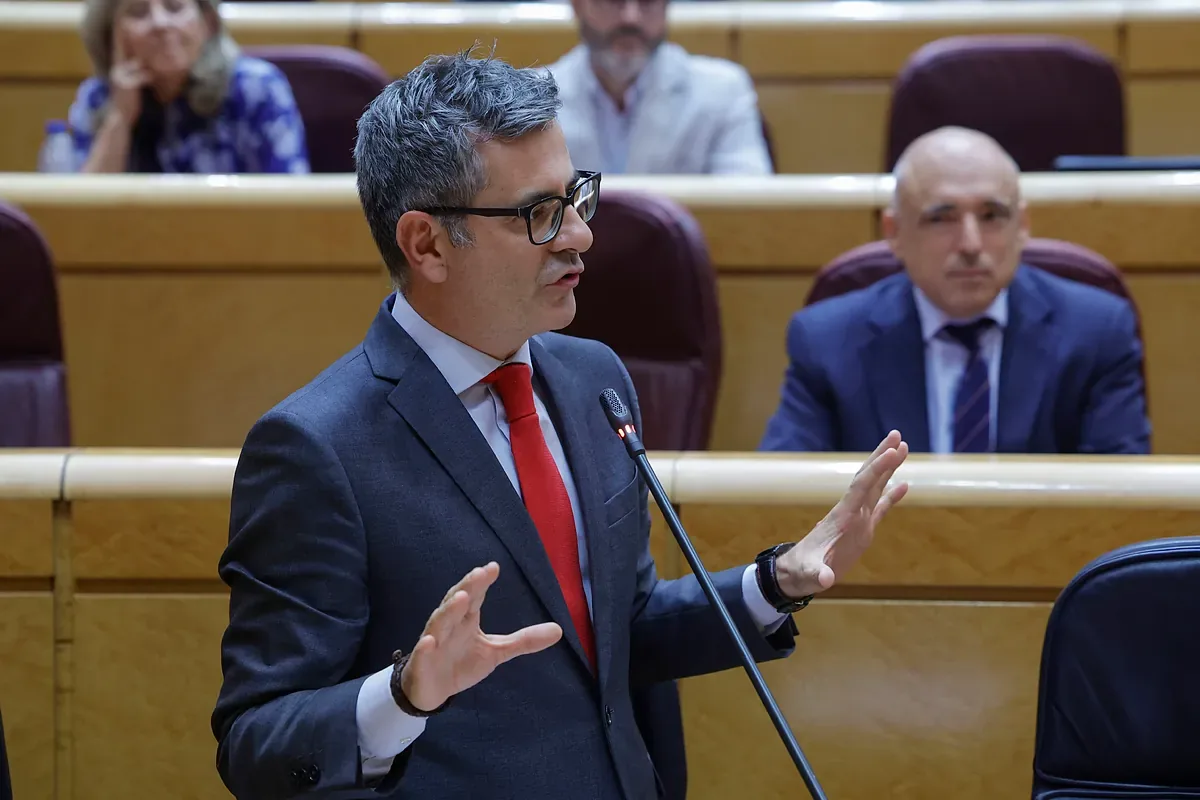
The Minister of the Presidency, Justice and Relations with the Courts, Félix Bolaños, has defended in the Senate the granting of the right to vote to all descendants of Spanish exiles, understanding as such all those who left Spain between 1936 and 1955 and those who, according to an interpretative “instruction” of the Historical Memory Law, are presumed to be victims and persecuted by Francoism.
Bolaños, in his speech, urged the Supreme Court to unblock the recognition of the right to vote for those people, which has been temporarily halted after the high court considered that this concession clearly increases the census and could significantly alter the electoral result. The minister pressured the Supreme Court by reminding them that many naturalized citizens who were able to vote in the 2023 elections could see their right taken away in the next elections. “These people are Spanish and must have all rights, including the most sacred one, which is the vote,” he emphasized.
The minister expressed himself in these terms in response to a harsh interpellation from the PP senator, Alfonso Serrano, who not only accused the PSOE of trying to do “electoral engineering” with a view to the upcoming elections but also warned Bolaños that with this maneuver he could end up “in Estremera, Valdemoro or Soto del Real”.
The PP senator insisted that his party defends that the descendants of exiles be naturalized and have the right to vote but rejected that the method to access this be an “administrative instruction,” issued in 2022 by the Director General of Legal Security and Public Faith, Sofía Puente, which discretionarily expanded the scope of people who can claim the right. The Populars argue that “an instruction cannot implement what the law does not contemplate, cannot replace the legislator nor create rights that Parliament has not recognized.” Consequently, Serrano urged the minister to repeal the provision that extends the status of exile to all those who left Spain on the cited dates.
The Popular emphasized that in Argentina there are one million naturalization requests and in Cuba, 350,000, despite official records barely noting a total of 500 republican exiles in that country. “Going from 500 to 350,000 seems excessive,” Serrano stressed, who also asked the minister to explain the criteria for assigning constituencies to the new voters. According to him, “thousands of descendants have registered in municipalities that did not exist in 1955,” and there are already 160 municipalities “with more census outside Spain than in the town itself.”
Bolaños made an attempt to lash out at Alfonso Serrano for his position as number two of Ayuso in the Madrid PP. The minister mocked the “level” of both despite them being, he said, “the pinnacle, the penthouse” of the party and then insisted that the objectives of the Memory Law are none other than to repair the damage caused to those who had to leave Spain as a consequence of the Civil War and the dictatorship.
The minister defended that there was already a wave of 300,000 naturalized people who were also granted the right to vote with the 2007 law and thanks to a provision, he argued, “identical” to the one now questioned in the 2022 law. He also recalled the promises made by Feijóo to the descendants of Spaniards in Argentina and even cited the paragraph in which this measure was proposed in his electoral program. With these arguments, he accused the PP of “hypocrisy” and reproached them for “being dragged by the far right” and becoming an “anti-system” party.
For the minister, the effects of the Supreme Court ruling are that “there are first and second-class Spaniards: some with the right to vote and others without it.” In his opinion, it was precisely the high court’s decision that “altered the census” because people who voted in 2023 right now could not do so. “I ask the Supreme Court,” he stated, “to resolve this before the 2027 electoral processes. I ask you respectfully. All Spaniards are equal and with the same rights, including the most sacred: the vote.”