








On May 28, 2026, the drug trafficker from Huelva Jesús el Negro was piloting a recreational boat along the Piedras River, very close to the beaches of Punta Umbría and La Antilla. Inside, it carried a load of 1,280 kilos of hashish. The boat used by el Negro was the Airamdulas II. The name, read from right to left, is “salud María” (Hail Mary). That day, Customs Surveillance and the Civil Guard, who had been tracking the trafficker from a distance, arrested Jesús. El Negro ended up in prison hours later.
Just 80 days later, on August 16, a prison officer from Huelva approached Jesús’s cell, woke him up, and told him he had bad news. The Moriña, a rival clan to the family of el Negro’s partner, the Salazars, had hired two hitmen to kill his mother-in-law and his wife, María Salazar, who at that time was eight months pregnant.
The massacre had taken place in Isla Cristina, just 40 kilometers from where el Negro had been arrested three months earlier. The gunmen arrived on a high-powered motorcycle to the neighborhood where the two women lived. There, in a town with hotels full of tourists and streets crowded with people, they fired several bursts of shots.
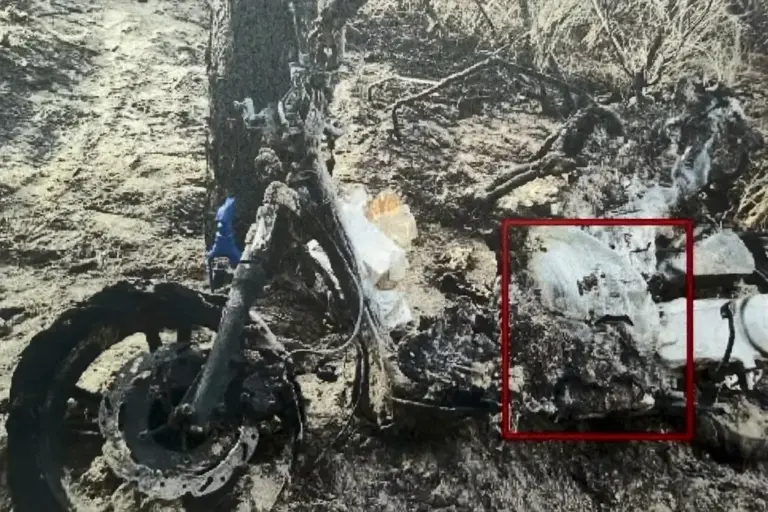
Then, during their escape, they got rid of the vehicle and the weapons used in a wooded area near a campsite on the outskirts of Isla Cristina. After committing the crime, the killers burned the motorcycle, an assault rifle, and a pistol. Despite this, the Civil Guard failed to recover any fingerprints or DNA traces.
In extremis, doctors managed to extract el Negro’s son from his deceased mother’s womb. The baby, who survived for a few hours, died in the hospital. In a gesture of compassion for the inmate, the management of the Huelva prison allowed the drug trafficker to leave on leave to attend the funeral of his three loved ones.

The triple tragedy of Jesús el Negro is another episode in a war that two families from Huelva, the Moriña and the Salazar, have been waging for two years. Along the way, there have already been six deaths. Among them, the son of this imprisoned drug trafficker and a 16-year-old teenager who was walking near where María Salazar and her mother were shot. It happened near the square in the El Rocío neighborhood, in Isla Cristina. Two more people were injured.
THE BROTHER OF THE FIRST VICTIM ARRESTED
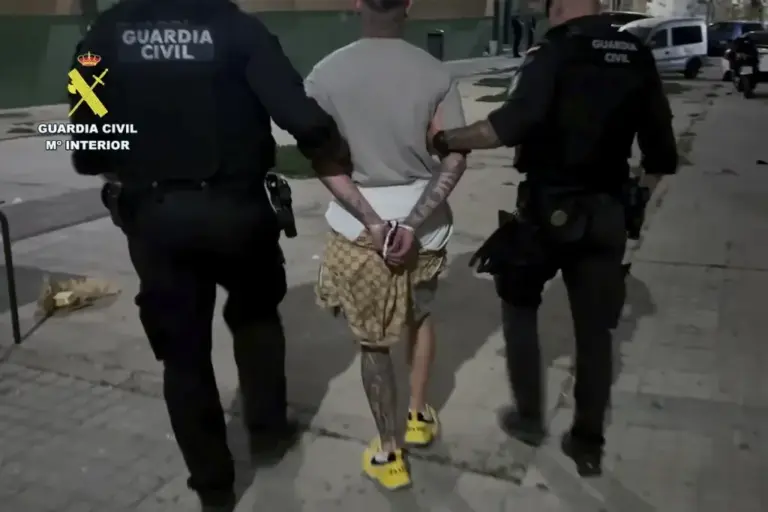
Chronicle, thanks to various case documents and consultation with sources familiar with the details of the judicial investigation, has been able to reconstruct an event that this summer has captured social and media attention in Spain. This week, the Civil Guard has arrested three men.
Last Thursday, a judge in Ayamonte sent them to prison for the four deaths in Isla Cristina in mid-August. They are accused of the alleged commission of three counts of murder, one count of intentional injury to the fetus resulting in death, one count of belonging to a criminal group, one count of injury, and one count of attempted homicide. One of those imprisoned is Amador Moriña, brother of the first victim of this blood feud, Ramón Moriña.
Another of those sent to prison is the person who rented a house in Isla Cristina through Airbnb. The house became the “safe house” frequented by both Amador Moriña and the other detainee during the days leading up to the deaths of el Negro’s mother-in-law, wife, and baby — as well as the death of a minor who had nothing to do with the conflict between the two mentioned families.
“We are facing a pure hitman process,” explain sources familiar with the investigation. “For days, a whole prior operation is maintained to learn the victims’ routine,” they add. “They repeatedly go to Isla Cristina at night, all from Huelva. They come and go. But they always pass through that apartment.”
During the searches carried out, Civil Guard investigators seized a firearm, nearly 30,000 euros in cash, about twenty mobile phones, bulletproof vests, a taser, and various documents that would link them to the events, although their study is pending.
THE ORIGIN: ‘EL BABA’ AND HIS ESCAPE TO GIJÓN TO HIDE
To understand the origin of this tragic story, one must go back to September 10, 2024. That day, a Salazar, Manuel el Baba, shot and killed a Moriña, Ramón, in the Huelva neighborhood of El Torrejón. Manuel Salazar was Ramón Moriña’s brother-in-law since el Baba was married to Saray Moriña.
Days later, Saray herself stated on television that the confrontation between the two families occurred because she wanted to leave her husband and he threatened to kill her brother, as eventually happened.
However, police sources tell this newspaper that they do not rule out that this first death was not due to marital problems but rather to “frictions” between members of both family clans, with historical ties to the drug trafficking business, both in drug dealing and large-scale drug distribution.
The El Torrejón neighborhood, where the Salazar and Moriña lived until two years ago, has been “a marijuana garden” for more than a decade. Some of its buildings’ houses are connected to each other through open gates in the walls. Thus, if police forces raid, it is easier for criminals to escape the pressure of justice. The traffickers from this neighborhood in the capital of Huelva imitate the model of the drug neighborhoods of Marseille.
But Huelva’s problem is not just marijuana. From El Torrejón and other neighborhoods, such as La Navidad, much labor force comes from the drug clans that traffic hashish and cocaine by speedboats. Unloaders, crews, off-road vehicle drivers to move the merchandise, security personnel for their guarderías (stash houses)…
Hours after Ramón Moriña’s murder, an image of el Baba, with a dark beard, 39 years old, stocky, tattooed, began circulating on social media and WhatsApp. It requested information about his whereabouts and offered a reward of 50,000 euros to anyone who provided truthful information about his hiding place. Days later, the offer doubled to 100,000 euros. “This rat is wanted,” read the photo.
But el Baba was saved by the National Police. He had fled to the other side of the country, escaping from Huelva. In the early hours of October 12, 2024, police officers arrested him in Gijón, where part of his family lives. They had given him shelter there. The judge decided to send him to prison.
THE FIRST VICTIM AMONG THE SALAZAR AFTER THEIR EXILE
Ramón Moriña’s death caused the Salazar to have to leave El Torrejón. The other families in the neighborhood decided they should be exiled and no longer live in Huelva city. The destination chosen by this clan was Isla Cristina, 50 kilometers away by road.
The first fatal victim among the Salazar occurred on June 11, 2025. Two armed men (still not arrested) broke into the Isla Cristina house where at that time lived el Baba’s mother and, in turn, Jesús el Negro‘s mother-in-law. Although they were looking for her or her daughter María — sister of el Baba and wife of el Negro — they killed a man. He was the current partner of el Baba’s mother.
THE TRIAL OF ‘EL BABA’
That time, those two hitmen missed their target. But a year later, on August 16, two hooded gunmen on a motorcycle shot dead el Baba’s mother, his sister María, and his unborn nephew at point-blank range. At the same time, Jesús el Negro lost his mother-in-law, his wife, and his baby.
As the two-year anniversary of that first crime that keeps the province of Huelva on edge approaches, in five weeks its alleged material perpetrator will sit in the dock of the accused. The First Section of the Provincial Court of Huelva has scheduled the start of the trial against el Baba for October 16.
The oral trial process is expected to last until the 21st. The first session will be dedicated to constituting the popular jury that will try the facts, before moving on to the statements of the accused, witnesses, and experts.
Manuel Salazar, alias el Baba, will not be the only one to sit in the dock. Alongside him will be tried a cousin accused of concealment for having helped him hide after Ramón Moriña’s death.
The third accused is, precisely, another of the victim’s brothers, who is charged with attempted homicide for having opened fire in the street against el Baba to avenge the death of his brother-in-law Moriña.
One of the latest major operations against drug trafficking in Spain highlights this boom of drugs that Huelva is experiencing, a reason that could be behind the existing confrontation between the Salazar and the Moriña, as the consulted sources maintain.
An intervention by the Civil Guard demonstrates this symbiosis generated by the province: on one hand, the proliferation of indoor marijuana plantations in neighborhoods guarded with war weapons, as happens in El Torrejón; on the other, large-scale international drug trafficking, which in turn serves as a vehicle for access to weapons coming from other parts of the world.
On October 2, 2024, the Civil Guard completed Operation Truck, with which it seized from Carmelo el de la Pela’s gang, a Huelva nightlife businessman turned drug trafficker — or vice versa — 8,946 kilos of hashish, 123 kilos of marijuana buds, 736 cannabis plants, 11 cars, a truck, four firearms…
Twenty-nine people were arrested, but not Carmelo, who managed to escape at the moment they were going to arrest him. On January 31, 2025, he had another scare when he was kidnapped. He was held for two days by his captors. This drug trafficker, whose nickname comes from the high purchasing power he and his family have always shown, comes from Ayamonte, the town in Huelva bordering Portugal.
At the beginning of his famous novel Anna Karenina, the Russian Leo Tolstoy wrote: “All happy families are alike; each unhappy family is unhappy in its own way.”
The Salazar and the Moriña decided to take justice into their own hands in their respective misfortunes. Six lives have already been lost. The question is whether the number will continue to grow. “There will be more dead. We take it for granted,” say those who know them.