







The serious situation that Ceuta is suffering after the massive assault on the border on July 30 and 31 exacerbates the debate and political confrontation in the Congress and the Senate. The respective plenary sessions of the Chambers focus on the crisis, on the Government’s management, criticized by the majority of political parties who see Pedro Sánchez as “blackmailed” by Rabat, and on the obstructive and electoralist attitude, according to the Executive, of the opposition.
The Popular Party proposes to immediately return all illegal immigrants to Morocco and to strengthen the presence of the State Security Forces and Corps. The PSOE replies by accusing the PP of “intending to prolong the crisis in Ceuta to gain electoral advantage” and “to sow hatred and confrontation.” Meanwhile, in Congress, the debate and vote on the decree that includes measures to try to solve the situation in Ceuta and recover its economy heats up.
The PP attacks the Government and its management, which now seriously affects women and minors who suffer sexual violence, and the PSOE responds by demanding that the authorities of Ceuta fulfill their obligation to protect minors and that the Popular Autonomous Communities host them. The PP recalls that “Ceuta asked for help again and again and was ignored” and also how “Sánchez spoke of an attack on territorial integrity and then went on vacation.”
The Popular Party also points out that Rabat has assured it wants the return of all its nationals and in that sense they ask what the Government is waiting for and urge the Foreign Minister, José Manuel Albares, to keep his word that all will be returned. Albares has assured that he maintains everything he said but, from the PP they reply: “If they did not return the dead, how are they going to do it with the living?”. In addition, they lash out at the Defense Minister, Margarita Robles, for not defending the CNI, which the Government discredits by assuring that it did not transmit alerts about the avalanche. Robles, now fully aligned with La Moncloa’s arguments, accuses the Popular Party of only intending to attack the Government.
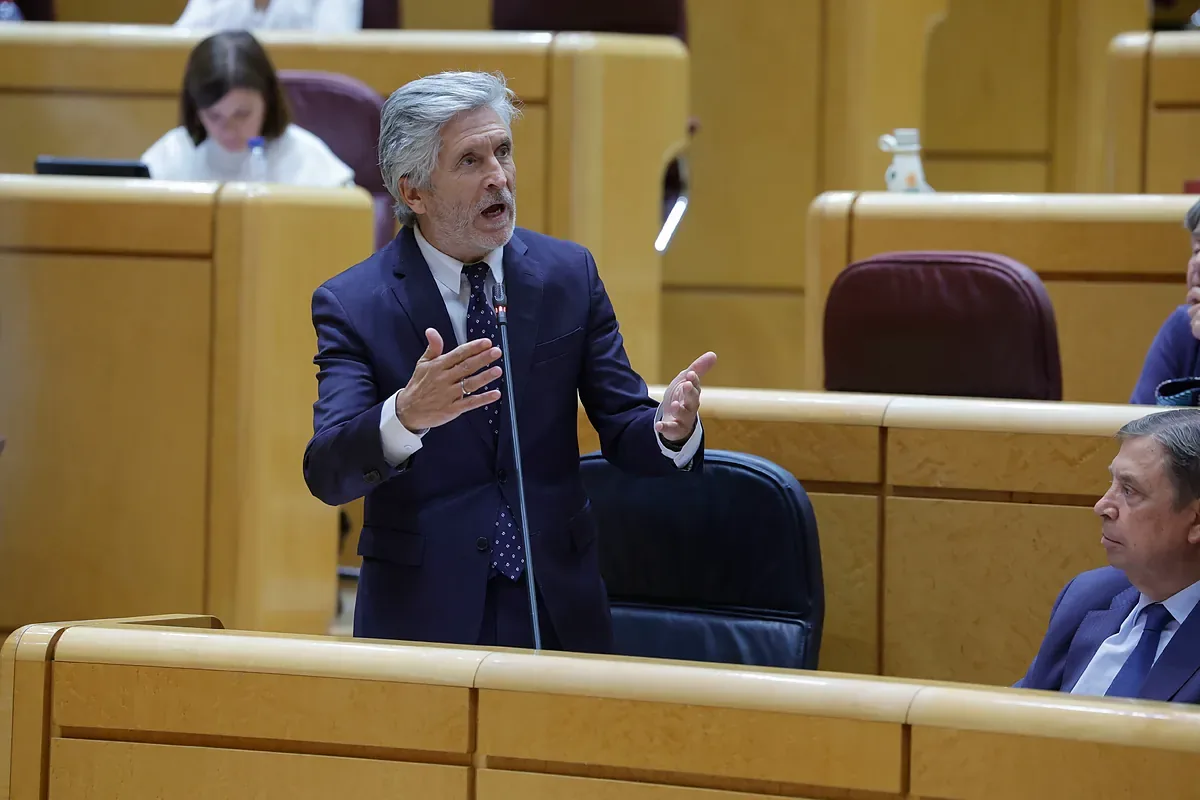
Marlaska, for his part, has insisted in the Senate that no one foresaw the avalanche and that “there was no context and no alert” that suggested something like this. The Interior Minister accuses the Popular Party of “provoking and encouraging the feeling of insecurity” among the people of Ceuta. From the PP they remind him that the declassified reports say otherwise and reproach him for his “lack of dignity” for not resigning. Marlaska has stated in the Upper Chamber that he is willing to remain in the Government “to face” the PP. The Popular bench in chorus responded with an insistent “resignation, resignation”.
Vox demands the direct expulsion of all immigrants, that the “invasion” be considered a case of “hybrid war” and that the Armed Forces and the State Security Forces and Corps be provided with “clear rules of engagement” to ensure that this does not happen again. This group maintains that the “traitor” Government is “subject to Morocco” and predicts that, at the pace at which the files are processed, “it will take years” to solve the problem. Abascal’s party also accuses the PP of “weakness”
The PSOE, for its part, demands “solidarity,” “responsibility,” “coordination,” and a “joint response from the Government of Spain, Ceuta, and the Autonomous Communities.” In their opinion, the PP, as Senator Carmela Silva has pointed out, has “a despicable political objective” which is “to feed confrontation and generate a climate of agitation, destabilizing coexistence and provoking hatred towards migrants.”
UPN reproaches the Government for “staggering” and the president for not having been heard “not a single word about the situation that women and girls, both Ceutian and immigrant, are living.” María Mar Caballero regrets that the Executive “tries to blame others for everything that happened.”
The PNV recalls that sexual violence is also being suffered by migrant girls and women. The Basque nationalists insist that all, both Ceutian and immigrant, have the right to protection. They advocate providing Ceuta with the resources it needs to face this situation.
Junts describes the situation in the autonomous city as “very serious” but insists that the crimes “are individual” and that all immigrants cannot be criminalized. Junts thus again calls for the transfer of migration powers to Catalonia.
ERC acknowledges that a Government that claims to be feminist “cannot look the other way” with what is happening in Ceuta but also accuses the PP of “instrumentalizing” the attacks on women.