




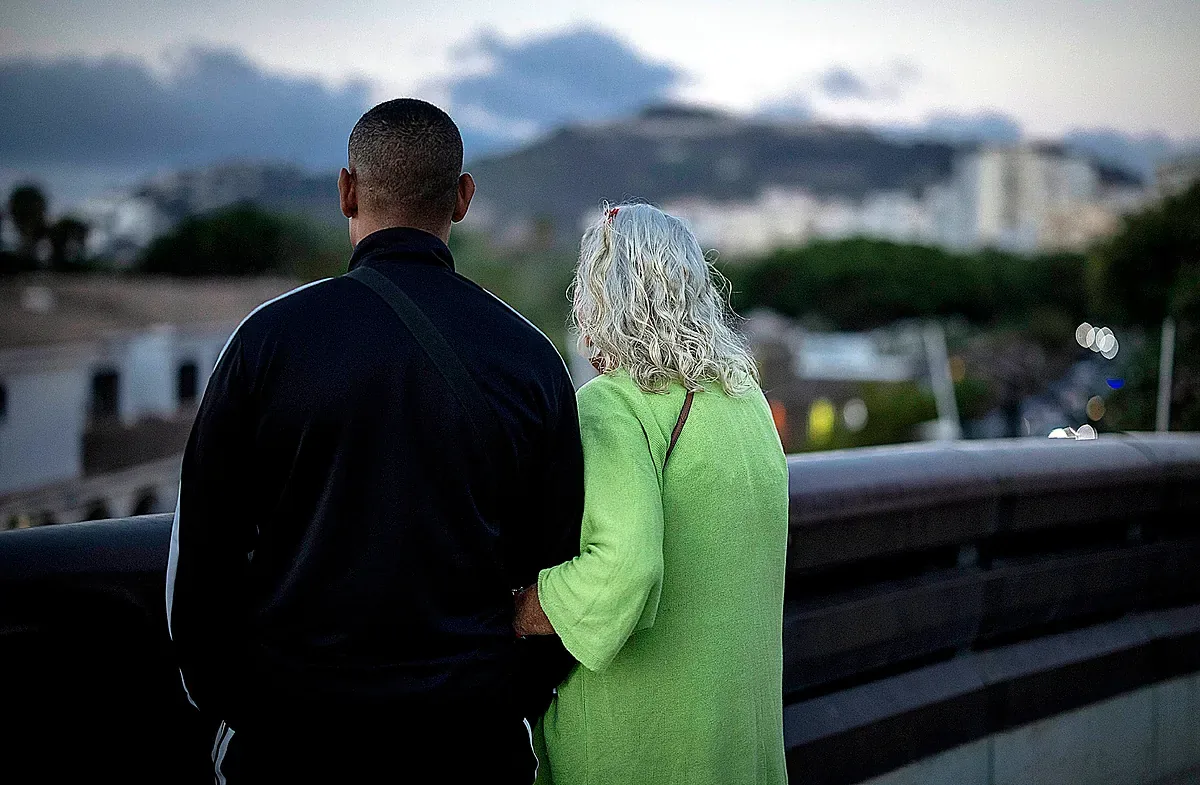
She has ordered a decaffeinated bombón and he a glass of hot milk. It is a few minutes past seven in the evening and we are on a terrace in the center of Ceuta, where the city falsely appears to beat with some normality. The couple sits with us and agrees to tell their story in case “the fourth estate,” they say, can do something for them. The woman, María, is Spanish, from Cartagena (Murcia), and since she does not want to specify her age, she provides the fact that she is already retired as a reference. The man is Simo, Moroccan from Beni Melal – about 200 kilometers northeast of Marrakech -, he is 40 years old and was one of the first immigrants who swam across the El Tarajal border last July 30. He did not come to Ceuta seeking a better future in Spain nor because he is persecuted for political or any other reasons. He came, he assures, for love.
The couple has been requesting since 2020 to be allowed to marry, clashing with the Spanish Administration, which every time it examines their case closes it with the same verdict: “Marriage of convenience”. “It is all prejudice because of the age difference; if it were the other way around, nothing would happen,” she complains.
Tired of bureaucracy, they explain, Simo joined the migratory avalanche of the last two days of July and María moved to Ceuta from Cartagena to be with him. While waiting to regularize their situation and move to the Peninsula, they live together in the apartment she has rented in the autonomous city: about 40 square meters for which she pays 750 euros a month.
Simo speaks Spanish but is quite sparing with words. According to his account, about three months ago he moved to Casablanca, where a sister lives, and while there he received an invitation from a friend who is a taxi driver in Ceuta. This acquaintance offered him to spend a few days of the summer in the house he has in Castillejos, the Moroccan city adjacent to the Spanish border. He arrived there, Simo says, on July 24, just one week before the massive entry into Ceuta, of which he knew nothing, he assures, until the very morning of the events. “Another friend called me on the morning of July 30, at seven in the morning, and told me: ‘There is a possibility to enter Ceuta’,” he recounts.
Following this indication, he took his documentation, his mobile phone, and a plastic bag to protect them from water and set off towards the border. There are three kilometers walking between Castillejos and El Tarajal. “I arrived among the first and there were few people. I arrived and the [Moroccan] police stopped me. Then many more people came and the police no longer stopped them.”
Simo estimates that about fifty Moroccan agents were guarding the border. He believes it was around 10:00 a.m. when the police no longer stopped them and the first ones, mostly young men like him, jumped into the sea. He did not see women or children around him in the water nor any drowned – 87 people is the official number of deaths. He easily swam around the 200 meters of the El Tarajal breakwater and that was it. “I arrive in Ceuta and call my taxi driver friend and then call María,” he details his first steps on Spanish territory.
Now she takes the floor, who assures that she did not know about Simo’s plans until she received his call: “Suddenly, he tells me: ‘I am in Ceuta.’ ‘What nonsense are you saying.’ ‘Hey, listen to me.’ And he makes a video call and I see that he is in a taxi in Ceuta. ‘You have to come,’ he told me. ‘Wait, how am I going to go running, I have medical appointments…'”
The first days, Simo stayed at the taxi driver’s house and then in a “wooden shack with a padlock” that he provided him. “He told me he was afraid, that there was only Police around: ‘Out, out’,” María recounts, who finally arrived in Ceuta on August 5.
-And how did you meet?
-It was in 2018, I was not retired yet. I have been a non-teaching teacher, a commercial delegate, and in recent years I worked in social health care and home help. I wanted to take a trip alone through Morocco, I was looking for a trustworthy person to be my guide and I found Simo. We traveled all over: Casablanca, Marrakech, Essaouira… He was very honest. I gave him 50 euros and with that we ate, entered all places, he paid for the hotel… But we did not live together since in Morocco if you are not married you cannot be together in hotels. The trip ended and I thought I would never return to Morocco. ‘It was very good, girl, but that’s it.’ He cried when we said goodbye, I saw his tears. Then, like any couple, we started writing to each other, talking, and I returned to Morocco. I stayed at his sister’s house in Casablanca, I met his family.”
Until in 2020, she explains, they decided to get married. “Since he is not an EU citizen, he needed authorization from the Civil Registry, to prove he was not already married, that it was not a marriage of convenience. We could get married in Morocco but it would not be recognized in Spain.”
The document they needed is called a marriage capacity certificate and María started the procedures to obtain it in November 2020. With the pandemic in between, it was not until August 21, 2021, that he was called by the Spanish consulate in Casablanca for an interview to determine whether his relationship with María was genuine or not. “When he arrived home I asked him to make a video explaining how the interview had been. He was attended by a lady who asked him in Spanish. He began to answer and at one point he said: ‘Can you repeat?’ And the lady replied: ‘You don’t know any Spanish.’ He spent an hour and a half being asked: ‘Which side of the bed do you sleep on?, what is the color of your toothbrush?, your favorite food?, your favorite color?, the name of your ex-husband?, your mother’s name?'”
A couple of months later, in October 2021, María was called by the Civil Registry of Murcia for the same. “They asked me three questions: ‘What food do you like?, what is your phone number?’… They called my son as a witness. My son was younger [he is 23 years old]. ‘Say you know him from photos’,” she recounts how her interview went. It took “five or six months” to receive a response. “The report said it was a marriage of convenience, because he did not speak Spanish, because of the age difference, because he did not know the name of my ex-husband nor my mother – who is Purificación, but he did not pronounce it well and the lady did not understand -, that my son did not know him… Denied.”
-What would you say to people who think your relationship is one of convenience, how to prove to them that it is real?
-The proof is that we have known each other since 2018 and we are still together. There are documents that prove that I visited his house, that I knew his family. And if what he wanted was to come to Spain, he could have looked for a Moroccan woman who was already in Spain, I see them in Facebook groups looking for a husband: “Hey, do you know any good Moroccan to marry?” And two years ago he could also have gone to Israel, where he got a job.
María says that the official who gave her the report denying Simo the marriage capacity was moved to see her reaction: “He saw that I started crying and told me: ‘Madam, don’t worry, you can appeal; find a lawyer’.” She then went to a Spanish lawyer of Moroccan descent who filed a first appeal without result, a second contentious appeal with a negative response, and, three years ago, a civil lawsuit requesting the annulment of the report denying the marriage capacity, a process that is still unresolved.
“Last year I appealed to the Ombudsman, who contacted the Civil Registry of Murcia. Thanks to him, they admitted that we could apply for marriage again,” María recounts. She was in Casablanca when, last November, the consulate called Simo to repeat the interview. “I sent him an email to give to the Moroccan consul in which I explained that when I retired I was going to live there and that I had sent money to Simo to build our house on the second floor of his father’s. I sent those proofs that it was not a marriage of convenience.”
María was also interrogated again in Murcia: “I took a friend as a witness and they asked if I had gone to the Civil Registry under duress. Two months ago they gave us the result: ‘She claims she wants to live in Morocco and he wants a marriage of convenience.’ I told Simo: ‘Find another woman because I have already appealed everything.’ He laughed.”
Before traveling to Ceuta, María contacted a law firm in the autonomous city. They have requested an appointment for the triage – in which it is decided whether the arrivals are asylum candidates or not – and have provided her with a document in which she expresses her willingness to apply for it, which would prevent her return to Morocco until her file is resolved. Since Simo is in Spain, María explains, they would no longer need the marriage capacity. It would be enough for one of them to be registered to be able to marry in Ceuta before a notary. It is not difficult for her to get registered and she is already working on it. “But the problem now is that with all these waits, his passport has expired,” María says. He takes out the document, with green covers. Indeed, it expired on September 13. “The notary would have to accept the expired passport.”