



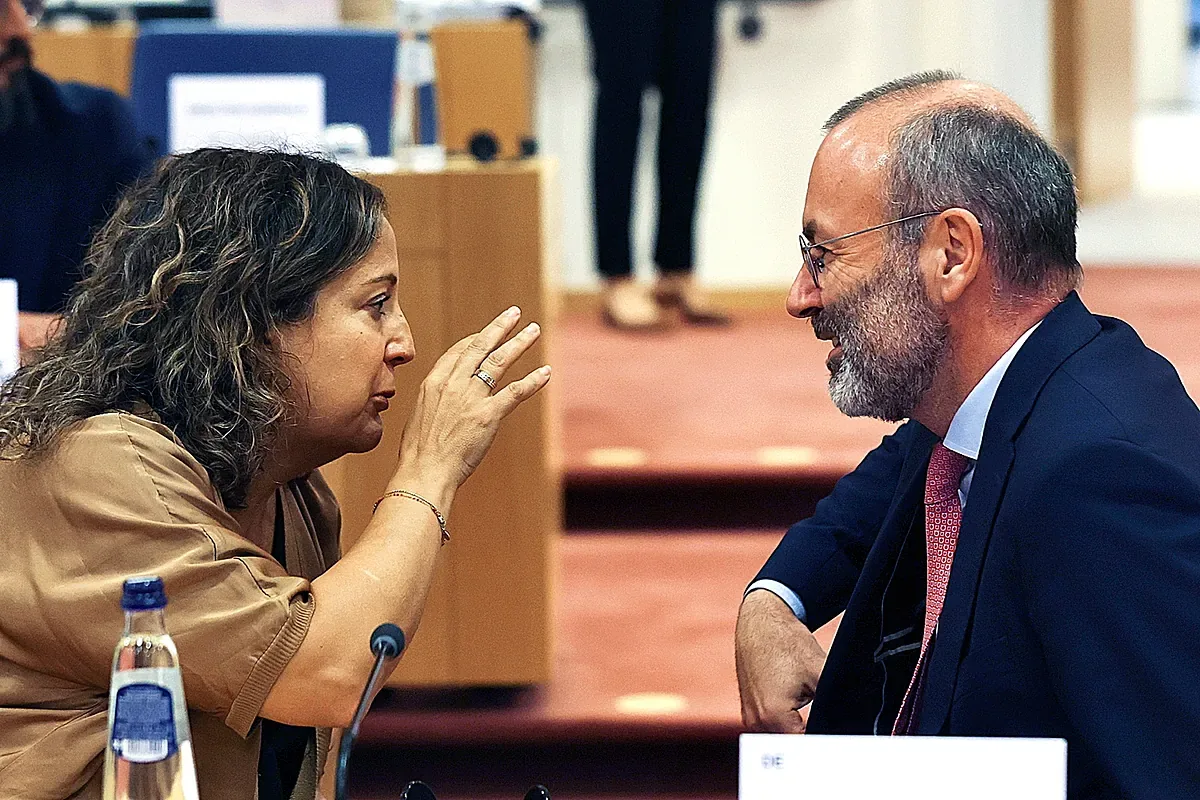
European socialists are not at all interested in approving a joint resolution with the European People’s Party condemning the invasion that Ceuta suffered. The president of the S&D, Iratxe García, even assured yesterday that this possibility is practically ruled out. And although negotiations will continue until tomorrow’s vote, her words are another sign of how willing the group to which the PSOE belongs is to put all possible obstacles to that pronouncement of the European Parliament.
For this reason, it is very likely that the European People’s Party (EPP) will have to seek other partners among the liberals or the far right to push through its own resolution, which clearly demands that “the Moroccan authorities assume their responsibilities as a key partner of the European Union and fulfill their commitments regarding border management, return, and migration cooperation,” although a total break in relations is not supported. Or even that the pronouncement is delayed due to the impossibility of reaching a sufficiently broad agreement, something that some parliamentary sources did not rule out yesterday afternoon. That the plenary, therefore, ends without any sign of support for Ceuta.
That would be great news for the S&D because there would be no hint of criticism towards Morocco from the European Parliament. In the party’s own resolution proposed yesterday, the Moroccan country is barely mentioned. Moreover, more space is devoted to criticizing Giorgia Meloni and “Italy’s decision to immediately introduce controls at the internal borders with Spain from August 1 following the events in Ceuta, despite the fact that those who had arrived irregularly could not continue their journey to Spain or any other Schengen state.”
European socialists also echo the arguments of Pedro Sánchez’s government. And these, in turn, are also the same as those the Moroccan government sent on Monday, just before the debate on Ceuta, to a group of MEPs by email. “In light of the regrettable events of July 30, 2026, the Moroccan authorities are working to determine the causes and the actors behind this situation,” states the six-point document revealed by the PNV MEP, Oihane Agirregoitia, and which was also received by other Renew and Socialist group parliamentarians, but not by those of the People’s Party or Vox.
The text also highlights “the evident role played by misinformation spread through social networks,” an argument typical of the Spanish government. It also points out that “Morocco has committed to readmitting all affected persons, including Moroccan citizens, unaccompanied minors, and nationals of third countries,” and that “the Spanish government has publicly declared that the information it has does not allow it to hold Morocco responsible for these events.”
And it ends with a series of questions that the Moroccan representation to the EU and NATO itself, which sent the email, states “are worth considering.” “What interest would Morocco have in provoking a serious crisis with Spain and the European Union, especially at a time when the EU is Morocco’s main partner and relations between Morocco and the EU are going through a phase of greater strengthening and consolidation? Would Morocco have deliberately provoked a migration crisis on the day of the Kingdom’s national celebration, Throne Day, a date of great symbolic significance during which Morocco celebrates the Kingdom’s achievements?” Morocco’s attempt to influence the European Parliament process seems clear.