







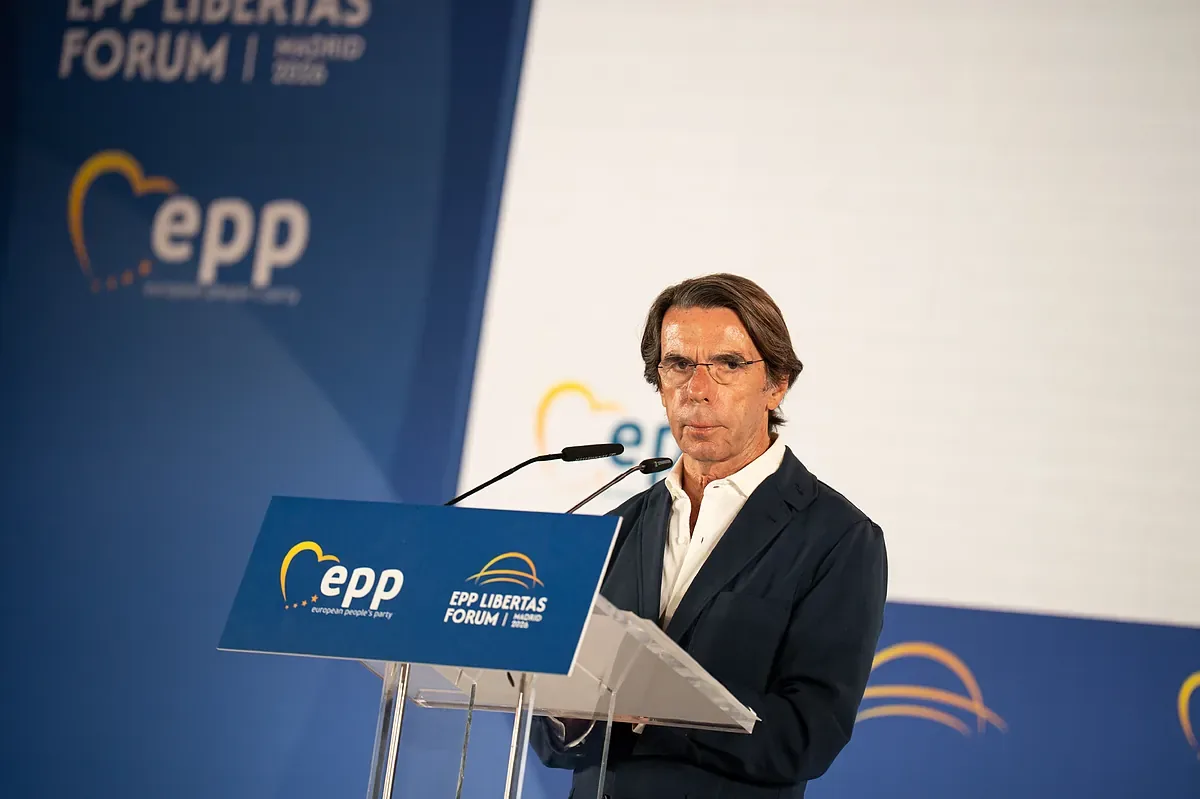
The second day of the Foro Libertas, which brings together leaders of the European PP and the Hispanic-American right in Madrid, had in the speech of José María Aznar its main highlight, with the ruling of the EU Court of Justice (CJEU) in the crosshairs.
And the news broke just 10 minutes before the former Spanish Prime Minister between 1996 and 2004 began to speak. The CJEU concluded this Thursday that the Amnesty Law is not contrary to European regulations. The response of the Grand Chamber of the Luxembourg court to the preliminary questions from the Audit Court and the National Court was that the Spanish regulation does not affect the financial interests of the Union nor does it violate the anti-terrorism directive.
Aznar was very clear, right after the news: “We must fight the attempt to confront democracy and law. And on a day like today, especially on a day like today, it is worth remembering, because the seditious aggression against the law must not go unpunished, much less be rewarded.”
“In Spain, we know well that certain nationalist pretensions harbor the hope of cracking the cornerstones of the Union – the European States – to rebuild the building from smaller, impoverished, and opposed fragments,” he warned.
For Aznar, the attempt at Catalonia’s independence was an unequivocal aggression against the EU: “Today is a good time to reiterate that when the constitutional integrity of a member state is attacked, the victim is the entire European institutional system. The unity of Spain, France, Germany, Italy, are the foundation of Europe’s unity.”
Soon after, the national leadership of the PP sent a statement to the media with its assessment of the Luxembourg Court’s ruling: “First of all, our absolute respect for the Court’s decision. The PP does not interpret rulings based on whether they like them more or less. Democrats always respect rulings. It would be desirable for the Government to do so in all judicial cases that directly affect them.”
That said, the main opposition party downplays the importance of the ruling and reminds that it was limited “to a very specific analysis.” “It does not examine constitutionality, nor political opportunity, nor does it issue a ruling on the entire Amnesty Law. It only resolves specific doubts about certain aspects of Union Law raised by the Spanish courts, so now it will be these courts that apply it according to this resolution,” the PP sources add.
For the PP, “the Government will try to present this ruling as the end of the debate,” but “it is mistaken.” “The debate was never only legal. The debate is whether a president can negotiate criminal privileges in exchange for a parliamentary majority. And our answer remains no,” they add, because that is and “will always be morally unacceptable.”
Finally, the PP considers that “no decision absolves the very serious irresponsibility committed by separatism.” “Their political responsibility is not eliminated. Because even ten years later Catalonia is trying to recover from that great toxic process,” the sources conclude.
Vox: “Those who said Brussels would bring Puigdemont must give explanations”
While the PP has avoided criticizing the CJEU ruling, Vox has jumped to the counter shortly after learning of it. For the hard-right party, the EU Court’s resolution “makes clear” that “the unity of Spain, its territorial integrity, and its constitutional order must be defended and protected by Spaniards, without waiting for international bodies to support it.”
“Those who said Brussels would bring us [Carles] Puigdemont or that Brussels would annul the Amnesty Law must give explanations,” also said the head of Vox’s European delegation, Jorge Buxadé, thus stirring his party’s usual critical discourse on the functioning of community politics.
In any case, Buxadé wanted to focus on the national level when expressing his disagreement with the rulings of various courts that have endorsed the pardon law: “The fundamental problem comes from the politicization of the Constitutional Court, which issued a ruling that constitutes the greatest attack on the rule of law,” he said about the endorsement given a year ago by the High Court to the Amnesty Law.
Under these criticisms, Buxadé, in statements sent to the media, conveyed his party’s commitment, if it comes to power, to “put everything necessary to reverse the effects of all the decisions of the Government of [Pedro] Sánchez and his separatist accomplices.”
Read more Vox’s international bet gains strength: its network of American allies rises to power


