









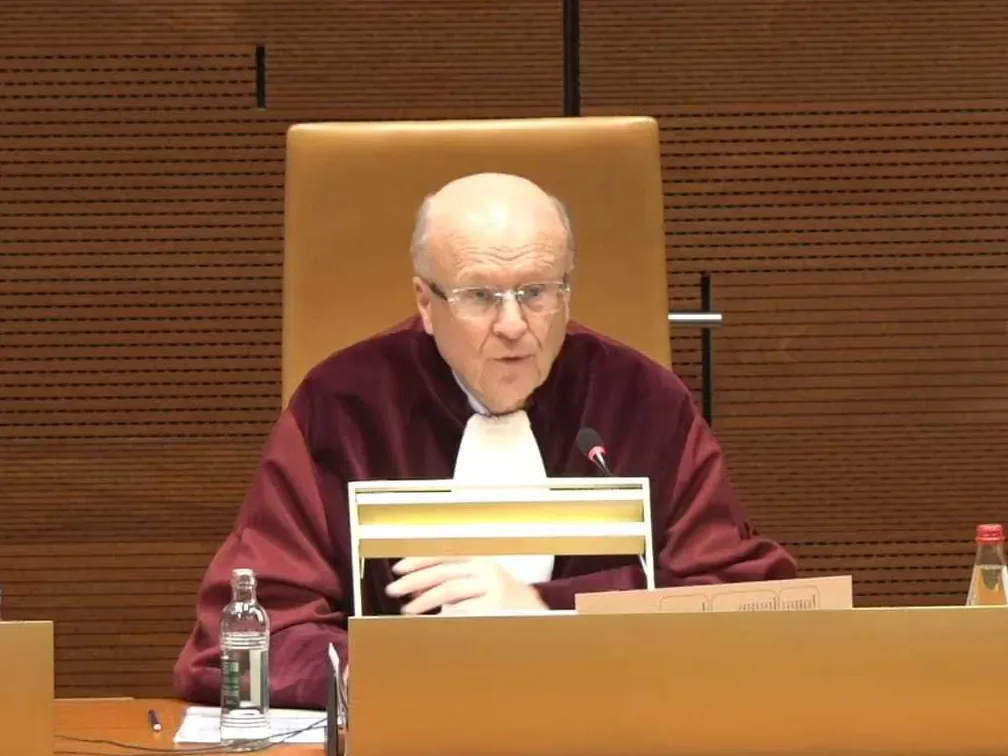
The Court of Justice of the European Union (CJEU) concluded this Thursday that the Amnesty Law is not contrary to European regulations. The response of the Grand Chamber of Luxembourg to the preliminary questions was that the Spanish rule does not affect the financial interests of the Union nor does it infringe the EU directive against terrorism.
Read more Vox’s international bet gains strength: its network of American allies rises to power
Both the Court of Auditors and the National Court had expressed their doubts in this regard and had taken them to Luxembourg at the request of Sociedad Civil Catalana and the Catalan Association of Victims of Terrorism. In the first case, accounting responsibility for funds allegedly derived for the procés was addressed. The second case concerned the prosecution of 12 accused of terrorism in the case against the CDR. Both proceedings, which had been suspended pending the CJEU, will be reactivated to amnesty the defendants.
Regarding the financial scope, the president of the CJEU, the Belgian Koen Lenaerts, publicly read the position of the CJEU: the Treaty on the Functioning of the European Union “does not oppose a national rule that amnesties acts of accounting responsibility carried out in the context of political activities aimed at achieving the independence of a part of the national territory of a member state and relating to funds that do not come from the EU budget nor are intended for it because that independence could have caused a reduction in the EU’s own resources”.
As for the aspect related to terrorism, Lenaerts communicated that the EU directive on the matter “does not oppose a national amnesty law that, to reduce institutional and political tensions and facilitate a reconciliation scenario, establishes the exemption from criminal liability of any person who has committed, within a defined period and in the context of a process of independence of a part of the national territory of a member state, acts covered by this directive that have not intentionally caused serious human rights violations”.
He also sees no legal certainty problems in the vagueness of the Amnesty Law regarding what type of terrorist acts it affects. Nor problems of discrimination: “It cannot be considered that the crimes committed in that context and the crimes committed in other contexts correspond to comparable situations,” he says referring to the fact that the rule limits its application to matters related to the procés.
The decision removes a barrier to the return of former president Carles Puigdemont, but it is not by itself sufficient to free him from criminal responsibilities. Now the phase of the concrete application of the rule to the former president is reactivated. The Supreme Court considered that the embezzlement for which he is prosecuted was not amnestied. Puigdemont appealed to the Constitutional Court, which was awaiting today’s CJEU decision to resolve that point, something it will not address before the end of September.
Read more The PP promotes ties with Latin America in the EU to compete with China
One possibility is that, if the Constitutional Court imposes on the Supreme Court a different interpretation of the embezzlement that implies Puigdemont’s amnesty, the Supreme Court will present a new preliminary question that will again paralyze the former president’s situation for months.
In its rulings, the CJEU has reinforced the margin of national courts to go to Luxembourg without the limitation that was derived from the Amnesty Law. The court emphasizes that this law “must not deprive the preliminary ruling procedure of its useful effect”. That would happen if the maximum two-month period imposed on courts or tribunals to apply the amnesty and lift precautionary measures “were applicable even when a request for a preliminary ruling has been made to the Court of Justice, without it being possible to wait for it to issue a ruling”. “If it were shown that the amnesty law contains provisions that give rise to this effect, they should be left unapplied,” it concludes.
This point is the only objection of the CJEU to the Amnesty Law. Regarding other procedural aspects in which even the Constitutional Court saw problems, Luxembourg indicates that they are not significant enough to warrant its intervention.
The still open dispute over whether the embezzlement of the procés should be amnestied not only affects Puigdemont. The former vice president and ERC leader Oriol Junqueras was convicted by the Supreme Court for that crime. Since it is not amnestied, he remains disqualified from holding public office.
Read more Messi’s first time against Spain: the most desired and mourned final


