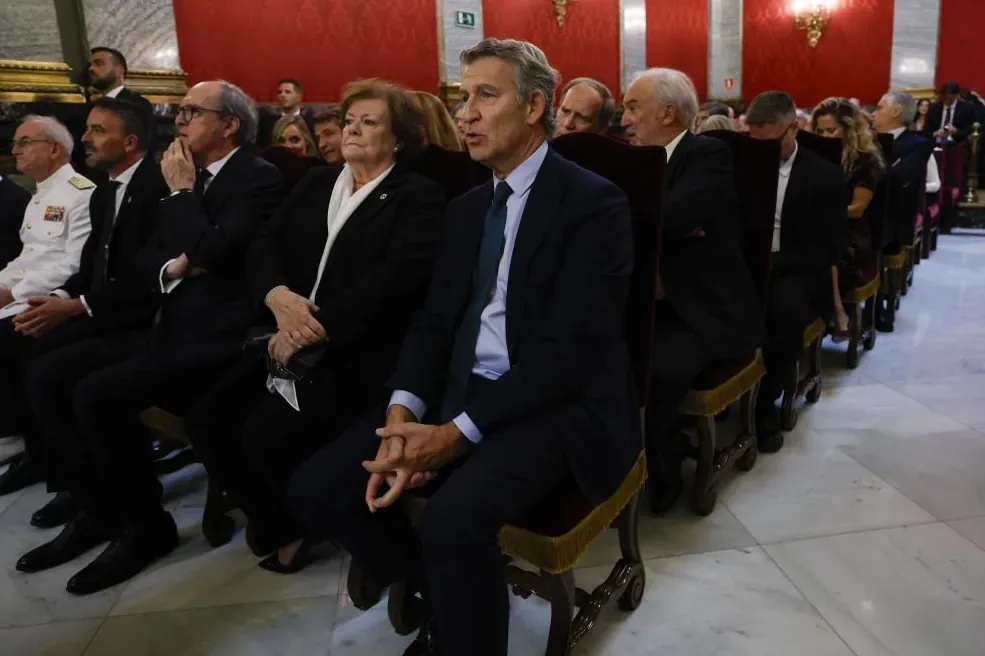




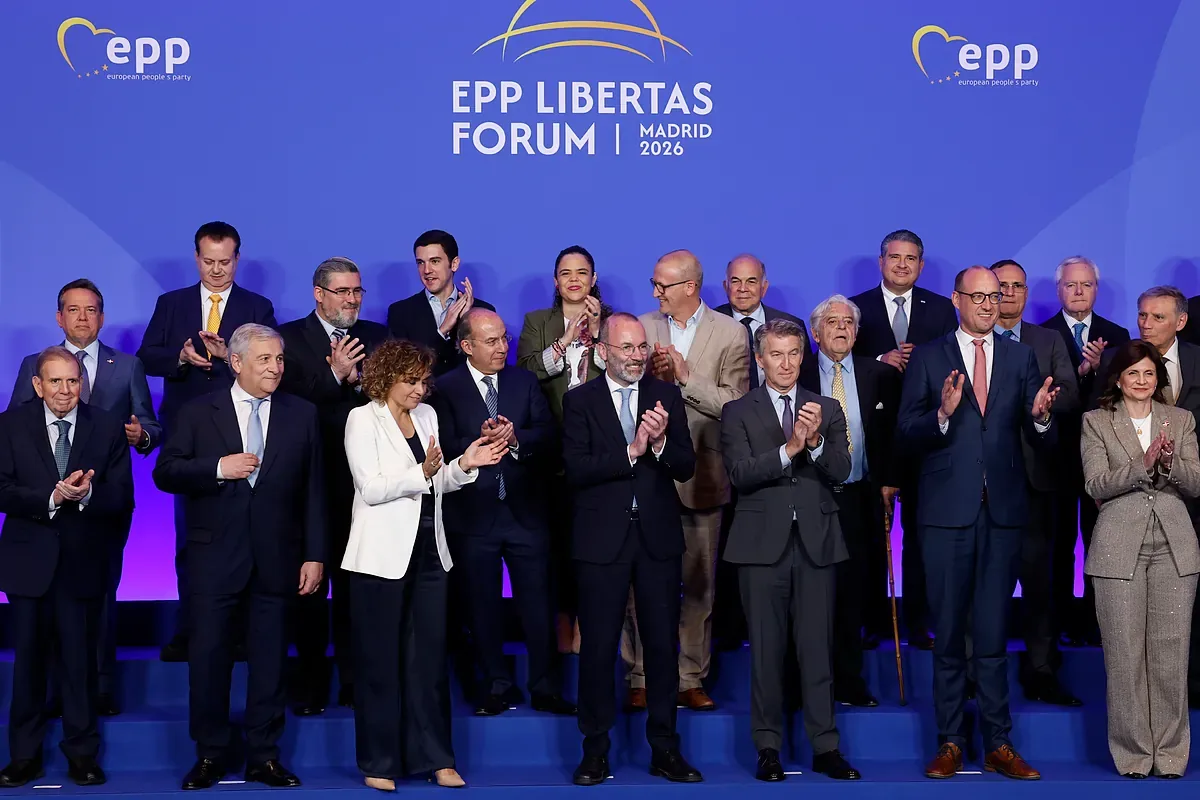
The meeting of European and Latin American center-right leaders at the Libertas Forum yesterday in Madrid served for Alberto Núñez Feijóo to convey his vocation to lead a new “Atlantic link” in which the European Union focuses on Latin America. The president of the Spanish PP wants, if he reaches La Moncloa in 2027, to captain a new economic and political alliance with the region, at a time when China and the US have deployed their economic power there to capitalize on the reserve of critical minerals. Above all, those of lithium, which is key for technological components.
Read more Messi’s first time against Spain: the most desired and mourned final
The Spanish PP wants to serve as a “link” between the EU and the region, due to Spain’s natural ties and the new political landscape, with a majority of conservative governments. This is confirmed to EL MUNDO by sources from Génova: “If the European PP considers Latin America a strategic priority, Spain will be the one to lead that operation. We have the vocation to push the European PP to take advantage of the opportunity now opening in Latin America, and we want the next Government [of Spain] to be the one to open that path.”
In his speech during the forum, Feijóo made a strong defense of the “link” between the EU and Latin America, and asked Manfred Weber to be “the first president of the EPP who is clear that the EU’s priority must be Ibero-America.” “You have that mission,” he entrusted him. Which one? To promote that “European governments look across the Atlantic and at Ibero-America in a special way, as we have done for decades towards the United States of America, with whom we will not break our friendship.” “We must continue building that great community of democracies capable of defending together what gives us meaning,” and that now passes through Latin America, he stated.
Weber shared the idea and emphasized “the unique link between both continents: we share languages, history, and cultural heritage.” He valued the EU trade agreement with Mercosur, which “will create growth” on both shores, at a time when China is “deeply destabilizing the global economic order,” with “unfair” trade practices. Competition with the Asian giant is fundamental, since the dictatorship has only spoken in favor of establishing a “community” of countries with a single region of the world: Latin America. And its economic exchanges grew by 29% in 2025.
In the last four years, many left-wing governments have fallen in Ibero-America, giving way to right-wing or far-right leaders. In Argentina, Milei now governs. In Chile, Kast. In Peru, Keiko Fujimori has been elected president, who spoke at the event yesterday. In Colombia, Abelardo de la Espriella has won. In Ecuador, Daniel Noboa has consolidated. And in Panama, Bolivia, Honduras, or Costa Rica, there has also been a shift to the right.
For Feijóo, this reflects “a citizenry that wants to change failed recipes and leave them behind.” “And even where freedom has been repressed by dictatorship, signs of hope are perceived: Venezuela and Cuba, and hopefully soon Nicaragua,” he added. PP sources assure this newspaper that “Spain must accompany this new democratic impulse, strengthen its ties with those who share these values, and continue to be a committed partner with an Ibero-American community based on democracy, freedom, prosperity, and the rule of law.”
For the Populars, there is an investment vein to exploit: “The Ibero-American experience shows that political trust ends up translating into economic trust. And when a nation regains trust, it also regains its capacity to grow, attract investment, strengthen its institutions, and offer a better future to its citizens.”
Not only Spain wants to captain this European strategy of economic boost in Latin America. Italy also does. Before Feijóo, the vice president of that nation, Antonio Tajani, also advocated “working together with the countries of Latin America” to exploit critical raw materials in “increasingly integrated industrial chains,” and thus be able to “compete” with China, “which is the queen” of raw material trade, he said.
“It is something fundamental for the competition of all European companies.” “The EPP wants to be more and more the voice of Latin America,” which is “an absolute priority for us” and “a key priority partner” for supply chains, especially after the closure of the Strait of Hormuz, emphasized the also vice president of the community Populars.
Connecting from Lima, Fujimori also advocated “strengthening the links” between the EU and Latin America. “My country is starting a new stage with the purpose of recovering its institutions,” ties with Europe, and “trust.” And for that, she highlighted the “geostrategic position towards the Pacific” of her country as a point in favor of European investments on Peruvian soil.
Sánchez, «authoritarian»
Right after her, Feijóo delivered a speech with a marked Atlanticist tone, but also very focused on domestic criticism. In fact, he hardened his terms against Pedro Sánchez to an unprecedented level. He called him – without naming him, but leaving no doubt about whom he referred to – “authoritarian”. To “recognize an authoritarian,” he said, “just look at what he wants to control”. “If he mistrusts judges, if he despises parliamentary majorities when they do not favor him, if he replaces merit and effort with state dependence, if he questions the independence of institutions, and if he fears the polls if they do not guarantee him power, look no further: that is an authoritarian president”
This statement elicited strong applause from the 400 officials present in the room. Among them, the Deputy Prime Minister of Belgium, Vincent Van Peteghem; the winner of the Venezuelan elections, Edmundo González; and the Prime Minister of Portugal, Luís Montenegro.