





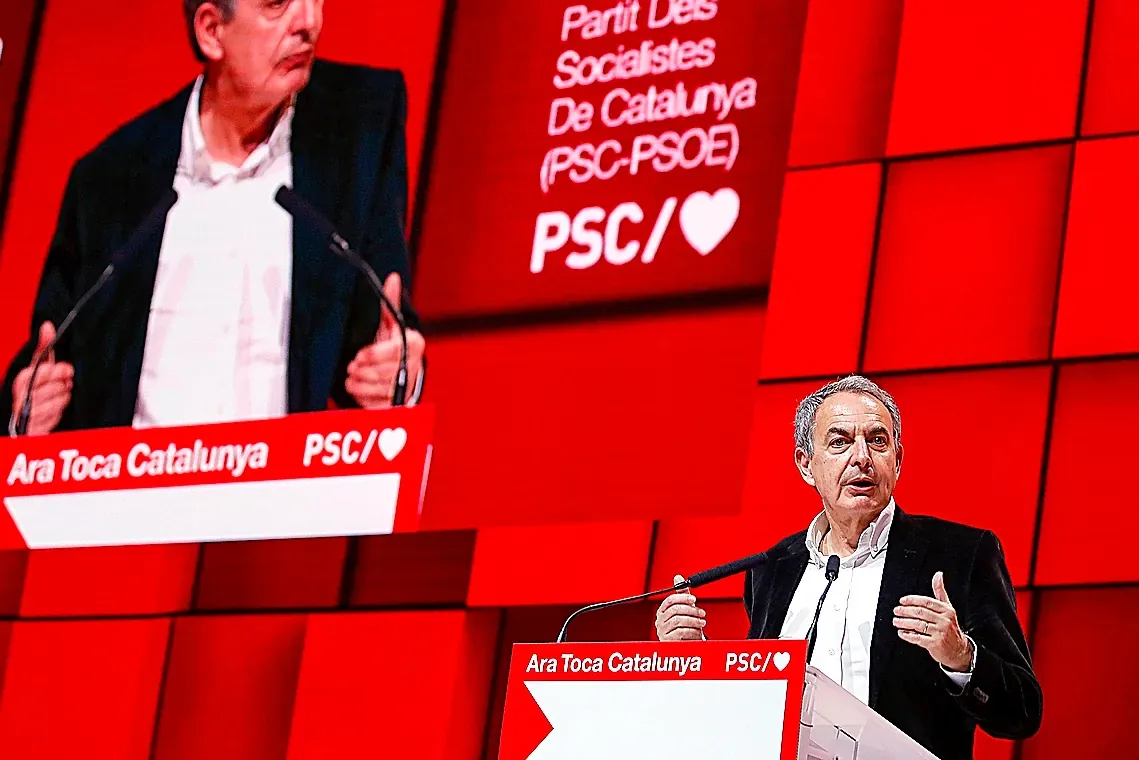
Former Prime Minister José Luis Rodríguez Zapatero considers that the European Justice ruling endorsing the Amnesty Law “strengthens our Rule of Law, which is renewed in its democratic principles” and urges those who “harassed” the law “and those of us who defended it” to carry out “a process of reflection”.
Read more The trail of Cerdán’s money: from the Toyota RAV4 to Acciona’s payments
He also describes the ruling of the Court of Justice of the European Union (CJEU) as “historic” and emphasizes that by broadly supporting the law in relation to Community law there is “reason” for “hope”. He ventures that this ruling will help resolve “the serious political, institutional and social crisis” that began in 2017 with the so-called procés in Catalonia.
Zapatero states, in exclusive comments to EL MUNDO after analyzing the ruling, that “the judgment of the highest court of the European Union, guardian of the principles and values of the space of freedom and human rights to which we belong, has strongly and fundamentally supported the Amnesty Law based on the democratic principles of the Rule of Law”.
The former PSOE leader thus breaks his silence for the first time after being charged by the National Court last May for the crimes of criminal organization, influence peddling, smuggling, forgery, and against the Public Treasury. Since then, Zapatero has chosen to remain silent advised by his defense, has refused to grant interviews, and now makes an exception to speak out about a law in whose negotiation and drafting process he actively participated representing the Government of Pedro Sánchez.
The former head of government emphasizes that the law, which came into force in 2024 and benefited more than 300 people including politicians, police officers, citizens, and those convicted for causes linked to the procés, “was born for the pacification of the consequences of the serious political, institutional and social crisis”. He adds that with the ruling, which responds to two preliminary questions sent by the Court of Auditors and the National Court about whether the expenses of the independence process put European financial interests at risk or if it contravenes Community law on terrorism, “our Rule of Law is strengthened and renewed in its democratic principles”. In Rodríguez Zapatero’s view, these principles “are based on the law as an expression of the popular will and on reconciliation and coexistence as essential values of a democratic society”.
The former leader, who is currently focused on his defense strategy in the Plus Ultra case, in which he has already requested the nullity of the procedure alleging alleged irregularities in the investigation, also sends a message to the opposition led by the PP. “It would be very convenient for those who harassed this law and those of us who defended it to have a process of reflection, so convenient in a plural society,” he adds. All this in relation to “the actions carried out since 2023”, when the negotiation process of the law began. “Personally, I think that today the future of democracy in Spain is more solid thanks to this historic ruling of the CJEU, which is a reason for hope for everyone,” he concludes.
He, who is already the first former Spanish prime minister investigated by Justice during democracy, led talks with former Catalan president Carles Puigdemont in Switzerland until last autumn, when the secessionist party decided to withdraw its support from the Government and break the investiture pact. From that moment, and as this newspaper revealed, he began to maintain indirect contacts with the Junts leadership through Swiss mediators, coordinated around the Henri Dunant foundation, and occasionally personally updated President Pedro Sánchez on the state of the talks.
Read more Cerdán shot up his cash spending while Ábalos awarded contracts
Among the messages that Junts sent to the PSOE through Zapatero after withdrawing their support is a document kept secret until now in which Puigdemont’s team directly blames the Government for having used judicial rulings on the Amnesty Law, particularly the rulings of the Constitutional Court, to deceive them so that they would not withdraw their support from the Government.
Thus, Junts harshly reproaches Pedro Sánchez’s Government for having promised them already in 2024 that the Constitutional Court would not only endorse the Amnesty but also allow the return of Carles Puigdemont, a point that has not yet been possible as the Supreme Court considers that the law is not applicable to the former Catalan president due to the crime of embezzlement of public funds. Hence, they attribute to the PSOE negotiators an attempt to persuade them with a “dance of dates” of rulings from the Court of Guarantees that never occurred as agreed.
José Luis Rodríguez Zapatero unsuccessfully tried to appease the secessionists arguing that the socialist Government had done everything possible with the approval of the Amnesty Law and that the opposition of the Spanish courts to its full application was completely beyond their control. On numerous occasions, he told them that he “preferred to live in a country in which he did not agree” with some judicial rulings and that this had already happened to him as president with the Statute of Catalonia.
EL MUNDO already published in 2024 the first version of the Amnesty Law sent to them by the socialist negotiators. It was dated September 17, 2023 and completely excluded the crimes of terrorism and treason established in the Penal Code. So that if that 17-page document had remained unchanged, Puigdemont, whose return is cleared by the CJEU ruling, would never have been able to be amnestied.
The talks with Puigdemont’s team, which now boasts the final drafting of the law, were adapted to their demands. Not surprisingly, both parties exchanged more than two dozen versions in which Community law was finally set as the reference instead of the Spanish Penal Code.


