


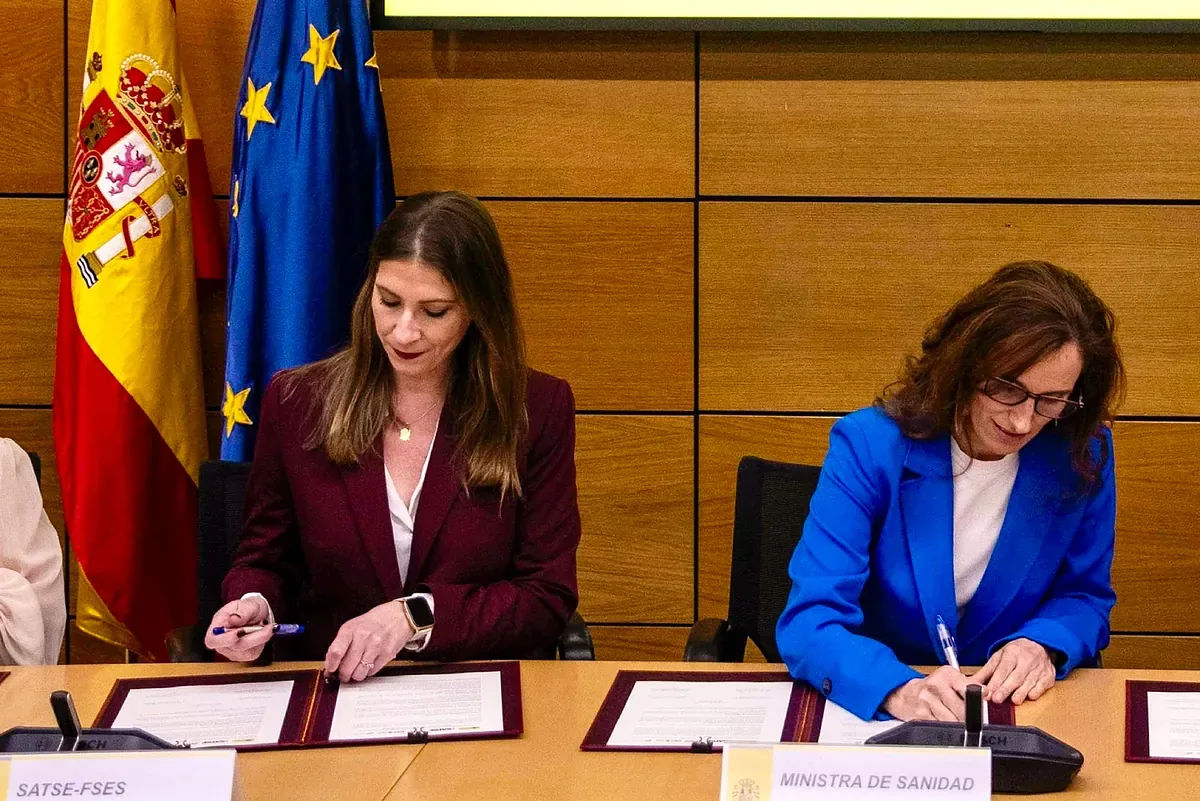
About five months ago, the Ministry of Health agreed on the draft Framework Statute with the class unions, those representatives in the Negotiation Scope (SATSE -FSES, FSS-CCOO, UGT and CSIF without CIG-Saúde). It was supposed that the text signed in January was the one Mónica García had taken to the Council of Ministers last Tuesday.
To the open war with the medical collective, García could add the rebellion of more than 227,000 nursing professionals working in the National Health System, because the reform being processed does not conform to what was signed in January. The main union representing them and belonging to the negotiation table, Satse, through a statement, has shown its frontal rejection of the text that is now beginning its processing.
The nursing union considers this an “unjustified outrage,” which it describes as “institutional betrayal” and “a mockery” of the entire Nursing and Physiotherapy collective. “Especially when a meeting of the Interterritorial Council is imminent with proposals that clearly violate the legal framework governing union negotiation and disregard any union belonging to the Negotiation Scope,” it adds.
In its formal presentation at the beginning of the year, in a joint appearance by Mónica García with union representatives, including Laura Villaseñor (president of Satse), the minister defended that an agreement had been reached “that we have been working on in an almost artisanal way for more than three years with the unions in the sector for this new Framework Statute.”
Then, Villaseñor highlighted the incorporation of more than 100 measures into that “outdated text after three years of work.” And, at the same time, she stated that this agreement “is only one step on the way and it is necessary to involve the rest of the ministries, especially the Treasury,” which is why she emphasized “the need for the entire Government to be involved.”
Today, the situation is different and Satse denounces that “cuts have been made in essential rights and advances already committed, so, despite the public hearing phase that is opening, it understands that this drift already deserves the use of all kinds of measures that are being evaluated”.
What is missing from the text agreed with the sector’s unions?
Satse points out that it is a text that differs from what was agreed upon in essential aspects, such as the possibility of regulating early retirement due to the arduousness inherent in healthcare activity, as well as access to partial retirement in an agile manner and on equal terms with other workers.
The union organization points out that the current text does not contemplate this aspect, as the Ministry of Health could only urge the initiation of the procedure that would allow the Ministry of Social Security to determine in the future access to early retirement due to activity for statutory personnel. And regarding partial retirement, it is not stated that this right will be made effective directly and immediately upon its entry into force, so it would not be an accessible right for this personnel.
Satse also highlights that the text now submitted for public hearing and information contemplates modifications to remuneration concepts that it also does not share, because they are detrimental to the collective of public health professionals. “Cuts have been made in rights and advances already committed that we will not allow,” it points out.
The union argues that “it seems unbelievable” that a Government and autonomous communities have to be reminded that “any modification related to working hours, professional classification, remuneration, work organization, professional representation, or specific negotiation structures must be addressed from a global perspective of the National Health System and through legally established negotiation channels,” it states.
The union organization demands that all these matters fully respect the role of the Negotiation Scope and that any agreement that may be adopted expressly preserve the negotiation processes currently open or pending.
It also asks the Ministry of Health to avoid decisions that could be interpreted as “corporate or exclusionary” solutions regarding the entire body of professionals, and that the autonomous communities, as administrations responsible for the management of health services, actively participate in strengthening collective bargaining and social dialogue spaces. Otherwise, it reserves the right to initiate any type of reactive measure regarding this issue, which it will announce in the coming days.
Read more If Sánchez were innocent, he would have already resigned