

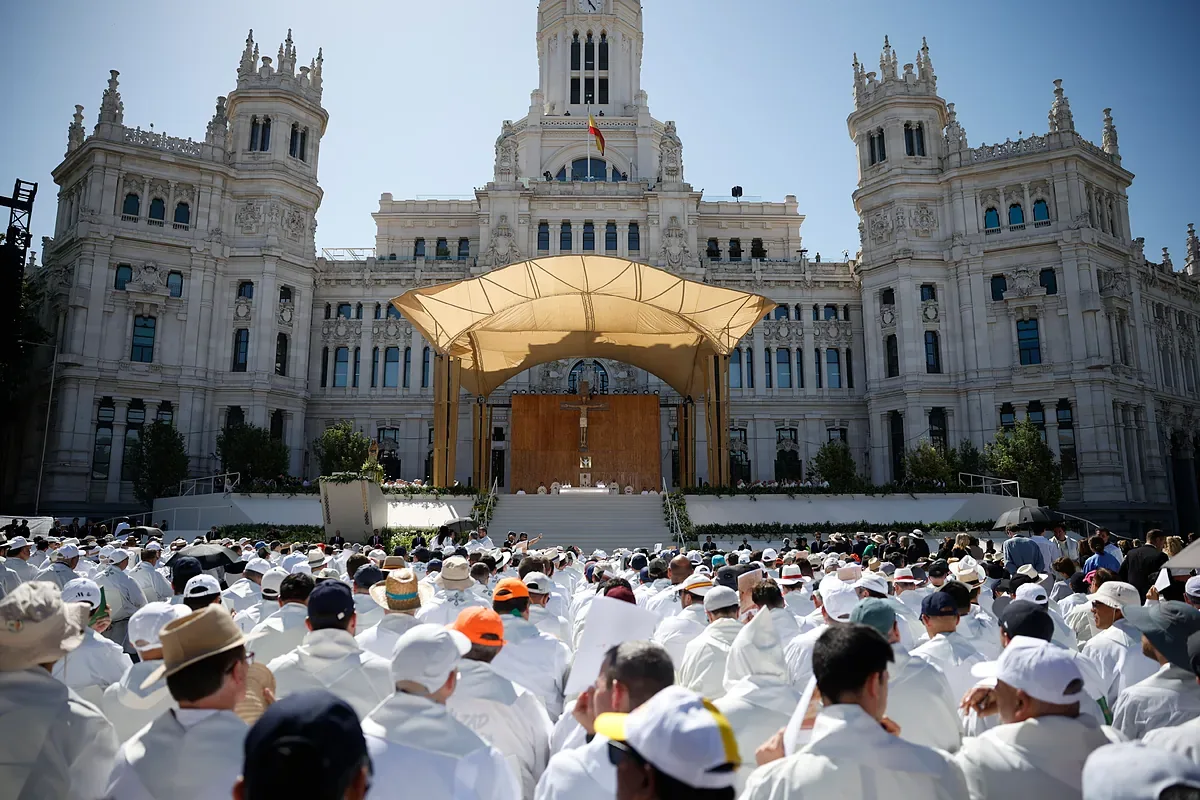
A flock of helicopters hovers tirelessly over the sky of Cibeles square, where more than a million people eagerly await the longed-for arrival of Pope Leo XIII. They fly over the airspace so that no stone is left unturned in terms of security. The tide of faithful extends beyond the Puerta de Alcalá, reaching Colón square and settling next to the Prado museum. It’s just past 9:00 AM and a message is repeated over and over again to the despair of more than one: “¡Probo, probo, probo!”. The final details of the sound system are being finalized in Italian, while the crowd wonders about the Pope’s route. “Will the Popemobile take the roundabout or cut short to reach the City Hall?” asks one of the attendees, under a straw hat protecting him from the sharp fangs of the Madrid sun.
“We ask you to avoid raising signs and waving flags,” the organization warns, while a rumor begins to take hold of the great open-air temple the capital has become. “The Pope is coming!” one of the hundreds of volunteers announces, under the orange cap of his uniform. Then the classic message that the youngest are accustomed to chanting resonates: “This is the Pope’s youth!” He approaches the Cibeles square roundabout with some delay compared to the scheduled time, but, yes, he respects the roundabout, before accessing the Madrid city hall via Alcalá street.
And in the building’s entrance hall, the Pontiff receives the Golden Key of the city, from the mayor of Madrid, José Luis Martínez-Almeida, and in the presence of the entire Royal Family. “May Madrid continue to be a welcoming and inclusive city, where life in society is inspired by authentic human values,” he writes in the Book of Honor, a message for the capital’s memory, before the great celebration begins.
Probably, there is no better box to experience the great event with the Pope than the balcony of the Bank of Spain, where a handful of people gather not to miss any detail. Below, next to the main stage for 600 people, chairs marked with the names of the most illustrious attendees. “Will Pedro Sánchez?” asks a young woman, unaware of the absence of the Prime Minister. “He’s not coming to this. It’s not his thing,” notes her companion, who came after doing a double shift after the vigil in Lima square. Little by little, water bottles take over the scene. The heat is pressing.
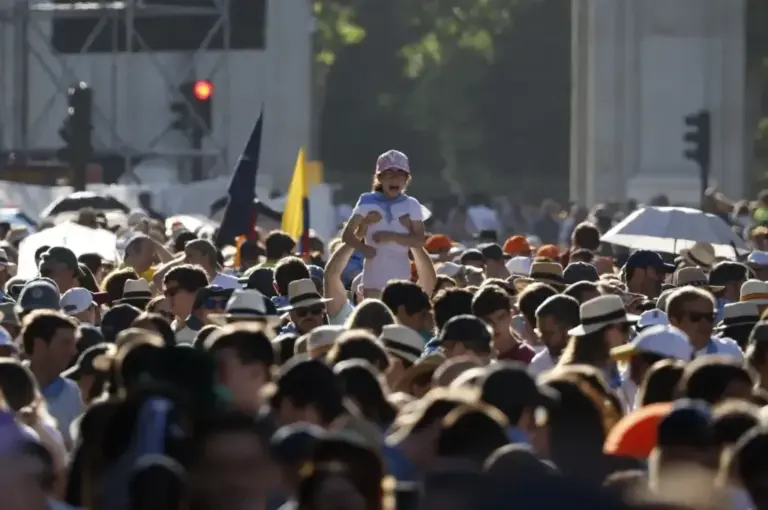
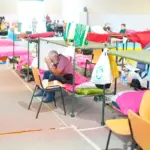
But the mass is not only experienced in the heart of Cibeles. There are many stories far from that epicenter of the Eucharist. For example, that of María, 52, who waits by the fence of the National Library. She holds the chair of her eldest son, who has a disability, and whom she says they have not allowed into the central lane of La Castellana to see the celebration. “They put us in a sector where the sun was shining and the screens couldn’t be seen, and I really came because he, who won’t be able to see it, was excited about it,” she protests. Seeing the situation, a volunteer approached to lead them to a rest tent, where they placed the boy’s chair next to the volunteers, and from where he can see one of the screens broadcasting the service.
The volunteers acknowledge that the capacity of the sectors was calculated to the millimeter and regret that some people could not enter. “The same thing happened, it’s a great pity because they are left outside without being able to see the screens, but we can’t do anything,” notes Teresa, a volunteer from sector W9. Adriana, 25, waits with a group of young people alongside a hundred others in front of a crosswalk. “We had QR codes, but we couldn’t enter our sector, there are too many people,” she points out.
More than one, by the way, reached Cibeles through the Metro’s emergency exits. At Príncipe de Vergara station, those gates were opened before the tide of faithful who wanted to experience a historic event up close. Dozens of priests, under white umbrellas, gave communion to hundreds of people, while the voices of the choir and incense permeated the heart of the city. After the Corpus Christi procession, with an army of white umbrellas deployed, came the blessing of Leo XIV. An indelible page that is now part of the capital’s history.